

Key takeaways
- Compare the best egg beaters for fluffy eggs, whipped cream, and smooth light batters, from classic hand-crank models to easy push whisks at home.
There is a particular kind of kitchen satisfaction that comes from beating eggs with a tool that needs no cord, no battery, and no counter space. A good egg beater turns a handful of eggs into a fluffy, evenly aerated mixture in under a minute, folds air into cream without splattering the walls, and smooths out pancake or waffle batter without the overmixing an electric mixer can cause. For small, everyday jobs, egg beaters are often faster to grab, use, and wash than any powered alternative.
That said, not all egg beaters are created equal. The category covers two main families: the classic hand-crank rotary beater, with twin beaters driven by a geared wheel, and the newer semi-automatic push whisk, which spins as you press down on the handle. Within those families, build quality varies enormously. Cheap gears grind and skip, thin beaters flex instead of cutting through batter, and poorly sealed mechanisms trap water and rust from the inside out. A well-made beater feels smooth from the first turn and rinses clean in seconds.
We put together this guide to help you find the right tool for the way you cook. Below you will find five egg beaters that cover the main styles, sizes, and budgets, along with a buying guide that explains what separates a beater you will reach for daily from one that ends up forgotten in the back of a drawer. As an Amazon Associate, we earn from qualifying purchases made through links on this page, at no extra cost to you.
How to Choose the Right Egg Beater
Crank or push design
The hand-crank rotary beater is the design most people picture: you hold the top handle steady with one hand and turn the crank with the other, and the gearing multiplies each turn into several fast rotations of the twin beaters. Crank beaters give you the most control over speed and are the better choice for egg whites and cream, where a steady, sustained rhythm matters. Push whisks work differently. A spring mechanism inside the handle converts each downward press into a spin, so the whisk head rotates back and forth as you pump. They need only one hand, work beautifully in narrow glasses and mugs, and are wonderful for scrambling two or three eggs or frothing milk, but they are less suited to larger bowls and longer whipping sessions.
Materials and build quality
Stainless steel is the material to look for in the beaters themselves. It resists rust, does not react with acidic ingredients, and is stiff enough to move through batter without bending; higher grades such as 18/8 or 18/10 are a good sign. For crank models, pay attention to the gear housing: enclosed gears stay cleaner and are protected from splashes, while open gear wheels are easier to inspect and wipe down but need a quick rinse after use. Handles should feel solid, with no flex at the joint.
Beater shape and bowl fit
Wide, flat beater blades move more liquid per rotation and are best for incorporating air, which is what you want for omelets, meringues, and whipped cream. Narrower wire-style heads suit push whisks and smaller vessels. Check the length as well: most rotary beaters are around 12 inches long, which keeps your knuckles clear of a standard mixing bowl while the beaters stay submerged.
Comfort and control
You will be turning a crank or pumping a handle for a minute or more at a time, so ergonomics matter. Look for a top handle that fills your palm without sharp edges, a crank knob that spins freely on its axle, and a mechanism that turns smoothly without catching. Very light beaters can feel flimsy, while an all-metal beater around ten to fourteen ounces tends to feel planted and stable in the bowl.
Cleaning and storage
Egg residue dries like glue, so easy cleaning is not a luxury. Detachable beaters that pop off for the dishwasher are the gold standard on crank models. Push whisks rinse clean under the tap in seconds because there are no gears to trap batter. Finally, a slim push whisk disappears into a utensil drawer, while a rotary beater is happier hanging from a hook or standing in a crock.
The 5 Best Egg Beaters
1. OXO Good Grips Egg Beater

Specs
- Stainless steel twin beaters with a dishwasher-safe detachable base, enclosed smoothly rotating gears, soft non-slip handle and turning knob, approximately 12 inches long, beaters elevated to work while resting on the bowl bottom.
The OXO Good Grips Egg Beater is the modern benchmark for the classic rotary design. Its gears are fully enclosed in the body, so batter and egg wash cannot work their way into the mechanism, and the turning action is noticeably smoother than on open-wheel vintage-style beaters. The beaters are raised slightly, which means the tool keeps churning even when it rests on the bottom of the bowl, reducing the arm strain of holding it suspended.
Cleanup is where this model really pulls ahead. Press the two side buttons and the entire base detaches for the dishwasher, and the beaters themselves pop out individually. For anyone who beats eggs most mornings and wants one tool that simply works every time, this is the easiest recommendation on the list.
Pros:
– Enclosed gears stay clean and turn very smoothly
– Detachable base and beaters are dishwasher safe
– Comfortable non-slip grip, even with wet hands
– Beaters work while the tool rests on the bowl
Cons:
– Plastic body feels less heirloom-solid than all-metal rivals
– Twin beaters are narrower than vintage flat blades
2. Norpro Egg Beater Classic Hand Crank Style
Specs
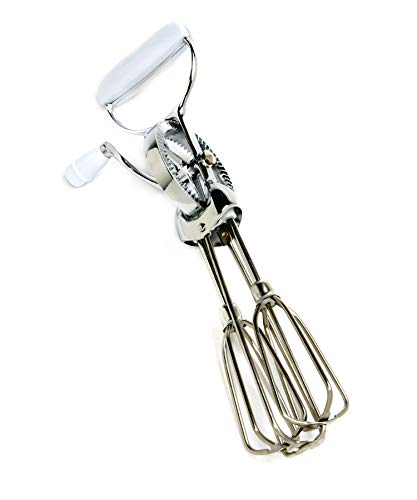
- 18/10 stainless steel twin beaters, polished aluminum body and gear wheel, plastic grip handles, 12 inches long, open classic rotary design, no electricity or batteries required.
The Norpro 2268 sticks closely to the time-tested design that filled farmhouse kitchens for a century, and that is exactly its appeal. The heavy-duty 18/10 stainless beaters will not react with acidic foods, and the big polished aluminum gear wheel gives the crank a satisfying, flywheel-like momentum once you get it spinning.
Because the mechanism is open, a quick rinse and a shake dry is all it needs after use, and there are no hidden cavities to trap water. It is a sturdy tool with very few parts to go wrong, well suited to cooks who prefer simple metal construction over molded plastic housings.
Pros:
– Premium 18/10 stainless steel beaters
– Smooth, momentum-rich cranking action
– Simple open design is easy to rinse and inspect
– Built for smaller baking jobs without electricity
Cons:
– Open gears need a prompt rinse after messy jobs
– Plastic handles feel basic next to the metal body
3. Prepworks by Progressive Egg Beater (BA-3021)

Specs
- Stainless steel beaters with a molded plastic gear wheel and handle, teal color accents, approximately 12 inches long, lightweight open-wheel rotary design, hand-crank operation.
The Prepworks BA-3021 keeps the traditional open-wheel layout but swaps the gear wheel and handle to molded plastic, which brings both the weight and the cost down. The result is a light, cheerful beater that is easy for kids and occasional cooks to handle, and it still spins its stainless beaters fast enough to scramble eggs or smooth out a thin batter in short order.
This is a sensible pick for a second beater, a cabin or camper kitchen, or anyone who only reaches for a hand beater a few times a month. It does not have the heavy, machined feel of the all-metal models, but for light-duty whisking it covers the essentials in a compact, easy-to-store form.
Pros:
– Lightweight and easy for anyone to crank
– Stainless beaters resist rust and staining
– Compact size stores easily in a drawer
– Friendly design for occasional and younger cooks
Cons:
– Plastic gear wheel is less durable under heavy loads
– Not the best choice for thick batters or big batches
4. Digead Stainless Steel Egg Whisk, Hand Push Rotary (12 Inch)

Specs
- Food-grade stainless steel construction, semi-automatic spring-driven push mechanism with riveted structure, 12 inches long, balloon-style whisk head, no batteries or electricity required.
If cranking is not for you, this push-style beater from Digead offers a completely different motion: press the handle down and the whisk head spins rapidly, then spins back as the spring returns it. The riveted internal structure is a step up from the welded joints on many similar whisks, giving it a more secure, longer-lasting action. Because it works one-handed and fits inside a mug or measuring jug, it is brilliant for scrambling a couple of eggs, frothing milk for coffee, or whisking a small vinaigrette.
The all-stainless build rinses clean in seconds and will not rust, and the 12-inch length keeps your hand clear of hot pans when you are whisking a sauce. It will not replace a crank beater for a big bowl of egg whites, but for quick daily jobs it is often the fastest tool in the drawer.
Pros:
– One-handed semi-automatic action, no wrist twisting
– Riveted spring mechanism feels sturdy and secure
– Works in narrow mugs, glasses, and small bowls
– All stainless steel, quick to rinse and dry
Cons:
– Less effective for large volumes and long whipping
– Spring action takes a few tries to master
5. Cooks Innovations Zip Whisk, 14 Inch
Specs
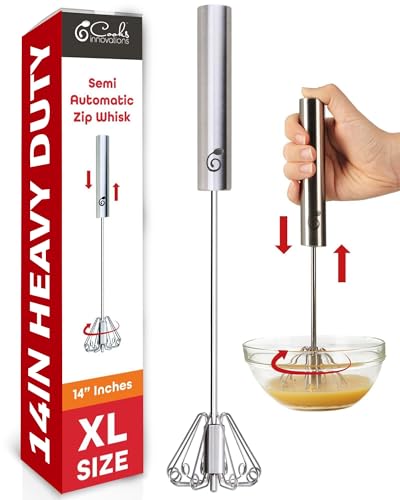
- Full stainless steel construction, semi-automatic push-down rotating head, extra-long 14-inch length, whisk head sized for blending, whipping, and frothing, dishwasher-friendly design.
The Cooks Innovations Zip Whisk takes the push-whisk idea and stretches it to 14 inches, and that extra length turns out to be genuinely useful. It reaches the bottom of deep stockpots and tall blending jars, keeps your hand well away from simmering sauces, and gives each press a long, sweeping spin that moves a surprising amount of liquid. The all-stainless construction feels durable, with none of the creaking you get from plastic-handled versions.
It also earns its keep frothing milk and blending smoothies and shakes, making it a general-purpose whisker, blender, and stirrer in one drawer-friendly tool. If your whisking happens in deep pots as often as in mixing bowls, the added reach makes this the push whisk to choose.
Pros:
– Extra-long 14-inch reach suits deep pots and jars
– Durable all-stainless steel build
– Fast, easy push-down spinning with minimal effort
– Easier on the wrists than a traditional whisk
Cons:
– Too long for small mugs and shallow bowls
– Push style is not ideal for stiff, heavy mixtures
Frequently Asked Questions
Are egg beaters better than a regular whisk for eggs?
For beating eggs specifically, yes, in most cases. A rotary beater or push whisk moves the mixture many times faster than a hand whisk with far less effort, so yolks and whites combine more completely and pick up more air, giving fluffier omelets and scrambles. A whisk still wins for delicate folding and for reaching into the corners of saucepans, which is why many cooks keep both.
Can an egg beater whip cream and egg whites properly?
A hand-crank rotary beater can, provided you are patient and start with a chilled bowl and cold cream. The twin beaters incorporate air steadily, and after a few minutes of cranking you can reach soft to firm peaks. Push whisks are better for small amounts, such as frothing milk or whipping a little cream for coffee, but they are slow work for a full bowl of meringue.
How do I stop my egg beater from rusting?
Rinse it straight after use, before egg or batter dries in the mechanism, then dry it thoroughly rather than leaving it to air-dry in a wet sink. Stainless beaters are naturally resistant, but water trapped inside gear housings is the usual culprit, so give crank models a shake and store them somewhere airy. A drop of food-safe mineral oil on an open gear wheel once in a while keeps vintage-style beaters turning sweetly.
What size egg beater should I buy?
For most home kitchens, a beater around 12 inches long is the sweet spot: it fits standard mixing bowls, keeps your hands clear of the mixture, and stores in a deep drawer or utensil crock. Choose a longer 14-inch push whisk if you often whisk in deep pots or tall jars, and a compact model if you mainly scramble one or two eggs in a mug or small bowl.
Conclusion
The humble egg beater has survived more than a century of kitchen fads because it solves a daily problem quickly, quietly, and without a power cord. If you want the most polished all-rounder, the OXO Good Grips pairs enclosed gears with genuinely easy cleaning. Traditionalists will appreciate the Norpro’s all-metal classic build, the Prepworks BA-3021 keeps things light and simple, and the Digead and Cooks Innovations push whisks show how far the one-handed semi-automatic idea has come. Whichever style suits your cooking, any of these five will earn its place in the drawer from the first breakfast.
More from Amazon
Programs that pair well with the guide above. Offers and eligibility are set by Amazon and may change.
Collect the home and kitchen items you want in one registry that guests can shop from.
Create a wedding registrySet up recurring deliveries of everyday items on eligible products. Terms and savings are set by Amazon.
Explore Subscribe & SaveFree shipping on eligible items, Prime Video and more. Eligible new members can start with a free trial.
Start a Prime free trialAudiobooks and podcasts to listen to on the go. Eligible new members can start with a free trial.
Try Audible freeAs an Amazon Associate we earn from qualifying purchases.

Write Your Review
No reviews yet. Be the first to share your experience!