

Key takeaways
- Find the best dough cutters for clean, even portions, from stainless bench scrapers with ruler markings to wood-grip classics and flexible scraper sets.
As an Amazon Associate, we earn from qualifying purchases made through links on this page. This helps support our work at no extra cost to you.
A good dough cutter is one of those tools that looks almost too simple to matter, right up until you try to portion a sticky batch of bread dough with a dinner knife. Instead of tearing, dragging and stretching the dough into uneven pieces, a wide, straight blade presses down in one clean motion, giving you portions that proof and bake at the same rate. Even pieces mean rolls that finish together, pizza bases that cook evenly and pastry that looks like it came from a bakery counter rather than a wrestling match.
Dough cutters, also sold as bench scrapers or bench knives, earn their keep well beyond dividing dough. The same blade scrapes a floured worktop clean in seconds, lifts and turns dough during shaping, transfers a pile of chopped onions from board to pan without spillage, and cuts everything from cookie dough logs to soft cheese and fudge. If you bake regularly, it will become one of the most reached-for tools in the drawer.
To build this guide we compared the cutters home bakers actually buy and keep: classic all-stainless models, cushioned-grip designs with etched ruler markings, a traditional wood-handled option, a value set that adds flexible bowl scrapers, and a heavier commercial-style griddle scraper. Below you will find how to choose the right one, followed by our five picks.
How to Choose a Dough Cutter
Blade material and stiffness
Most dough cutters use a stainless steel blade, and for portioning that is what you want. A rigid steel blade pushes straight down through a large mass of dough without flexing, so the cut stays true and the pieces separate cleanly. Thin, bendy blades tend to bow and leave the centre of the dough uncut. Flexible plastic and silicone scrapers have their place — they are the right shape for sweeping dough out of a round mixing bowl — but they are companions to a steel cutter, not replacements for one.
Size
The standard bench scraper blade is about six inches wide and four inches tall, and that size suits most home bakers. The width covers a good span of dough in a single press, while the height keeps your knuckles clear of the work surface when scooping. If you regularly divide very large batches or work with wide pizza doughs, a slightly wider blade saves extra passes. Smaller blades suit compact counters, but four inches of blade height is worth keeping for safe, comfortable scooping.
Handle style
Handles fall into three camps. A rolled or rounded metal handle, formed from the blade itself, is durable, easy to clean and gives a traditional feel, though it can dig into the palm over time. A cushioned synthetic grip spreads pressure across the hand and stays put when your hands are floury or damp, which many bakers prefer for big batches of rolls. A wooden handle, usually beech or walnut, offers a warm, classic grip that many bread bakers love, with the trade-off that it should be washed by hand and dried promptly.
Measurement markings
Many blades carry etched inch or centimetre markings along the edge. They sound like a small detail, but they change how you work: instead of guessing, you can score a dough log at even intervals and cut portions that are genuinely the same size, ideal for dinner rolls, burger buns and cinnamon rolls. If even portions are your main goal, put markings high on your list.
Edge, extra uses and care
A dough cutter edge is firm and slightly bevelled rather than knife-sharp, which is why it can also chop herbs, crush garlic, cut butter into flour and portion soft foods safely around children. Some heavier models double as griddle scrapers for flat-top cooking. For care, all-steel and synthetic-grip models are usually dishwasher safe, while wood handles need hand washing. Whatever you choose, dry the blade before putting it away and store it flat in a drawer rather than loose against your knives, so the edge stays straight and true.
The 5 Best Dough Cutters
1. OXO Good Grips Stainless Steel Multi-Purpose Scraper & Chopper (ASIN: B00004OCNJ)

- Specs: Stainless steel blade, approximately 6.25 x 4 inches; etched quarter-inch measurement markings along the blade; soft, non-slip cushioned grip handle; dishwasher safe.
The OXO scraper and chopper is the default recommendation for most home bakers, and it is easy to see why. The stainless blade is stiff enough to press cleanly through a kilo of sourdough in one motion, and the etched markings run along the blade so you can measure and cut portions without reaching for a ruler. The tall blade face doubles as a scoop for moving chopped vegetables or a mound of grated cheese from board to pan.
The soft grip is the other half of the appeal. It is broad, slightly pillowy and genuinely non-slip, so it stays comfortable and secure when your hands are dusted with flour or damp from washing produce. For bakers who divide big batches of rolls or buns, that comfort adds up over a long session.
Pros:
– Stiff blade cuts dough cleanly in a single press
– Etched ruler markings make even portions simple
– Comfortable, secure non-slip grip
– Dishwasher safe and easy to store
Cons:
– Blade markings can be a little hard to read in low light
– Dough can collect where the blade meets the handle
– No protective sheath included for drawer storage
2. Norpro Stainless Steel Scraper/Chopper (ASIN: B000SSZ4Q4)
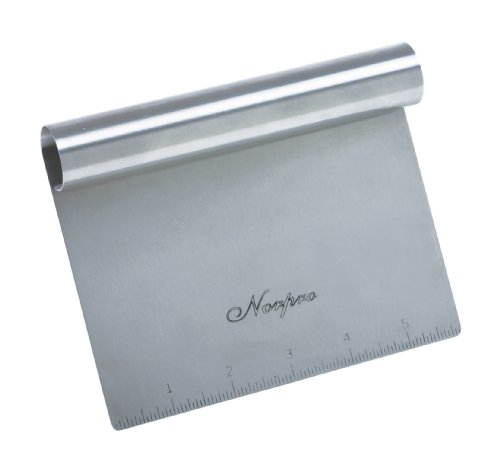
- Specs: Heavy-duty stainless steel blade, 6 x 4 inches (15 x 10 cm); one-piece rolled stainless steel handle; model 577; 7.5 ounces; dishwasher safe.
Norpro’s scraper and chopper is the classic one-piece design that has been in bakery drawers for decades. The blade and the rounded handle are formed from a single piece of heavy-duty stainless steel, so there are no seams, screws or joints to trap dough or work loose over time. Norpro designed it specifically to scrape and split bread dough, and it also handles crushing, chopping and measuring duties around the board.
It covers a comfortable width of counter, and the rolled handle gives you a firm bar to press down on when dividing stiff doughs. Because the whole tool is steel, it goes straight in the dishwasher and shrugs off everyday knocks.
Pros:
– One-piece steel construction with nothing to loosen or trap food
– Purpose-built for splitting bread dough
– Lightweight yet sturdy at 7.5 ounces
– Fully dishwasher safe
Cons:
– Bare metal handle is less cushioned for long sessions
– No cushioned grip for wet hands
– Plainer look than wood-handled rivals
3. Nordic Ware Scraper 02105 Dough Cutter with Beechwood Grip (ASIN: B08WH6LVPW)

- Specs: Stainless steel blade; solid beechwood grip handle; model 02105; hand washing recommended to protect the wood.
If you prefer natural materials on the counter, Nordic Ware’s dough cutter pairs a stainless steel blade with a smooth beechwood grip, and the combination feels as good as it looks. The wood handle fills the palm with a rounded, warm hold that many traditional bakers find more comfortable than flat metal, and it gives the tool a classic bakery look that sits happily in a utensil crock.
The blade does the serious work: it portions bread and pizza dough, scrapes the board clean and lifts chopped ingredients for the pan. The beechwood grip is shaped for downward pressure, so dividing a batch of dough feels controlled rather than slippery. The only real compromise is care — wood prefers a quick hand wash and a towel dry over a dishwasher cycle.
Pros:
– Warm, comfortable solid beechwood grip
– Stainless blade portions and scrapes effectively
– Classic look worth leaving on the counter
– Secure, palm-filling handle shape
Cons:
– Wood handle should be hand washed and dried
– No etched measurement markings on the blade
– Wood can show knife-board stains over time
4. Ecavria Bench Scraper Set with Flexible Bowl Scrapers (ASIN: B0D96JFFXF)

- Specs: Three-piece set: stainless steel bench scraper with etched measuring scale, plus two flexible bowl scrapers; model Scraper001; suitable for bread, pizza, pastry and cake work.
The Ecavria set solves the two-tool problem in one purchase. The stainless steel bench scraper handles the portioning, with an etched measuring scale along the blade for dividing dough into even pieces, while the two included flexible bowl scrapers curve against the inside of a mixing bowl to sweep out every last bit of dough and batter. Anyone who has tried to clean a bowl with a rigid steel blade will appreciate how much dough the flexible scrapers save from the bin.
As a set it is also a sensible starter option for new bakers: one purchase covers cutting, portioning, bench scraping and bowl scraping. The steel scraper is firm enough for bread dough, and the flexible pair also works for smoothing cake batter and portioning soft doughs on the board itself.
Pros:
– Steel cutter and two bowl scrapers in one set
– Etched measuring scale for even portions
– Flexible scrapers recover dough a rigid blade leaves behind
– Good coverage for bakers building a first kit
Cons:
– Three pieces to store instead of one
– Flexible scrapers are not suited to heavy portioning
– Handle comfort is average on long sessions
5. Anmarko Dough Cutter and Professional Scraper Chopper (ASIN: B07H4P9M6T)
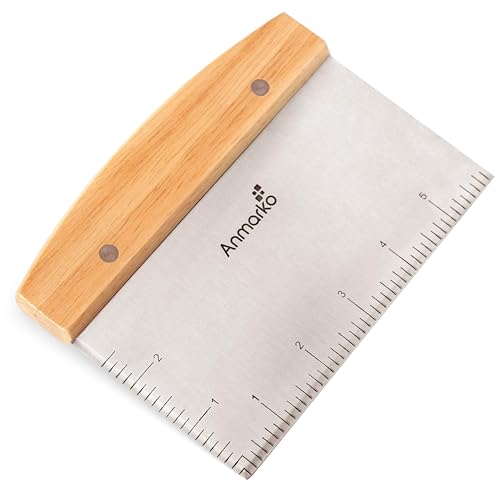
- Specs: Stainless steel blade and construction; commercial-quality build; designed for bread and pizza dough, general chopping and flat-top griddle scraping.
The Anmarko scraper chopper is the heavy-duty option in this line-up, built to commercial standards and aimed at cooks who portion dough often or work a flat-top griddle. The stainless blade is broad and rigid, so it powers through large masses of pizza dough and also serves as a griddle scraper for smash burgers, chopped steak and vegetables, then cleans the cooking surface.
That dual-purpose design makes it a smart buy for outdoor-cooking fans who bake as well: one tool divides the pizza dough indoors and then goes outside to work the griddle. The blade face is generous for scooping and transferring chopped ingredients. It is more tool than a once-a-month baker needs, but frequent cooks will use the extra sturdiness every week.
Pros:
– Commercial-quality, rigid stainless construction
– Works for dough, chopping and flat-top griddle cooking
– Broad blade scoops and transfers large piles easily
– Built to handle frequent, heavy use
Cons:
– Heavier and more utilitarian than bakery-style cutters
– No cushioned grip
– Overkill for occasional small-batch baking
FAQs
What is the difference between a dough cutter and a bench scraper?
There is no practical difference. Dough cutter, bench scraper and bench knife are three names for the same tool: a wide, flat blade with a handle along the top edge. Makers and shops use the terms interchangeably, so shop by size, material and handle comfort rather than by the name on the listing.
Can a dough cutter replace a knife for portioning dough?
For dividing raw dough, yes — and it usually does the job better. A straight downward press cuts without dragging or tearing the gluten strands the way a sawing knife can, and the wide blade then lifts the portion straight onto a scale or tray. Keep your knives for slicing baked loaves and trimming pastry, and let the cutter handle raw dough.
Are metal dough cutters safe to use on every work surface?
Metal blades are fine on wooden boards, stainless steel counters and stone worktops. Be more careful with delicate surfaces: avoid pressing and dragging a steel edge across non-stick baking pans, soft plastic boards you want to keep unmarked, or polished surfaces that scratch easily. On those, portion the dough on a board first, or use a flexible plastic scraper instead.
How should I clean and store a dough cutter?
Rinse the blade soon after use so dough does not dry onto it, then wash it with warm soapy water or in the dishwasher if the maker allows it. Cutters with wooden handles should be hand washed and dried straight away. Store the cutter flat in a drawer or standing in a utensil crock, with the edge kept away from your good knives so both stay in shape.
Conclusion
A dough cutter is a small purchase that quietly upgrades almost everything you bake. For most people, the OXO Good Grips Scraper & Chopper is the easiest recommendation, thanks to its stiff blade, helpful ruler markings and comfortable grip. Traditionalists will enjoy the all-steel Norpro or the beechwood-handled Nordic Ware cutter, new bakers get the most coverage from the three-piece Ecavria set, and keen cooks who also run a griddle should look at the heavy-duty Anmarko. Pick the one that matches how you bake, and clean, even portions stop being guesswork.
More from Amazon
Programs that pair well with the guide above. Offers and eligibility are set by Amazon and may change.
Collect the home and kitchen items you want in one registry that guests can shop from.
Create a wedding registrySet up recurring deliveries of everyday items on eligible products. Terms and savings are set by Amazon.
Explore Subscribe & SaveFree shipping on eligible items, Prime Video and more. Eligible new members can start with a free trial.
Start a Prime free trialAudiobooks and podcasts to listen to on the go. Eligible new members can start with a free trial.
Try Audible freeAs an Amazon Associate we earn from qualifying purchases.

Write Your Review
No reviews yet. Be the first to share your experience!