

Key takeaways
- Compare the best sandbakkelse tins for crisp Norwegian sand tarts, from anodized aluminum tartlet pans to nonstick carbon steel and stainless sets.
As an Amazon Associate, we earn from qualifying purchases made through links on this page. That support helps us keep researching and comparing kitchen gear at no extra cost to you.
Sandbakkelse, also called sandkaker or sand tarts, are the crisp, buttery almond cookies that anchor Scandinavian Christmas cookie trays. The name means sand cakes, a nod to the fine, crumbly texture, and the shape is non-negotiable: dough is pressed by hand into small fluted tins, baked until the edges turn golden, then tapped out as delicate little shells. The shells are delicious plain, and they double as edible cups for whipped cream, jam, or berries.
The tins do the defining work. A proper sandbakkelse tin is small, shallow, and fluted, so the dough presses into a thin, even layer that bakes up crisp rather than bready. Traditional sets were stamped from tin-plated steel in assorted shapes, round, oval, diamond, heart, and star, and many families still bake in tins handed down for generations. If you are starting from scratch, modern tartlet tins in the same sizes and fluted profiles bake the cookie just as faithfully, in materials the old sets never offered.
For this guide we compared the main options a home baker can buy today: a professional anodized aluminum set, a big-count plain aluminum set, a large stainless steel set, and two nonstick carbon steel sets, one with removable bottoms.
How to Choose Sandbakkelse Tins
Material decides browning and release
Tin-plated steel is the heritage material. It conducts heat well, browns evenly, and develops a patina that releases cookies more easily over time. Its weakness is rust: tins must be dried thoroughly and never soaked. Plain aluminum is the closest modern substitute, light, rustproof, and quick to heat, with the pale-gold finish many bakers prefer.
Anodized aluminum goes a step further. The hardened surface resists sticking and scratching better than plain aluminum, will not rust, and is the choice of professional pastry kitchens.
Carbon steel with a nonstick coating is the forgiving option. The steel core holds heat for crisp edges while the coating lets fragile shells slide out with a tap, which matters because sandbakkelse crack easily when pried at. The trade-off is lifespan: coatings wear, and metal tools damage them.
Stainless steel is the durability pick. It will not rust or stain and shrugs off decades of use. It heats a little less evenly than aluminum and offers no nonstick help, so unmolding takes more care.
Size sets the cookie
Classic sandbakkelse tins run about 2 to 3 inches across and roughly 0.75 to 1 inch deep, taking about a tablespoon of dough pressed thin and baking in 10 to 12 minutes. Tins near 2 inches give dainty two-bite cookies for a crowded tray. Tins closer to 3 inches make shells big enough to fill as individual desserts. Oversized tins near 4 inches drift into tartlet territory, with centers that bake thicker and softer.
Fluting and shape
The fluted wall is functional, not just pretty. The ridges give the thin dough more surface area, which crisps the edges, and they give your fingers purchase when you squeeze the tin to loosen the shell. Round fluted tins are the standard and the easiest to press evenly. Assorted-shape sets make the prettiest trays, but they are increasingly hard to find new, so round tins are the practical start.
Count and batch planning
Sandbakkelse are batch cookies. A single recipe typically yields three to four dozen, and because each cookie bakes in its own tin, your tin count sets your pace. With 12 tins you will bake in relays, cooling and re-pressing between rounds. With 30 to 40 tins you can press the whole batch at once.
Care basics
Let the cookies cool a few minutes, then invert the tin and tap or gently squeeze to release the shell while still warm; fully cooled cookies grip harder. Wash tins in warm water, dry them completely, and store nested in a dry cupboard. Avoid soaking carbon steel sets.
The 5 Best Sandbakkelse Tins
1. Fat Daddio’s PMTH-2 Natural Aluminum Mini Tartlet Pan, 20 Count (ASIN: B084H25WR5)

- Specs: Anodized aluminum; 2 inches across by 0.9 inches deep; 20 tins per set; fluted walls; model PMTH-2 from Fat Daddio’s ProSeries line; hand wash recommended.
If you want the closest modern match to how traditional tins bake, start here. Fat Daddio’s builds bakeware for professional pastry kitchens, and the PMTH-2 is an anodized aluminum tartlet mold sized almost exactly like a classic sandbakkelse tin: 2 inches across, just under an inch deep, with fluted walls.
Anodized aluminum heats quickly and evenly, so a full tray browns at the same pace, and the hardened surface releases buttery dough more cleanly than plain aluminum while resisting scratches from years of stacking. With no coating to wear out and nothing to rust, this is the set most likely to become the hand-me-down kind. At 20 tins, one set covers a half batch at a time; serious December bakers will want two sets.
Pros:
– Anodized surface releases shells cleanly, with no coating to wear off
– Classic 2-inch size matches traditional proportions
– Even heating for uniform browning
– Rustproof and built for decades of use
Cons:
– Hand washing recommended to protect the finish
– Round shape only, no assorted shapes
– Twenty tins means relay baking for a full recipe
2. Yesland 40 Pack Egg Tart Mold, Aluminum, 2-7/8 Inches (ASIN: B08C581RVJ)

- Specs: Aluminum; 2-7/8 inches across; 40 tins per pack; fluted tartlet cups; reusable; model Y-EggTartMold-40p.
The Yesland set solves the batch problem in one purchase. Forty plain aluminum cups at just under 3 inches across let you press an entire recipe at once and bake in rotation without waiting on a tin to cool. Plain aluminum heats fast, browns gently, and never rusts, and its slight grip is helpful while you press, because the dough stays where your thumbs put it.
The 2-7/8-inch size sits at the generous end of the range, producing shells that hold whipped cream and berries comfortably, so the set doubles as mini tart and pudding cups the rest of the year. The cups nest tightly for storage, which matters when you own forty of anything.
Pros:
– Forty tins cover a full recipe in one pressing session
– Plain aluminum heats fast and will not rust
– Larger shells suit filled, dessert-style sandbakkelse
– Nests compactly despite the big count
Cons:
– No nonstick help, so release technique matters
– Bigger size bakes a slightly thicker shell
– Round fluted shape only
3. Dicunoy 30 PCS Egg Tart Mold, 3.8 Inch Stainless Steel (ASIN: B091TMCHGV)
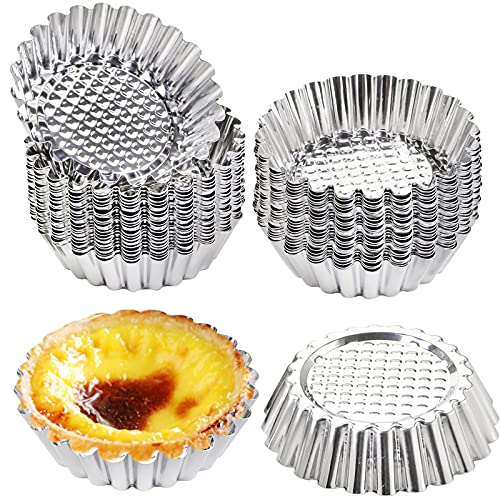
- Specs: Stainless steel; 3.8 inches across; 30 tins per set; fluted mini tart and muffin molds; rust resistant and dishwasher tolerant.
Dicunoy’s set is the pick for bakers who want to buy once and never think about tin care again. Stainless steel does not rust in a damp cupboard, does not stain from berry fillings, and can go through the dishwasher after a long baking day. Thirty tins is a practical count for most recipes.
Be clear about the size, though: at 3.8 inches these are the largest tins on this list, well past classic dimensions. Pressed thin and baked crisp, they make handsome oversized sand tarts that work best filled and plated as individual desserts rather than stacked on a cookie tray. Steel heats a touch less evenly than aluminum, so rotate the tray halfway through. Stainless also offers no release assistance, so press evenly and let shells cool a few minutes before tapping them out.
Pros:
– Stainless steel will not rust, stain, or need special care
– Thirty tins handle most batches with minimal relay baking
– Large shells are ideal for filled, plated desserts
– Sturdy construction resists dents and warping
Cons:
– Oversized for traditional cookie-tray sandbakkelse
– No nonstick properties, so unmolding takes patience
– Less even browning than aluminum without tray rotation
4. LoveDeal 12 Packs Egg Tart Molds, 2.6 Inch Carbon Steel Nonstick (ASIN: B0CH9V2FNJ)
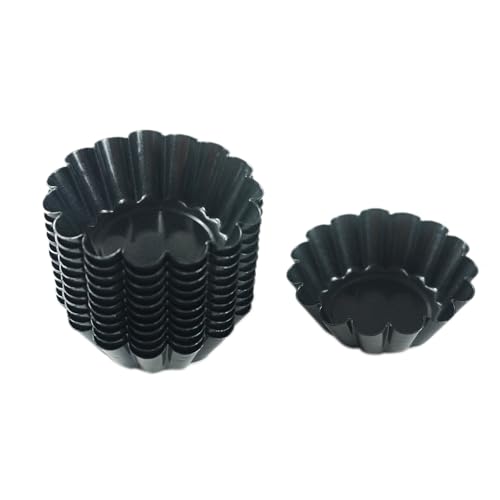
- Specs: Carbon steel with nonstick coating; 2.6 inches across by 0.9 inches deep; 12 tins per pack; fluted edges; total set weight about 10.7 ounces.
For a first attempt at sandbakkelse, this small nonstick set lowers the stakes. The carbon steel core gives you the crisp, well-browned edge that defines the cookie, while the nonstick coating handles the part beginners dread: getting fragile shells out intact. A warm tap and the cookies slide free, without the squeeze-and-pray routine plain metal sometimes demands.
The 2.6-inch size is right in the classic band, big enough to fill, small enough for a cookie tray. Twelve tins is a starter count, fine for a half recipe or test batch, and the set is light and compact in a drawer. Treat the coating kindly: no metal tools or abrasive scrubbers, and hand wash to stretch its life.
Pros:
– Nonstick coating makes unmolding easy for beginners
– Classic 2.6-inch size suits trays and filling alike
– Carbon steel core browns edges crisply
– Small, light set is easy to store
Cons:
– Twelve tins means several relay rounds per recipe
– Coating wears over time and needs gentle handling
– Hand washing recommended
5. Cyimi 12 pcs Egg Tart Molds, 3 Inch Removable Bottom, Gold (ASIN: B098NY5Y59)

- Specs: Carbon steel with nonstick coating; 3 inches across by 0.8 inches deep; 12 tins per set; removable bottoms; fluted design; gold finish.
Cyimi’s set adds one clever feature the other tins lack: a loose, removable bottom in each mold. Instead of tapping and squeezing a baked shell out of its tin, you push the bottom up and lift the cookie free, which nearly eliminates cracked shells. For bakers who fill their shells and want a flawless fluted edge, that difference is worth having.
The molds are carbon steel with a nonstick coating, so browning stays crisp, and the removable discs make washing easy, since no dough residue hides in a fixed base seam. At 3 inches across and 0.8 inches deep, the size runs slightly large and shallow, giving elegant, wide shells that show off cream and fruit fillings. The trade-offs are the small count and the extra pieces: twelve tins and twelve loose discs, best stored together so a disc never goes missing.
Pros:
– Removable bottoms release shells without tapping or squeezing
– Nonstick coating plus loose bases make cleanup easy
– Wide, shallow shells present fillings beautifully
– Carbon steel crisps edges well
Cons:
– Only twelve tins, so full recipes need relay rounds
– Loose bottom discs are easy to misplace
– Coating requires non-metal tools and gentle washing
FAQs
Do sandbakkelse tins need to be greased before pressing the dough?
Traditional recipes say no, and with plain metal tins the butter in the dough is usually enough once the tins are seasoned by use. If a first batch sticks, brush the flutes with a thin film of melted butter for the next round, then taper off as the tins build a patina. Nonstick sets rarely need greasing at all.
What is the best tin size for authentic sandbakkelse?
Most Norwegian recipes assume tins between 2 and 3 inches across and under an inch deep, taking about a tablespoon of dough pressed into a thin shell. The Fat Daddio’s PMTH-2 at 2 inches and the LoveDeal set at 2.6 inches sit squarely in that range. Larger tins like the 3.8-inch Dicunoy set still work, but they produce filled dessert shells rather than tray cookies.
How do you get sandbakkelse out of the tins without breaking them?
Let the baked cookies cool in the tins for three to five minutes, then turn each tin over and tap the base, or gently squeeze the sides to break the seal. Shells should drop out while still warm; fully cooled cookies grip the flutes and crack more easily. Removable-bottom molds like the Cyimi set sidestep the problem entirely.
Can these tins be used for other baking besides sandbakkelse?
Yes. The same fluted tins bake egg tarts, mini quiches, pecan tassies, cheesecake bites, flans, and pudding cups. Aluminum and stainless sets handle all of those without special care, while nonstick sets excel with sticky caramel and custard fillings that cling to bare metal.
Conclusion
Sandbakkelse live or die by their tins, and every style of baker is covered. Choose the Fat Daddio’s PMTH-2 for professional anodized aluminum in the true classic size, or the Yesland 40 pack if your baking runs to full recipes pressed in one session. The Dicunoy stainless set is the carefree, buy-it-for-life option in an oversized dessert format, while the LoveDeal nonstick set gives beginners the easiest first batch. If presentation matters most, the Cyimi removable-bottom molds deliver the cleanest shells with the least breakage. Whichever set you pick, press the dough thin, bake to a deep golden edge, and tap the shells out warm.
More from Amazon
Programs that pair well with the guide above. Offers and eligibility are set by Amazon and may change.
Collect the home and kitchen items you want in one registry that guests can shop from.
Create a wedding registrySet up recurring deliveries of everyday items on eligible products. Terms and savings are set by Amazon.
Explore Subscribe & SaveFree shipping on eligible items, Prime Video and more. Eligible new members can start with a free trial.
Start a Prime free trialAudiobooks and podcasts to listen to on the go. Eligible new members can start with a free trial.
Try Audible freeAs an Amazon Associate we earn from qualifying purchases.

Write Your Review
No reviews yet. Be the first to share your experience!