

Key takeaways
- Compare the best kegerator cleaning kits for home draft systems, from hand pump tanks to tablet bottles, and keep every pour fresh and clean tasting.
As an Amazon Associate, we earn from qualifying purchases made through links on this page. This helps support our work at no extra cost to you.
A home kegerator pours beautifully for the first keg or two, and then the flavor slowly drifts. The beer turns a little sour at the edges, the foam gets loose and soapy, and a faint yeasty smell lingers in the glass. In almost every case the keg itself is blameless. The problem lives inside the beer line, where a thin film of yeast, protein, and mineral scale builds up with every pour. That film, often called beer stone once it hardens, shelters bacteria and feeds off flavors into the next glass.
The fix is unglamorous and quick. A draft beer line cleaning kit pushes a measured cleaning solution through the line, the faucet, and the coupler, loosens the film, and flushes it out before it can harden. Done between kegs, the whole job takes well under an hour, and most of that time is simply letting the solution sit and work. The kits in this guide use a hand pump tank, a pressurized bottle, or a squeeze bottle to move cleaner through the system at home, without a service call and without wasting gas from your supply tank.
What separates one kit from another is fit and routine. A kit built for a ball lock homebrew keg will not help a commercial Sankey tower unless it ships with the right adapter, and a one quart bottle that suits a single tap becomes tedious on a two tap tower. Cleaner format matters just as much. Pre-measured packs and tablets remove the measuring step, bulk powder stretches across a season, and a no-rinse formula shortens the job. The five kits below cover the main home setups, and each one includes the hardware needed to push solution through the lines rather than a brush or a spare part sold on its own.
How to Choose a Kegerator Cleaning Kit
Start with your keg connection
Check the coupler on your keg before anything else. Most commercial kegs in the United States use a Sankey D coupler, while homebrew kegs usually use ball lock disconnects. Some kits connect at the coupler, some at the beer line tailpiece with a beer nut adapter, and some remove the faucet and attach at the shank. Any approach can work, but the kit has to match the connection on your tower.
Pick a cleaning method you will actually use
Hand pump tanks pressurize a bottle or jug and push solution through one line at a time, which suits most single tap home kegerators. Squeeze bottle and gravity kits are simpler still, with fewer seals to maintain, and they reward a slow, patient flush. A splitter kit feeds two lines from one tank and cuts the work on a dual tap tower roughly in half. The best method is the one that fits your routine, because a kit that feels like a chore tends to stay in the cabinet.
Look at the cleaner that comes in the box
Alkaline powder cleaners are the workhorses of draft maintenance and handle beer stone and protein film well when mixed with warm water and given contact time. No-rinse formulas save a step and suit frequent light cleanings. Tablets offer the tidiest measuring of all, since each one doses a fixed amount of water. Confirm the kit actually includes cleaner for the first sessions, and note how refills are sold so the second cleaning is not delayed by an empty packet.
Match capacity to your system
A one quart bottle handles a short single line without waste. A one gallon tank covers longer runs and two tap towers with fewer refills, and it gives the solution enough volume to soak rather than just pass through. Owners who clean between every keg often prefer the larger tank, while occasional pourers do fine with compact bottle kits.
The 5 Best Kegerator Cleaning Kits
1. Kegco 1 Gallon Homebrew Hand Pump Pressurized Cleaning Kit

Specs
- 1 gallon hand pump tank, 10 packs of no-rinse cleaner, nylon faucet brush, ball lock adapter, cleans without removing the faucet
This Kegco kit is built around the setup most homebrewers actually run. The one gallon tank pressurizes with a hand pump, connects straight to the beer line through the included ball lock adapter, and pushes solution through the line and out the faucet, so the faucet stays mounted on the tower for the whole job.
The cleaner comes as ten individual no-rinse packs, which suits the between kegs routine well. There is nothing to measure and no rinse pass afterward, so a session fits into the same half hour as a keg swap. The nylon faucet brush handles the tap spout and the coupler face, the two spots a line flush cannot reach.
Pros:
– Pressurized tank cleans without faucet removal
– Ball lock adapter connects directly to the beer line
– Ten no-rinse packs remove measuring and rinsing steps
– Faucet brush included for the spout and coupler
Cons:
– Hand pump takes steady effort on long lines
– One gallon can run short on larger systems
– Sankey owners should confirm adapter fit first
2. Kegconnection Kegerator Beer Line Cleaning Kit

Specs
- Squeeze bottle kit with faucet adapter, 8 oz of Brew Clean powder, metal faucet wrench, faucet brush and ball lifter included
The Kegconnection kit is the traditional gravity and squeeze bottle approach in one complete box. Mixed solution goes into the bottle, the hose fits onto the faucet shank after the faucet comes off with the included metal wrench, and a steady squeeze moves the cleaner through the line and the coupler. The ball lifter holds the coupler check ball open so solution flows through the coupler body instead of stopping at it.
Brew Clean powder is the heart of this kit, and the 8 oz supply is rated by the maker for roughly twenty sessions at line cleaning strength, the longest lasting cleaner supply in this guide. The powder mixes in hot tap water and works on stainless, glass, plastic, and rubber parts, so the same solution can soak the faucet and coupler while the lines rest. The trade is patience.
Pros:
– Powder supply covers many sessions from one box
– Ball lifter lets solution flow through the coupler
– Metal wrench and brush cover faucet teardown
– Simple bottle design with few parts to wear out
Cons:
– Faucet removal is required every session
– Gentle pressure is slower on heavily fouled lines
– Powder must be measured and dissolved before use
3. Fermtech Beer Line Draft Keg Cleaning Kit

Specs
- 100 oz hand pump tank, 4 oz of Brevline powder cleaner, PBW compatible, faucet plug and brushes included, beer line connection only, 6.3 x 6.3 x 12.6 inches
Fermtech takes the pressurized route in a compact footprint. The 100 oz pump tank connects directly to the beer line, pressurizes with a few strokes, and holds a steady flow without leaks when the fittings are seated. Because the connection happens at the line rather than the tower, the faucet stays in place.
The 4 oz packet of Brevline powder is a PBW compatible alkaline cleaner, and the maker rates that small packet for a surprising number of sessions at line strength, so the starter supply lasts longer than its size suggests. Standard draft line powders refill the routine when it runs out.
Pros:
– Hand pump holds steady, leak free pressure
– Cleans without removing the faucet
– Starter powder stretches across many sessions
– Compact tank stores easily beside the kegerator
Cons:
– Ships with the beer line connection only
– Manual pumping is tiring on long lines
– Small faucet plug is easy to misplace
4. Avenuebool Kegerator Cleaning Kit with 30 Cleaning Tablets
Specs
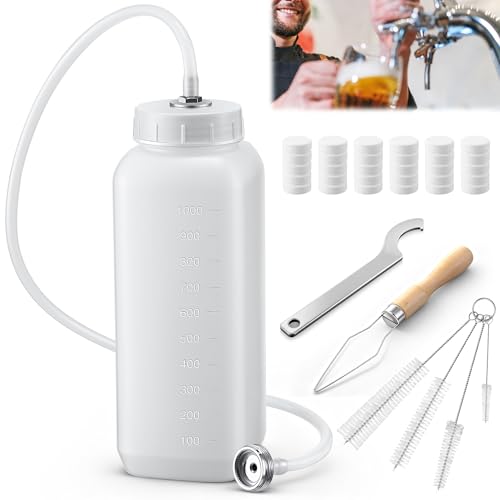
- 1 liter squeeze bottle, 30 active oxygen cleaning tablets, metal coupler hose with rubber sealing ring, faucet wrench, 4 brushes and manual included
The Avenuebool kit replaces powder and packets with tablets, and for many home pourers that is the whole appeal. One tablet doses the one liter bottle, so there is no scoop to level and no half used bag going stale in a drawer. Thirty tablets cover a long run of between keg cleanings.
The hardware leans durable for a bottle kit. The coupler hose is metal rather than thin plastic, with a rubber ring that seals against leaks, and the box adds a faucet wrench plus four brushes for the spout and fittings, along with a printed manual. The limit is pressure.
Pros:
– Thirty tablets give the simplest measuring here
– Metal coupler hose with a sealing ring resists leaks
– Wrench, four brushes, and manual cover the full job
– Compact bottle suits single tap home setups
Cons:
– Squeeze bottle pressure is gentle on heavy buildup
– No pressurized tank for long line runs
– Wrench fit should be checked on uncommon faucets
5. Dbgogo Beer Line Cleaning Kit with 1 Gallon Hand Pump Bottle

Specs
- 1 gallon (4 liter) hand pump bottle, Y-shaped hose splitter for two lines, universal connector for standard North American faucets, no gas or power required, cleaning solution not included
Dual tap owners feel the cleaning chore twice, and the Dbgogo kit is built to halve it. Its one gallon pump bottle feeds a Y-shaped splitter that sends solution through two beer lines in a single session, so a two tap tower gets one mixing, one pumping routine, and one rinse instead of two full repetitions.
The universal connector fits standard North American draft faucets, which covers most home towers, and the four liter capacity means a full flush rarely needs a mid job refill. One buying note matters here. This kit ships without cleaning solution, so a draft line cleaner must be on hand before the first session.
Pros:
– Y splitter cleans two lines in one session
– Large bottle supports a full system flush
– Hand pump needs no gas and no power
– Connector fits standard North American faucets
Cons:
– Cleaning solution is not included
– Pumping effort doubles on a two line run
– Splitter design is wasted on a single tap tower
Buying Guide Notes
Cleaning frequency does more for flavor than any single kit feature. A practical home rhythm is a flush every time a keg empties, with a deeper soak of the faucet and coupler parts every few kegs. Lines left for months develop hardened scale that gentle bottle kits cannot shift in one pass, while lines cleaned on schedule stay clear with the mildest solution in this guide.
Contact time does quiet work as well. Powder cleaners here are mixed with warm water, and the solution needs time sitting in the line to loosen film rather than a fast pass straight through. Fill the line, let it rest for the time the cleaner label states, then flush. Rinse rules follow the cleaner, not the hardware. No-rinse formulas end the job after the flush, while alkaline powders call for a clean water rinse before the next keg goes on.
FAQs
How often should you clean kegerator beer lines at home?
Clean the lines every time a keg empties, or every few weeks on a slow keg, whichever comes first. Regular light cleanings prevent the hardened scale that forces a deep soak later.
Do you need to remove the faucet when using a cleaning kit?
Some kits connect at the beer line or the coupler and leave the faucet mounted, while squeeze bottle kits attach at the shank and need the faucet removed with a wrench. Both approaches clean the line itself fully.
Can one cleaning kit work for both Sankey and ball lock kegs?
Only when the kit includes adapters for both connection styles or connects at a shared point such as the beer line tailpiece. Check the coupler type on your keg and the fittings in the box before ordering.
Do you have to rinse the lines after cleaning?
That depends on the cleaner rather than the kit. No-rinse formulas finish after the cleaning flush, while alkaline powders need a clean water rinse before the next keg is connected.
Conclusion
For a homebrew ball lock setup, the Kegco one gallon pump kit makes the between kegs routine about as painless as it gets, with the faucet left in place and nothing to measure. The Kegconnection kit remains the patient classic, trading faucet teardown for a powder supply that lasts a season. Fermtech suits standard lines in a compact tank, Avenuebool makes dosing foolproof with tablets, and the Dbgogo splitter kit is the one to pick when two taps double the work. Match the connection to your coupler and keep the schedule, and the next keg will taste the way the brewer intended.
More from Amazon
Programs that pair well with the guide above. Offers and eligibility are set by Amazon and may change.
Collect the home and kitchen items you want in one registry that guests can shop from.
Create a wedding registrySet up recurring deliveries of everyday items on eligible products. Terms and savings are set by Amazon.
Explore Subscribe & SaveFree shipping on eligible items, Prime Video and more. Eligible new members can start with a free trial.
Start a Prime free trialAudiobooks and podcasts to listen to on the go. Eligible new members can start with a free trial.
Try Audible freeAs an Amazon Associate we earn from qualifying purchases.

Write Your Review
No reviews yet. Be the first to share your experience!