

Key takeaways
- Stainless steel: Durable, odor-resistant, and unlikely to stain from citrus or cherries. It is the strongest choice for frequent use, although metal can show water spots and may be less convenient for microwave-free storage.
- BPA-free polypropylene: Lightweight, affordable, and commonly dishwasher-safe. It is practical for everyday home use, but it may scratch, discolor, or retain strong odors sooner than steel.
- Clear polycarbonate: Easy to organize because the contents are visible and more impact-resistant than ordinary acrylic. Check that the individual inserts are explicitly labeled food-safe and dishwasher-safe.
- Glass: Attractive and resistant to staining, but heavier and more vulnerable to chips or breakage. It works best for a stationary bar rather than a tray that is frequently moved.
- Bamboo or wood: Suitable for the outer frame, but the food-contact cups should be removable and made from a washable material. Unsealed wood around wet citrus or brine eventually absorbs moisture.
The best drink garnish tray for a cocktail bar is a lidded, food-safe tray with six to eight compartments, removable inserts, and a footprint no deeper than about 8 inches—large enough for a useful garnish selection without consuming the working space behind the bar.
For most home bars, choose a stainless-steel or BPA-free polypropylene tray with individual wells of at least 4 ounces each. Pick an open tray for fast service and easy visibility, a hinged-lid tray for occasional use, or a compact four-compartment model when counter space matters more than variety.
Our top picks
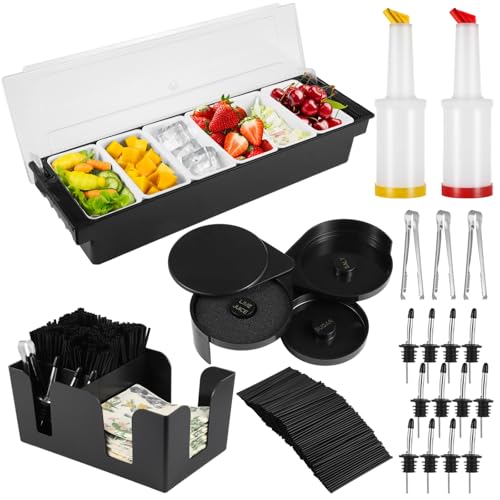
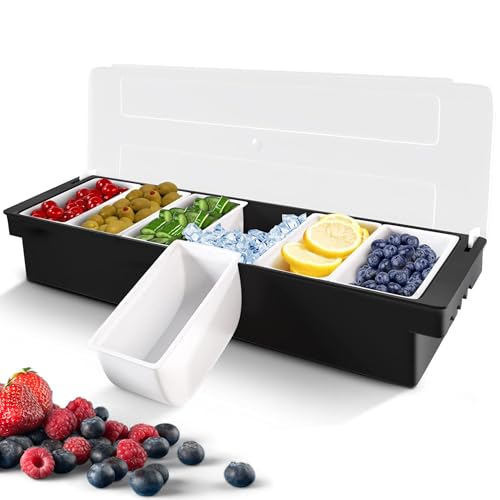
As an Amazon Associate we earn from qualifying purchases at no extra cost to you. Ratings are shown as listed on Amazon.
Our picks by home-bar situation
| Home-bar situation | Best tray type | Recommended specification | Typical price range |
|---|---|---|---|
| Small counter or bar cart | Compact four-compartment tray | 10–12 in. wide, 4–6 in. deep, removable inserts | $12–$25 |
| Frequent entertaining | Six- to eight-compartment service tray | 16–20 in. wide, 4–8 oz wells, non-slip base | $25–$60 |
| Occasional cocktails | Covered food-storage tray | Four to six wells, gasketed or snap-on lid | $18–$40 |
| Outdoor bar or warm kitchen | Stainless-steel tray with fitted lid | Rust-resistant metal, secure lid, dishwasher-safe parts | $35–$80 |
| Large garnish menu | Modular insert system | Eight or more sections, stackable or expandable | $40–$100+ |
What matters most when comparing garnish trays
Compartment count and useful capacity
Compartment count is less important than compartment size. A tray with ten tiny wells may look efficient, but it will not hold enough citrus wheels, olives, or cocktail onions for a gathering. For a home bar, four compartments cover the essentials: citrus, olives or onions, cherries, and a flexible space for herbs or specialty garnishes. Six compartments are a better balance if you serve several cocktail styles.
Eight or more sections make sense for a serious cocktail hobbyist, but only if the tray has enough width to keep ingredients identifiable. Crowded, shallow sections encourage spills and make tongs difficult to use.
As a practical target, allow approximately 1 ounce of capacity per guest for small garnishes and 2 ounces per guest for popular items such as olives or lime wedges. For eight guests, two 4-ounce wells for high-demand ingredients and four 2-ounce wells for secondary garnishes will usually be more useful than eight identical compartments.
Food-safe materials
- Stainless steel: Durable, odor-resistant, and unlikely to stain from citrus or cherries. It is the strongest choice for frequent use, although metal can show water spots and may be less convenient for microwave-free storage.
- BPA-free polypropylene: Lightweight, affordable, and commonly dishwasher-safe. It is practical for everyday home use, but it may scratch, discolor, or retain strong odors sooner than steel.
- Clear polycarbonate: Easy to organize because the contents are visible and more impact-resistant than ordinary acrylic. Check that the individual inserts are explicitly labeled food-safe and dishwasher-safe.
- Glass: Attractive and resistant to staining, but heavier and more vulnerable to chips or breakage. It works best for a stationary bar rather than a tray that is frequently moved.
- Bamboo or wood: Suitable for the outer frame, but the food-contact cups should be removable and made from a washable material. Unsealed wood around wet citrus or brine eventually absorbs moisture.
Avoid trays with painted interiors, unknown soft plastics, exposed unfinished wood, or decorative metal that is not identified as food-safe. “Food-grade” should describe the surfaces touching the ingredients, not merely the outside frame.
Footprint and counter organization
Measure the usable depth of the bar before choosing a tray. Many home bars have only 12 to 15 inches between the back wall and the edge, and a tray that is 10 inches deep can leave little room for a shaker, ice, and glassware.
For a compact station, look for a tray no deeper than 6 inches and no wider than 14 inches. A larger entertaining setup can accommodate a 16- to 20-inch tray, but it should still leave a dedicated landing area for the shaker and a separate place for used picks or tongs.
Rectangular trays generally organize a counter better than round bowls because they can sit flush against a wall or align with a bar mat. A non-slip base is useful, but check whether it is sealed. Fabric or felt feet absorb spills and are difficult to sanitize; molded silicone or raised plastic feet are easier to maintain.
Lid options
A lid is valuable when garnishes will sit for more than a few minutes. It limits exposure to dust, airborne debris, and drying, and it makes refrigerator storage easier. It does not replace refrigeration for cut fruit, herbs, or other perishable ingredients.
- Open tray: Fastest during service and easiest to refill, but ingredients are exposed and dry out more quickly.
- Loose lift-off lid: Simple to clean and inexpensive. It works well at home, though it can be misplaced or knocked aside.
- Hinged lid: Convenient for a fixed station and less likely to disappear. Hinges are the part most likely to collect sticky residue, so they need regular rinsing.
- Snap-on or gasketed lid: Best for transporting or refrigerating a tray. A tight seal can trap condensation, however, so dry ingredients before closing and release the lid periodically.
- Sliding lid: Useful where overhead clearance is limited, but its tracks can trap syrup and citrus pulp.
Head-to-head: open service tray versus lidded storage tray
| Feature | Open service tray | Lidded storage tray |
|---|---|---|
| Speed during cocktail making | Excellent; every garnish is immediately accessible | Good, but the lid requires an extra movement |
| Typical compartment count | 4–8 | 4–6 |
| Best use period | One serving session | Several hours of covered storage or refrigerator use |
| Cleaning difficulty | Low | Moderate, especially around hinges and seals |
| Typical footprint | 12–20 in. wide by 4–8 in. deep | 10–18 in. wide by 5–9 in. deep |
| Best buyer | Frequent host who prioritizes speed | Occasional host who prioritizes freshness and storage |
How to set up a garnish tray efficiently
- Put high-use ingredients in the middle. Place lime wedges, lemon twists, or olives in the easiest compartments to reach. Less frequently used cherries, herbs, and specialty items can go at the ends.
- Separate wet and dry garnishes. Brine, syrup, and cut fruit should not share a compartment with cocktail picks, dehydrated fruit, or sugar rims.
- Use one utensil per ingredient. A small pair of tongs for fruit and a perforated spoon for olives reduce cross-contamination and keep brine from spreading.
- Fill to service level, not maximum capacity. Leave roughly one-third of each well empty. This prevents garnishes from touching the lid and gives tongs room to work.
- Refrigerate promptly after service. Transfer the tray to the refrigerator when the session ends, following the storage guidance for the ingredients. Do not leave cut fruit at room temperature simply because the tray has a lid.
A useful organization method is to assign sections by cocktail function: sour citrus, aromatic citrus, brined garnish, sweet garnish, fresh herbs, and a rotating seasonal option. This is easier to maintain than changing the layout every time you make a different drink.
Durability and ownership realities
The first parts to wear are usually not the compartments themselves. Hinges loosen, silicone seals stretch, clear plastic scratches, and non-slip feet collect residue. If you choose a lidded model, confirm that replacement inserts or seals are available—or choose a design that still works without the seal.
Wash the tray after every use with warm water and dish soap. Rinse brine and citrus juice before they dry, since salt can spot metal and acid can dull some finishes. Use a soft brush around corners and hinges rather than an abrasive pad. Even when a tray is labeled dishwasher-safe, repeated high-heat cycles can warp thin plastic lids; the top rack and a lower-temperature cycle are safer choices.
Do not store sharp cocktail picks loose in a compartment, and do not stack wet inserts inside one another. Both habits create hard-to-clean crevices. For herbs, use a small removable container or liner so wilted leaves do not become trapped under the tray’s divider.
Bottom line
Choose a four-compartment compact tray if you have a small bar cart, a six-compartment lidded tray for occasional entertaining, and a stainless-steel six- to eight-compartment service tray for frequent cocktail making. Prioritize removable food-safe inserts, a washable base, adequate well capacity, and a footprint that leaves room for your shaker and ice. More compartments are useful only when they improve access and organization rather than turning the counter into a crowded garnish display.

Write Your Review
No reviews yet. Be the first to share your experience!