

Key takeaways
- Cream liqueurs: A short, slightly broad bowl or a small tumbler gives thicker liqueurs room to pour without feeling cramped. A moderate-to-wide rim makes sipping easier and suits drinks served over ice. Look for a stable base and a capacity around 90–150 ml (3–5 oz).
- Herbal liqueurs: A small tulip-shaped bowl, about 45–75 ml (1.5–2.5 oz), concentrates aromas near the nose. A narrower rim can make a small pour feel more expressive, but an opening that is too tight may make sipping awkward.
- Fruit liqueurs: A rounded cordial glass or compact tumbler works well for bright, sweet flavors. A somewhat wider bowl lets the aroma open up; choose roughly 60–90 ml (2–3 oz) unless you also plan to serve cocktails.
- Nut-based liqueurs: A small rounded bowl or a low, broad glass suits their rich, toasted aromas. A wide opening makes the drink easy to sip, while a stem or a thick base helps keep warm hands from transferring as much heat to a chilled pour.
The best liqueur glasses for digestifs depend on what you pour: choose a small, narrow-rimmed stemmed glass for aromatic herbal liqueurs, a wider bowl for cream or nut liqueurs, and a sturdy stemless glass for relaxed, frequent use.
For most homes, a set of 60–90 ml (2–3 oz) glasses offers the most flexibility. Digestifs are typically served in modest pours, so a glass does not need to be filled to its rim; extra space lets you swirl the drink and smell its aromas. Before buying, compare the bowl shape, usable capacity, rim opening, stem, and cleaning instructions—not just the glass’s advertised volume.
Our top picks


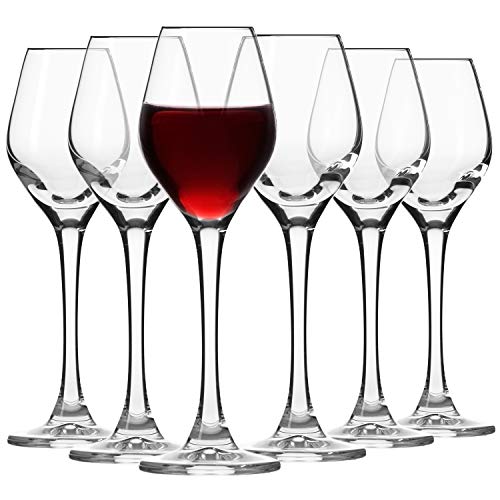

As an Amazon Associate we earn from qualifying purchases at no extra cost to you. Ratings are shown as listed on Amazon.
Choose by the digestif you serve
- Cream liqueurs: A short, slightly broad bowl or a small tumbler gives thicker liqueurs room to pour without feeling cramped. A moderate-to-wide rim makes sipping easier and suits drinks served over ice. Look for a stable base and a capacity around 90–150 ml (3–5 oz).
- Herbal liqueurs: A small tulip-shaped bowl, about 45–75 ml (1.5–2.5 oz), concentrates aromas near the nose. A narrower rim can make a small pour feel more expressive, but an opening that is too tight may make sipping awkward.
- Fruit liqueurs: A rounded cordial glass or compact tumbler works well for bright, sweet flavors. A somewhat wider bowl lets the aroma open up; choose roughly 60–90 ml (2–3 oz) unless you also plan to serve cocktails.
- Nut-based liqueurs: A small rounded bowl or a low, broad glass suits their rich, toasted aromas. A wide opening makes the drink easy to sip, while a stem or a thick base helps keep warm hands from transferring as much heat to a chilled pour.
These are serving-oriented guidelines, not rigid rules. A liqueur’s sweetness, strength, temperature, and whether it is served neat, chilled, or over ice can matter as much as its main flavor category.
Compare the common glass styles
| Style | Typical capacity | Typical rim width | Best fit | Main trade-off |
|---|---|---|---|---|
| Stemmed cordial glass | 45–90 ml (1.5–3 oz) | 35–50 mm (1.4–2 in) | Small neat pours; fruit and herbal liqueurs | Elegant and easy to hold by the stem, but more delicate to handle and store |
| Tulip-shaped tasting glass | 60–120 ml (2–4 oz) | 40–55 mm (1.6–2.2 in) | Aromatics; slow sipping of herbal or nut-based liqueurs | Good aroma concentration, but the narrow opening can be less convenient for thick drinks |
| Small tumbler | 90–150 ml (3–5 oz) | 55–75 mm (2.2–3 in) | Cream liqueurs, ice, and casual mixed drinks | Versatile and stable, but a large bowl can make a small neat pour look sparse |
| Stemless rounded glass | 75–120 ml (2.5–4 oz) | 45–65 mm (1.8–2.6 in) | Everyday use and compact storage | Less fragile than a fine stem, but the hand warms the bowl more readily |
Measurements in the table are practical ranges for choosing a style, not specifications for a particular product. Glass shapes vary, and capacity is usually measured to the brim. A 90 ml glass may feel crowded if you pour 60 ml and want room to swirl; for a typical 30–45 ml (1–1.5 oz) serving, a bowl holding about 60–100 ml often gives a comfortable balance.
Stemmed or stemless?
Pick stemmed glasses for aroma and a more formal pour
A stem provides a natural place to hold the glass without wrapping your fingers around the bowl. That helps keep a chilled drink cooler and makes a small, aromatic pour feel deliberate. Stemmed glasses are a strong choice for herbal and fruit liqueurs served neat, particularly if they will be carried carefully from table to table.
The stem is also the part most likely to chip or break during handling, washing, or storage. If glasses will be stacked in a crowded cupboard or loaded into a dishwasher, check whether the design is marked dishwasher-safe and whether the stems can sit securely in the rack. Avoid stacking delicate stemware unless the maker specifically says it is stackable.
Pick stemless glasses for stability and everyday use
Stemless designs are less likely to tip when set down and generally fit more easily in cabinets. They suit casual servings, cream liqueurs, and households that want one small glass to do double duty for tasting pours. Their trade-off is direct hand contact with the bowl, which can warm a chilled drink and leave fingerprints on clear glass.
Best choice by serving situation
| Your situation | Look for | Why |
|---|---|---|
| You mostly serve herbal liqueurs neat | Stemmed tulip shape; 60–90 ml capacity; 40–50 mm rim | Concentrates aromas without requiring a large pour |
| You often serve cream liqueurs or ice | Small tumbler; 100–150 ml capacity; 60 mm or wider rim | Leaves room for a thicker pour or a small ice cube |
| You serve several styles but have limited cupboard space | Stemless rounded glass; 75–100 ml capacity | Offers a useful middle ground and is generally easier to store |
| You entertain occasionally and want a polished presentation | Stemmed cordial glasses; 45–75 ml capacity | Suited to small pours and a formal after-dinner setting |
How to judge rim and capacity before buying
Start with how you actually pour. If you usually serve 30 ml, a 150 ml tumbler may be unnecessarily large unless you want space for ice or other uses. If you serve cream liqueurs in 60 ml portions, a tiny cordial glass can be awkward even if its capacity looks adequate on paper. Check the glass’s dimensions as well as its listed volume: two glasses with the same capacity can have very different bowl widths and heights.
Rim width changes the drinking experience, but it does not determine quality. A narrower rim can help keep aromas close to the nose; a wider one makes sipping and pouring thicker drinks easier. For a single all-purpose set, a rim around 45–60 mm (1.8–2.4 in) is a practical compromise. If possible, choose a gently rounded rim rather than an unusually thick one, which can feel bulky against the lips.
Materials, care, and what wears first
Clear soda-lime glass is a common, affordable choice. Lead-free crystal is often thinner and lighter, which can make a small pour feel refined, but it is not automatically more durable; construction and handling matter. For regular use, prioritize a stable base, an even rim, and a shape that fits your dishwasher or hand-washing routine. Tempered glass can be a practical option where impact resistance matters, though it may be heavier or less delicate in appearance.
With ordinary household use, rims and stems are the vulnerable points. Clinking glasses together, knocking them against a tap, crowding them in a dishwasher, or storing them rim-down on a hard shelf can cause chips. Wash glasses separately from heavy cookware, use a rack that prevents contact, and let them cool before exposing them to a sudden temperature change. For hand washing, use warm water and a soft cloth; avoid abrasive pads that can scratch the surface. If a glass develops a chip or crack, retire it rather than using it for drinking.
Bottom line
For one versatile set, choose stemless or short-stem glasses with a rounded bowl, a capacity of about 75–100 ml (2.5–3.4 oz), and a moderate 45–60 mm rim. Choose smaller stemmed tulip glasses if herbal aromas and neat pours are your priority. Go wider and larger—around 100–150 ml—for cream liqueurs, ice, or casual mixed drinks. Matching capacity and rim to your usual pour is more useful than buying the most ornate shape.

Write Your Review
No reviews yet. Be the first to share your experience!