

Our Short List of 3
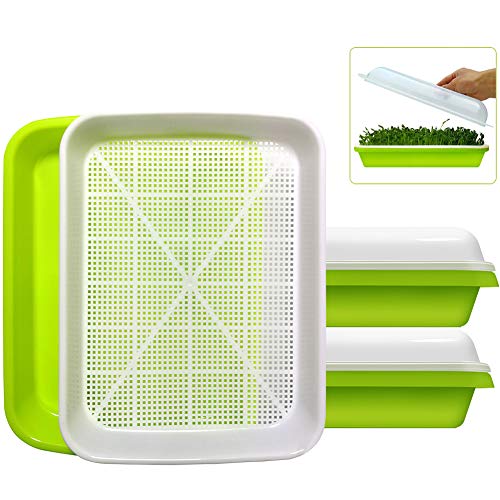
- Specs: BPA-free food-grade polypropylene; two tray sets, each with a clear lid, a fine mesh seed tray, and a solid bottom water tray; each tray measures about 13.2 x 9.8 inches; green trays with clear lids; soil-free design.
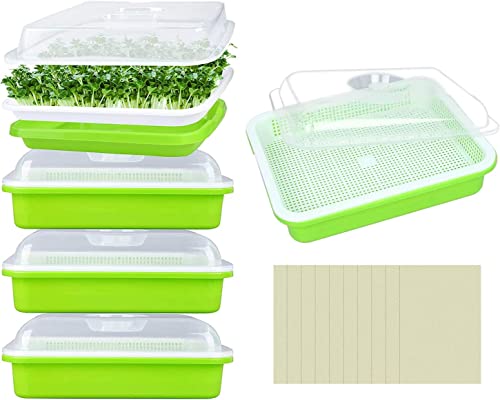
- Specs: Food-grade polypropylene, BPA free; five tray sets, each with a cover, a grid sprouter tray, and a base tray; trays measure about 12.7 x 10.1 inches; includes ten sheets of germinating paper; soil-free cultivation.

- Specs: Four stacking seed trays with 6-inch diameter round growing surfaces; includes basin tray and storage lid; starter packet of organic alfalfa seed included; BPA-free plastic; made in the USA.
All 5 Picks at a Glance
| Product | Specs | Action |
|---|---|---|
| 1. SUNPRO 2-Pack Seed Sprouter Tray |
| Check price on Amazon |
| 2. Legigo 5 Pack Seed Sprouter Trays with Lids |
| Check price on Amazon |
| 3. Kitchen Crop VKP1014 4-Tray Seed Sprouter by Victorio |
| Check price on Amazon |
 4. LeJoy Garden 4 Layers Sprout Trays |
| Check price on Amazon |
 5. Tribest Freshlife FL-3000 Automatic Seed Sprouter |
| Check price on Amazon |
Our Top Picks
- Legigo 5 Pack Seed Sprouter Trays with Lids5 Packs With Lids12.7 x 10.12 x 4.95 inches3.6 PoundsCheck on Amazon
As an Amazon Associate, we earn from qualifying purchases made through links on this page, at no extra cost to you.
Introduction
A sprouting tray turns a spoonful of dry seed into a handful of crisp, living food in less than a week, and it does the whole job on a corner of the kitchen counter. Compared with the classic jar-and-cheesecloth method, a tray spreads seeds in a single layer, so air moves freely, rinse water drains away instead of pooling, and the finished sprouts lift out in an even mat rather than a tangled clump. For anyone who adds sprouts to salads, sandwiches, stir-fries, or smoothies, a tray is simply the most forgiving way to grow them at home.
The five sprouting trays in this guide cover the main styles worth considering. Two are flat mesh tray kits that grow wide, shallow batches. One is a compact round stacking sprouter that has been a kitchen staple for years. One is a four-tier tower for households that run several varieties at once. The last is an automatic electric sprouter that handles the rinsing schedule for you. Each one grows food without soil, without fertilizer, and without any special skill beyond a daily rinse and a little patience.
How to Choose a Sprouting Tray
Tray format and footprint
Flat rectangular trays give seeds the most spreading room, which suits leafy sprouts such as alfalfa, clover, radish, and broccoli, plus soil-free wheatgrass. Round stacking sprouters take the opposite approach, growing upward in tiers so a small footprint produces several small batches at once. Measure your counter before choosing, because a wide two-tray kit needs a clear rectangle of space while a tower needs vertical clearance under cabinets.
Drainage and mesh size
Good drainage is the single most important feature in any sprouter. Seeds that sit in standing water turn slimy and sour, so look for a mesh or grid tray that holds the seed above a separate water reservoir or drip base. Fine mesh matters for tiny seeds like alfalfa and chia, which can wash through coarse grids, while larger holes drain bean sprouts and mung beans faster. A fitted lid helps hold humidity during the first two days, then comes off once the sprouts start to green.
Material and cleaning
Most trays are molded from food-grade polypropylene, which is light, inexpensive, and easy to rinse clean. Whatever the material, plan on washing every part with hot soapy water between batches, because a clean tray is the main defense against off flavors and mold. Smooth surfaces and parts that separate fully are easier to scrub than fixed assemblies with hidden corners.
Manual or automatic watering
Manual trays ask for a rinse two or three times a day, a routine that takes about a minute once it becomes habit. Automatic sprouters replace that routine with a timed sprinkler that mists the seeds on a cycle, which suits busy households and anyone who travels for a weekend mid-batch. The trade-off is cost, counter space, and one more appliance to store, so most beginners are well served by a simple manual tray.
Capacity and batch rhythm
Think about how many sprouts your household actually eats. A single flat tray produces a generous salad batch every four to six days, and staggered sowing keeps the supply continuous. Multi-tray kits let you run different seeds side by side, which is useful because radish sprouts finish days before bean sprouts. Buying a little more capacity than you think you need is rarely wasted, since trays also handle microgreens and cat grass.
The 5 Best Sprouting Trays
1. SUNPRO 2-Pack Seed Sprouter Tray
- Specs: BPA-free food-grade polypropylene; two tray sets, each with a clear lid, a fine mesh seed tray, and a solid bottom water tray; each tray measures about 13.2 x 9.8 inches; green trays with clear lids; soil-free design.
The SUNPRO kit is the straightforward starting point for tray sprouting. Each of the two sets stacks three pieces: a solid base that catches water, a mesh grid that holds the seed in a thin layer, and a clear lid that keeps humidity in during germination. The mesh is dense enough for small seeds such as alfalfa and broccoli, and the wide, shallow format gives sprouts room to leaf out instead of crowding. Because the two sets are independent, you can sow one on Monday and the second on Thursday for a rolling harvest, or dedicate one tray to wheatgrass while the other handles salad sprouts. The parts rinse apart in seconds and nest for storage, and the whole routine, soak, rinse twice a day, harvest inside a week, is easy to learn on the first batch.
Pros:
– Fine mesh handles small seeds that fall through coarser trays
– Two independent sets support staggered sowing and harvests
– Clear lids hold moisture during the germination stage
– Parts separate fully for fast, thorough washing
Cons:
– Wide footprint needs a clear stretch of counter
– Lids are shallow once sprouts grow tall
2. Legigo 5 Pack Seed Sprouter Trays with Lids
- Specs: Food-grade polypropylene, BPA free; five tray sets, each with a cover, a grid sprouter tray, and a base tray; trays measure about 12.7 x 10.1 inches; includes ten sheets of germinating paper; soil-free cultivation.
The Legigo five-pack suits growers who want variety or volume. Five identical sets mean five different seeds can run at the same time, which matters when radish finishes in four days and lentils take closer to a week. Each set follows the proven three-piece pattern of base, grid, and cover, and the included planting papers give very small or mucilaginous seeds a surface to grip while roots reach the water below. The trays are light and stack neatly when empty, so the full set stores in the space of one assembled unit. For a family that eats sprouts daily, or a gardener raising wheatgrass for juicing, this bundle removes the bottleneck of waiting for a single tray to free up. It is also an easy way to experiment, since a failed batch costs one tray out of five rather than the whole week of growing.
Pros:
– Five sets grow several seed varieties at the same time
– Germinating papers included for tiny or slippery seeds
– Large tray surface suits wheatgrass and microgreens
– Stackable design stores compactly between batches
Cons:
– Five sets are more than a casual grower needs
– Thin plastic rewards gentle handling during washing
3. Kitchen Crop VKP1014 4-Tray Seed Sprouter by Victorio
- Specs: Four stacking seed trays with 6-inch diameter round growing surfaces; includes basin tray and storage lid; starter packet of organic alfalfa seed included; BPA-free plastic; made in the USA.
The Kitchen Crop sprouter, long sold under the Victorio name, is the classic countertop tower. Four round trays stack over a basin, and water poured into the top tray percolates down through each level, rinsing every batch on its way to the base. That gravity-fed design means one pour waters the whole stack, a genuinely convenient routine. Each tray holds about a tablespoon of seed, so batches are modest, sandwich-sized harvests rather than bulk crops, and staggering the sowing by a day per tray keeps fresh sprouts coming. The included alfalfa seed packet lets a first-time grower start the day the box arrives. With its small round footprint, this is the sprouter for crowded counters, dorm rooms, and anyone who values a tidy vertical system over wide trays. The design has been sold for many years, and replacement trays remain easy to find.
Pros:
– One pour of water rinses all four trays from the top down
– Small round footprint fits tight counters
– Starter alfalfa seed included for an immediate first batch
– Expandable with additional trays sold separately
Cons:
– Small trays produce modest harvests per batch
– Round format is less suited to wheatgrass mats
4. LeJoy Garden 4 Layers Sprout Trays
- Specs: Four-tier stacking tray system; extra-strength plastic construction; soil-free growing for sprouts and wheatgrass; trays double as storage trays; designed for home, garden, and office use.
LeJoy Garden takes the stacking idea and stretches it into a four-level shelf of full-size trays. Each layer is a broad, shallow growing surface rather than a small round dish, so the tower produces serious volume while still occupying one square of counter. The reinforced plastic feels sturdier than the thinnest bargain trays, which matters when a full, water-heavy stack gets lifted and moved. Growers use the tiers to separate strong-flavored sprouts like radish and mustard from mild alfalfa, or to keep a wheatgrass flat growing above salad batches. When a tier is harvested, the same tray washes out and goes straight back into rotation, or serves as a storage tray in the refrigerator for the cut sprouts. For households that treat sprouts as a daily staple rather than an occasional garnish, this is the high-capacity manual option.
Pros:
– Four full-size tiers produce large, varied harvests
– Sturdier plastic than typical thin tray sets
– Tiers keep strong and mild sprout varieties separate
– Trays double as storage containers after harvest
Cons:
– Tall assembled stack needs vertical clearance
– More parts to wash after each full harvest
5. Tribest Freshlife FL-3000 Automatic Seed Sprouter
- Specs: Model FL-3000; electric automatic sprouter with timed sprinkler watering; expandable capacity up to three sprouting barrels; green housing; countertop unit about 10 inches across.
The Freshlife FL-3000 removes the one chore that defeats most sprouting routines, remembering to rinse. A built-in sprinkler waters the growing barrel automatically on a timed cycle, keeping seeds evenly moist day and night, and the controlled moisture produces noticeably uniform batches of bean sprouts, alfalfa, and other salad sprouts. The standard unit grows in a single barrel, and extra barrels stack on to expand capacity up to three levels for heavy users. Because the machine handles watering, it is the natural choice for frequent travelers and anyone whose sprouts have suffered from a forgotten weekend. It does ask for a power outlet, more counter presence than a simple tray, and a higher commitment than the manual kits in this guide, but for growers who want set-and-forget reliability, nothing else here matches it. Harvests stay on schedule whether you are home to tend them or not.
Pros:
– Automatic sprinkler eliminates manual rinsing
– Even watering produces consistent, uniform batches
– Expandable to three barrels for larger harvests
– Keeps sprouting on schedule during travel
Cons:
– Needs a power outlet and more counter space
– Moving parts need regular cleaning to stay fresh
FAQs
How long do sprouts take to grow in a tray?
Most salad sprouts are ready in four to seven days. Fast radish and clover sprouts can finish in four days, alfalfa usually takes five to six, and bean sprouts and mung beans often need closer to a week. Warm rooms speed growth slightly, while cool counters slow it down, so treat the timing as a range rather than a deadline.
Which seeds grow best in sprouting trays?
Alfalfa, clover, radish, broccoli, lentils, and mung beans are the reliable tray performers, and wheatgrass grows well on wide flat trays. Always buy seed sold specifically for sprouting, since it is tested for cleanliness and germination, and avoid garden seed that has been treated with fungicide coatings.
How often should sprouting trays be rinsed?
Rinse and drain two or three times a day with cool water. Each rinse removes the water that has been sitting in the base, refreshes the moisture around the seeds, and carries away the loose hulls that collect as sprouts grow. Thorough draining after every rinse is what keeps a batch smelling fresh and sweet.
Can sprouting trays go in the dishwasher?
Many polypropylene trays tolerate a top-rack dishwasher cycle, but hand washing is the safer default. Hot dishwasher water can warp thin trays over time, and a careful scrub with hot soapy water between batches removes the root hairs and seed residue that a dishwasher can leave behind in mesh corners.
Conclusion
For most kitchens, a simple two-tray mesh kit like the SUNPRO set covers everyday sprouting with the least fuss, while the Legigo five-pack and the LeJoy Garden tower scale the same idea up for variety and volume. The Kitchen Crop stacker remains the compact classic for small counters, and the Tribest Freshlife earns its place by automating the rinse cycle entirely. Whichever format fits your space, the reward is the same: fresh, crunchy sprouts grown steps from the cutting board, ready whenever a salad or sandwich needs them.
More from Amazon
Programs that pair well with the guide above. Offers and eligibility are set by Amazon and may change.
Collect the home and kitchen items you want in one registry that guests can shop from.
Create a wedding registrySet up recurring deliveries of everyday items on eligible products. Terms and savings are set by Amazon.
Explore Subscribe & SaveFree shipping on eligible items, Prime Video and more. Eligible new members can start with a free trial.
Start a Prime free trialAudiobooks and podcasts to listen to on the go. Eligible new members can start with a free trial.
Try Audible freeAs an Amazon Associate we earn from qualifying purchases.



Write Your Review
No reviews yet. Be the first to share your experience!