

Key takeaways
- Faint gray utensil marks in the center of dinner plates.
- Fading on dark or brightly printed areas after repeated dishwashing and sun exposure.
- Scratches along raised borders where plates rub during stacking.
- Chips or rough spots on the underside rim after being dropped on concrete or stone.
- Cloudiness caused by abrasive powders or harsh scouring pads.
Best Melamine Dinnerware Sets
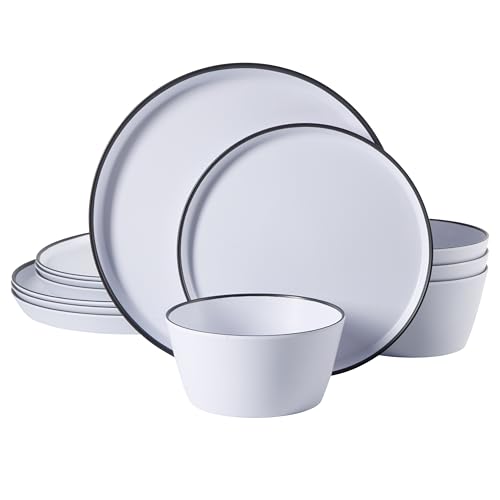
The best melamine dinnerware sets are the ones that match your serving style: a lightweight four-person set for everyday outdoor meals, a larger 12- or 16-piece set for family use, or a heavier, higher-quality set with thick rims when resistance to chips and fading matters most.
For most households, look for 100% melamine or a high-melamine composite, dinner plates measuring about 10 to 11 inches, bowls holding at least 20 ounces, dishwasher-safe labeling, and a set weight that is light enough for outdoor carrying but not so light that plates slide or tip. Melamine is durable, but it is not unbreakable: sharp knives, high heat, abrasive cleaners, and prolonged sun exposure are the main causes of premature wear.
Our top picks


As an Amazon Associate we earn from qualifying purchases at no extra cost to you. Ratings are shown as listed on Amazon.
What to compare before buying
Piece counts can be misleading. A “12-piece set” usually means four dinner plates, four salad plates, and four bowls, not 12 different serving pieces. A “16-piece set” may add four mugs, which are useful indoors but less practical around a pool or campsite. Count the pieces by function rather than by the number printed on the box.
| Set type | Typical contents | Dinner plate | Bowl capacity | Approximate set weight | Best use |
|---|---|---|---|---|---|
| Compact 12-piece set | 4 dinner plates, 4 salad plates, 4 bowls | 10–10.5 in | 20–24 oz | 5–8 lb | Small households and patios |
| Family 16-piece set | 4 dinner plates, 4 salad plates, 4 bowls, 4 mugs | 10.5–11 in | 22–28 oz | 7–11 lb | Everyday family meals |
| Six-person service set | 6 dinner plates, 6 salad plates, 6 bowls | 10–11 in | 20–28 oz | 8–13 lb | Frequent entertaining |
| Camping or serving assortment | Mixed plates, bowls, cups, and serving pieces | 9.5–11 in | 16–28 oz | 4–10 lb | Travel, picnics, and outdoor kitchens |
These are useful comparison ranges rather than universal specifications. Actual dimensions vary by manufacturer, rim design, and whether the set includes cups or serving bowls. Check cabinet and dishwasher space as carefully as the piece count.
Best choices by situation
Best for everyday family use: a heavyweight 16-piece set
A 16-piece set is the most balanced choice when four people will use the dishes regularly. The extra mugs make the set more versatile, while a dinner plate around 10.5 or 11 inches accommodates a full meal without feeling undersized. Choose a heavier design with a broad, slightly raised rim. It will feel closer to ceramic on the table and is less likely to flex when carrying food.
The trade-off is storage. Four mugs can occupy more cabinet space than expected, and thick melamine plates may not stack as tightly as thin camping-style dishes. If your shelves are narrow, measure the stack height and plate diameter before ordering. A stack of four plates commonly occupies about 3 to 5 inches, but raised patterns and wide rims can increase that.
Best for patios and picnics: a lightweight 12-piece set
For outdoor meals, prioritize grip, weight, and easy replacement over formal appearance. A 12-piece set without mugs is usually easier to pack and gives each person the essential plate-and-bowl combination. Look for plates weighing roughly 12 to 18 ounces each and bowls with a stable foot ring. Very thin pieces may be easy to carry but can feel unstable when loaded with pasta, salad, or grilled food.
Flat, low-contrast patterns are often better for outdoor use than highly raised decoration. Embossed borders collect food residue and can show scuffing sooner. If the set will live in a picnic bin, choose colors and patterns that make dirt visible rather than hiding it; that makes cleaning easier after meals.
Best for frequent entertaining: a six-person set or mix-and-match collection
A six-person set reduces the need to wash dishes during a gathering, but it is not automatically the best value. Calculate the useful capacity: if six guests each need a dinner plate, salad plate, and bowl, you need 18 primary pieces before adding serving platters. A six-person set containing only dinner plates and bowls may still require a second purchase for appetizers or dessert.
For entertaining, select a pattern with a printed surface protected by a clear melamine layer rather than a design that sits prominently on the raised rim. Dark, glossy colors can reveal knife marks and utensil scuffs more clearly than pale matte finishes. A neutral base with a colored border is usually easier to expand later than a seasonal pattern.
Best on a tight budget: a simple four-person set
Basic four-person melamine sets generally cost about $25 to $60, while heavier or more decorative collections often range from $60 to $120 or more. The lowest price is worthwhile when the pieces will be used occasionally, but inspect the specifications first. A cheap set with very small bowls or unusually thin plates can cost more per useful place setting than a slightly larger set.
Use this calculation when comparing sizes:
Cost per complete place setting = total price ÷ number of people served. For example, a $36 12-piece set serving four costs $9 per place setting. A $52 16-piece set also serving four costs $13 per place setting, but the difference may buy mugs, thicker construction, or larger bowls. Compare those features rather than assuming the lower total price is the better value.
Pattern durability and the parts that wear first
Melamine itself is usually more resistant to breakage than ceramic, but the decoration can age sooner than the body of the dish. The first visible wear commonly appears as:
- Faint gray utensil marks in the center of dinner plates.
- Fading on dark or brightly printed areas after repeated dishwashing and sun exposure.
- Scratches along raised borders where plates rub during stacking.
- Chips or rough spots on the underside rim after being dropped on concrete or stone.
- Cloudiness caused by abrasive powders or harsh scouring pads.
Printed patterns are generally preferable to thick surface decals or deep embossing for daily use. Ask whether the pattern is dishwasher safe and whether the maker recommends a particular rack position. Dishwasher-safe does not mean “immune to wear”: frequent hot cycles can gradually dull gloss and accelerate fading, especially on inexpensive pieces.
To extend pattern life, place dishes on the top or lower rack according to the manufacturer’s instructions, avoid nesting wet dishes for long periods, and use a nonabrasive detergent. Do not slide a fork or knife repeatedly across the same decorative border. Melamine tolerates ordinary table knives, but it is not designed for chopping or cutting food directly on the plate.
Dishwasher safety and temperature limits
Many modern melamine sets are labeled dishwasher safe, but they should not be used in a microwave or conventional oven. Melamine can become dangerously hot or deform under high heat, and microwave suitability should never be inferred from dishwasher labeling. Keep dishes away from stovetops, toaster ovens, broilers, and direct contact with hot cookware.
For dishwasher use, avoid placing pieces directly above an exposed heating element if your machine has that configuration. Let dishes cool before loading them after an outdoor meal, and do not pour boiling liquid into a bowl unless the manufacturer specifically allows it. For handwashing, warm water, ordinary dish soap, and a soft sponge are sufficient.
How much resistance should you expect?
Melamine is an excellent choice where dropped ceramic would be a problem, but “chip resistant” is not the same as chip proof. A fall onto grass may leave no mark, while the same drop onto concrete can damage the rim. Repeated impacts inside a crowded camping box can also create small edge chips.
Replace a piece if it develops a crack, deep gouge, sharp edge, or rough area that cannot be cleaned. Do not keep using a plate merely because it still looks attractive after a severe impact. Scratches that expose a rough substrate are a practical sign that the piece has reached the end of its useful life.
Quick buying checklist
- Choose 10–11-inch dinner plates for normal adult portions.
- Choose bowls of at least 20 ounces for soup, cereal, pasta, and grain bowls.
- Verify whether the stated piece count includes mugs or serving pieces.
- Prefer a broad base and moderate weight for outdoor stability.
- Look for dishwasher-safe labeling, but avoid microwave and oven use.
- Favor smooth printed patterns over heavily raised decoration.
- Measure cabinet shelves, dishwasher racks, and storage bins before buying.
- Buy one or two extra dinner plates if replacements may be difficult to find.
In short, the best melamine dinnerware sets balance useful dimensions with manageable weight. Choose a heavyweight 16-piece set for daily family dining, a compact 12-piece set for portable outdoor meals, and a six-person collection when entertaining is the priority. Whichever style you choose, dishwasher care, gentle utensils, and protection from high heat will matter as much as the original pattern and price.


Write Your Review
No reviews yet. Be the first to share your experience!