

Key takeaways
- Set quantity: 4 glasses.
- Stated capacity: 16 ounces per glass.
- Format: classic craft-beer goblet.
- Use class: everyday craft beer, pub-style service, and aromatic ales.
- Stem: the goblet category generally separates the hand from the bowl; confirm the current listing’s exact stem and care details.
- Best pour range: approximately 8–12 ounces, adjusted for foam and beer style.
The best snifter beer glasses for most aromatic brews are the True Beer Glasses Gift Set because its tasting-focused assortment covers IPA, Belgian ales, wheat beers, stouts, and porters without forcing every style into one bowl shape. It is the strongest choice for a drinker who wants to compare aroma performance across several beer families. For a traditional tulip-style presentation at the lowest cost, choose the Meolibour 16-ounce goblets; for Belgian ales served to a group, the Libbey 13-ounce Belgian glasses are the practical upgrade. The right snifter is not determined by capacity alone. Bowl width affects how quickly beer warms, the inward taper concentrates volatile aromas, a stem keeps your hand away from the bowl, a narrower rim directs aroma toward the nose, and thinner glass makes sipping feel more refined but usually requires gentler handling. This roundup compares those trade-offs rather than treating every rounded beer glass as interchangeable. It also separates true tasting glasses from brandy-style snifters, which can be excellent for strong beer but may be too small, too broad, or too fragile for regular pint-sized pours.
Top 3 Picks
Best overall: True Beer Glasses Gift Set
Choose this set if you drink several strong-beer styles and want a flexible tasting setup rather than one highly specialized glass. Its stated design purpose covers IPA, Belgian ales, wheat beers, stouts, and porters, making it the most sensible path for a mixed home collection.
Best budget: Meolibour 16-Ounce Classic Craft Goblets
The Meolibour set suits buyers who want four matching, full-size craft-beer goblets at a budget tier. A 16-ounce capacity gives generous headroom for a standard bottle or can poured below the rim, while the goblet format supports swirling and aroma concentration better than a straight-sided tumbler.
Best for Belgian ales: Libbey 13-Ounce Belgian Beer Glasses
The six-piece Libbey set is the group-serving choice, especially when Belgian ales, strong golden ales, dubbel-style beers, or other aromatic pours are shared. Its 13-ounce capacity encourages controlled pours with room for foam and reduces the temptation to fill the bowl so high that swirling becomes awkward.
Quick Comparison
| Product | Best for | Key specs and shape information | Price tier |
|---|---|---|---|
| Meolibour 16-Ounce Classic Craft Goblets | Matching everyday snifters and generous pours | Set of 4; 16-ounce stated capacity; classic craft goblet format; stemmed design | Budget |
| Libbey 13-Ounce Belgian Beer Glasses | Belgian ale service for a group | Set of 6; 13-ounce stated capacity; Belgian-beer glass format; stemmed bowl design | Premium |
| TRUE Lead-Free Crystal Snifter | Brandy-style tasting of strong beer | Lead-free crystal; snifter category; short-stemmed bowl; exact capacity is not stated in the supplied product name | Budget |
| Rastal Nucleated Teku 3.0 Stemmed Beer Glass | Craft-beer aroma and head retention | Stemmed Teku format; nucleated base; pint-class beer glass; exact capacity is not stated in the supplied product name | Budget |
| Libbey Craft Brews Assorted Beer Glasses | One mixed set for several beer styles | Set of 6; assorted craft-beer glass shapes; premium beer-glass category; individual capacities vary by shape | Premium |
| DeeCoo 7-Ounce Crystal Whiskey Glasses | Small pours and compact aroma tasting | Set of 2; 7-ounce stated capacity; crystal whiskey and wine-tasting glass category; short-stem or tumbler-style construction should be confirmed before ordering | Budget |
| TRUE Beer Glasses Gift Set | Style-by-style beer tasting | Clear tasting kit for IPA, Belgian ales, wheat beers, stouts, and porters; multiple glass forms; exact piece count and capacities should be checked in the current listing | Mid-range |
| DOTUHAO Cognac Glasses | Classic small-batch snifter service | Set of 2; 11.5-ounce stated capacity; short-stem brandy snifter format; rounded bowl and inward-tapering rim | Budget |
How We Chose
This selection is based on the product names, stated capacities, listed use cases, brand/category conventions, and the practical requirements of aromatic beer service. A suitable snifter needs enough bowl volume for a measured pour and a visible aroma chamber above the liquid; it should also provide a narrowing path from the bowl to the rim so swirling does not simply disperse every volatile note into the room. Stemmed construction matters because holding the bowl warms beer and leaves fingerprints where the glass is meant to be observed. Nucleation was treated as a separate feature: it can encourage bubbles and help maintain a foam presentation, but it does not replace a tulip or snifter’s inward taper. Assorted sets receive credit for coverage, while matched sets receive credit for consistency and group service. We did not treat a larger capacity as automatically superior. For strong beer, the useful capacity is the amount left after allowing roughly 20–30 percent of the bowl for head and aroma space. We also considered ownership: dishwasher guidance, rim fragility, storage footprint, and whether a glass can serve a second purpose such as whiskey or brandy tasting.
1. Meolibour 16-Ounce Classic Craft Goblets – Best for a generous everyday craft-beer glass
As an Amazon Associate we earn from qualifying purchases at no extra cost to you.

The Meolibour® Beer Glasses Set of 4 is the most approachable option for someone who wants four matching glasses with a familiar craft-beer goblet profile. The listed 16-ounce capacity places it above small tasting snifters and gives the drinker room to pour a bottle, can, or share-sized serving without filling the bowl to its rim. That extra space is useful for aromatic beer because the glass can be tilted, gently swirled, and allowed to settle while retaining a head. It also makes the set practical for casual table service, where a 7-ounce tasting glass might feel undersized.
The main question is how much of the nominal capacity should be used. A 16-ounce glass should not automatically receive 16 ounces of beer. Pouring 12 ounces into it leaves approximately 25 percent headspace, assuming the stated capacity is measured to the brim. That is a sensible starting point for a beer with moderate foam. A highly carbonated Belgian ale may need an even slower pour and more room, while a quiet stout can use somewhat more of the bowl without threatening the rim.
Key specifications
- Set quantity: 4 glasses.
- Stated capacity: 16 ounces per glass.
- Format: classic craft-beer goblet.
- Use class: everyday craft beer, pub-style service, and aromatic ales.
- Stem: the goblet category generally separates the hand from the bowl; confirm the current listing’s exact stem and care details.
- Best pour range: approximately 8–12 ounces, adjusted for foam and beer style.
Strengths
The generous bowl is the central advantage. It gives a strong ale or imperial stout more surface area than a narrow pint glass, while the goblet shape provides a natural place to hold the glass without touching the beer chamber. Four matching pieces are useful for a tasting flight of one beer or for serving guests. The design is also less specialized than a tiny brandy snifter: a drinker can use it for many ordinary craft beers without making the serving feel ceremonial.
Its capacity can be an advantage for aroma, but only if the pour is controlled. A 16-ounce bowl filled to the brim loses the very headspace that makes a goblet useful. For an aromatic beer, pour down the side until the glass is roughly half to two-thirds full, wait for the foam to contract, and add more if needed. The broad shape may also make it easier to compare color and clarity than a narrow vessel.
Pros
- Four matching glasses are practical for households and small tastings.
- 16-ounce capacity accommodates a range of bottle and can sizes.
- Goblet form supports swirling and keeps fingers away from much of the bowl.
- Budget positioning makes a complete set easier to replace than specialty crystal.
- More versatile for everyday use than a very small 7-ounce tasting glass.
Cons
- Large capacity can encourage overpouring and leave too little aroma headspace.
- The product name does not establish an exact rim diameter, bowl width, wall thickness, or weight.
- A broad goblet may concentrate aromas less sharply than a strongly tapered snifter.
- Matching sets provide less shape variety than an assorted tasting kit.
Nearest alternative
The closest alternative in this list is the DOTUHAO 11.5-ounce cognac snifter. The Meolibour is better for full-size beer servings and group use, while the DOTUHAO is more naturally suited to small pours, brandy-style swirling, and a tighter aroma chamber. Choose Meolibour when you want four identical, everyday beer glasses; choose DOTUHAO when the ritual of a rounded, short-stem snifter matters more than serving volume.
2. Libbey 13-Ounce Belgian Beer Glasses – Best for Belgian ales and group service
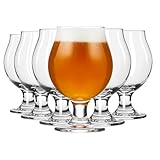
The Libbey Entertaining Essentials Belgian Beer Glasses are designed around a 13-ounce capacity and a six-glass set, making them the strongest pick for serving aromatic Belgian-style beer to several people. Belgian beer glasses are commonly built with a bowl that gives foam room and a stem or foot that lets the drinker hold the vessel without warming the liquid immediately. The listing’s Belgian-ale focus is more informative than the word “beer glass” alone: it indicates a shape intended for expressive, carbonated beers rather than a neutral straight-sided pint.
A 13-ounce capacity is a useful middle ground. It is large enough for a standard bottle poured with headspace, but not so large that a modest serving looks lost. If the vessel is filled to approximately 10 ounces, about 23 percent of nominal capacity remains above the liquid. That proportion is a practical starting point for a foamy ale, although actual usable volume depends on whether the listed capacity is measured to the rim and how much foam the beer creates.
Key specifications
- Set quantity: 6 glasses.
- Stated capacity: 13 ounces per glass.
- Format: Belgian beer glass.
- Primary use: Belgian ales and other aromatic, carbonated beers.
- Rim and wall measurements: not specified in the supplied product name.
- Best serving approach: slow side pour followed by a controlled top-up after the foam settles.
Strengths
The six-piece quantity is the defining practical benefit. It works for a tasting group, a dinner table, or a household that prefers not to mix unmatched glassware. The Belgian format should provide more aroma-friendly geometry than a standard shaker pint, with a bowl that allows a beer’s foam and volatile compounds to develop. The 13-ounce size also places a natural limit on the portion: it encourages measured service rather than a huge pour that grows warm before the drinker reaches the final third.
Libbey is a well-established glassware brand, and the entertaining-focused positioning suggests that the set is intended for regular service rather than only occasional collector use. That does not prove a specific wall thickness or dishwasher rating, so care instructions remain important. If the glass is thin at the rim, avoid stacking it inside another glass and do not twist it against a drying rack.
Pros
- Six-piece set is excellent for hosting or multi-beer comparisons.
- 13-ounce capacity balances a standard serving with foam and aroma space.
- Belgian-beer format is naturally suited to aromatic ales.
- Smaller than a full 16-ounce goblet, making storage and portion control easier.
- Useful for beer dinners where every guest needs the same vessel.
Cons
- It is less flexible if you regularly want very large pours.
- The listing name does not establish exact bowl dimensions, rim diameter, or glass thickness.
- A six-piece set may take more cupboard space than a two-glass snifter pair.
- It may be more glassware than needed for a solo drinker.
Nearest alternative
The nearest alternative is the Meolibour 16-ounce goblet set. Both offer a stemmed, bowl-oriented experience, but Libbey’s 13-ounce Belgian emphasis favors controlled servings and group presentation, while Meolibour’s 16-ounce capacity is more forgiving for larger pours. Select Libbey for Belgian-focused entertaining; select Meolibour for everyday flexibility and a four-piece budget set.
3. TRUE Lead-Free Crystal Snifter – Best for small, strong-beer pours

The TRUE Brandy Bourbon Whiskey Cognac Scotch Drinking Glass is a lead-free crystal snifter whose category makes it particularly interesting for strong beer. Although its listed uses center on spirits, a brandy-style snifter can work beautifully with barleywine, barrel-aged stout, Belgian quadrupel, imperial porter, and other beers where a small pour and concentrated aroma are more important than pint capacity. The listing does not provide a dependable capacity in the supplied name, so it should be considered a category-led choice rather than a precisely sized beer vessel.
The classic snifter has a rounded bowl, a relatively narrow opening, and a short stem. The large lower chamber gives aroma compounds room to collect; the inward taper directs them toward the nose; and the short stem allows the drinker to cradle the foot or stem rather than grip the bowl. That geometry can make strong beer seem more aromatic, but it also magnifies alcohol notes. The solution is not to dismiss the glass, but to use a smaller pour and allow the beer to rest for several minutes before judging it.
Key specifications
- Material category: lead-free crystal.
- Format: snifter for brandy, bourbon, whiskey, cognac, and Scotch.
- Beer suitability: strong, aromatic beers served in small portions.
- Stem: short-stem snifter category.
- Capacity: not established by the supplied product name; verify the current listing before buying for a particular pour size.
- Best pour: generally below the widest part of the bowl, leaving substantial aroma space.
Strengths
Lead-free crystal is a sensible material choice for drinkware because it avoids the specific concern associated with leaded crystal while retaining the visual clarity and refined feel expected from crystal-style glass. The snifter’s shape is more aroma-concentrating than a straight tumbler. For a 12 percent beer, a small pour in a rounded bowl can be more informative than filling a large beer glass, especially when the drinker wants to detect oak, dried fruit, roast, spice, or fermentation notes.
The cross-category design can also justify the purchase for someone who already serves whiskey or cognac. One glass can support a spirit tasting, a fortified beverage, and a high-gravity beer, reducing the need for a separate vessel. However, the short stem and broad bowl deserve careful handling. Do not lift a filled snifter by the bowl’s widest point, and avoid pouring boiling-hot water into a cold glass during cleanup.
Pros
- Rounded bowl and tapered opening are well suited to aroma concentration.
- Lead-free crystal is an attractive material class for tasting glassware.
- Works across strong beer and multiple spirit categories.
- Short stem allows controlled swirling while limiting direct contact with the bowl.
- Budget tier makes a specialty snifter accessible.
Cons
- The listed category is spirits-focused rather than specifically beer-focused.
- Exact capacity, rim diameter, wall thickness, and weight are not established here.
- A narrow opening can overemphasize alcohol if the beer is poured too high or served too warm.
- One small snifter is less practical for serving a group.
Nearest alternative
The DOTUHAO 11.5-ounce cognac snifter is the closest alternative. DOTUHAO provides a stated capacity and a two-glass set, which is useful when portion size and pairing are priorities. TRUE is preferable if lead-free crystal and cross-use with several spirits appeal to you; DOTUHAO is preferable when you want the clearest published volume and two matching pieces.
4. Rastal Nucleated Teku 3.0 – Best for head retention and aroma-focused craft beer

The Nucleated Teku 3.0 Stemmed Beer Glass by Rastal takes a different route from a traditional brandy snifter. It is a stemmed craft-beer glass with nucleation, meaning the base is designed to provide sites where dissolved carbon dioxide can form bubbles. That activity can help refresh the foam presentation and keep aroma moving above the beer. The Teku format is specifically associated with sensory-oriented craft-beer service, so it is a better match for drinkers who want to examine carbonation, head, aroma, and flavor in one vessel.
Nucleation should not be confused with a narrower rim or a deeper snifter bowl. A nucleated glass may create a livelier stream of bubbles, but the beer’s aroma concentration still depends on bowl geometry, fill height, temperature, and the size of the opening. The Teku’s stem is valuable because it lets you swirl or lift the glass without wrapping a warm hand around the bowl. The supplied product name does not establish exact capacity, rim diameter, wall thickness, or weight, so those should be checked in the current specification panel if cabinet fit matters.
Key specifications
- Brand/category: Rastal Teku 3.0 beer glass.
- Construction: stemmed craft-beer glass.
- Base feature: nucleated surface for bubble formation and head presentation.
- Primary use: aroma, head retention, and sensory evaluation of craft beer.
- Capacity: not stated in the supplied product name.
- Shape class: technical tasting glass rather than a traditional brandy snifter.
Strengths
The nucleated base gives the glass a functional feature that a normal snifter does not necessarily have. In a beer with healthy carbonation, a continuous bubble stream can carry aroma toward the surface and help keep the head visually active. That is useful for hoppy ales, Belgian beers, saisons, and other styles where carbonation is part of the intended experience. The stem also offers an ergonomic advantage over stemless craft glasses: the drinker can hold the vessel without rapidly warming the beer.
The Teku format is a good choice for someone who wants to learn how glass shape changes perception. Pour half a serving first, note the aroma, then add more after the foam settles. The changing fill height makes it easier to observe how the rim and head influence the nose. It is less of a traditional snifter and more of a deliberately engineered tasting tool.
Pros
- Nucleated base encourages visible carbonation and active foam.
- Stemmed design limits hand warmth and fingerprints on the bowl.
- Strong fit for craft-beer tasting and sensory comparison.
- More technically beer-specific than a brandy or whiskey snifter.
- Can reveal differences in head formation between beers.
Cons
- Nucleation cannot compensate for an unsuitable temperature or an overfilled glass.
- Exact capacity and rim dimensions are not confirmed by the supplied name.
- Its specialized shape may be less intuitive for casual guests.
- Small etched or nucleated areas may require careful cleaning to remove residue.
Nearest alternative
The TRUE Beer Glasses Gift Set is the nearest alternative for beer-specific tasting. TRUE is the more flexible choice if you want several style-oriented glasses, while Rastal is the more focused choice if bubble activity, head presentation, and a dedicated technical tasting shape matter most. Choose Rastal for analytical craft-beer sessions; choose TRUE for broader household coverage.
5. Libbey Craft Brews Assorted Glasses – Best for a mixed beer collection

The Libbey Craft Brews Assorted Beer Glasses Set of 6 is the natural pick for a household that buys many styles and does not want one universal snifter. An assorted set can include different bowl proportions for different beer families, allowing the user to choose a more suitable vessel for a wheat beer, stout, IPA, Belgian ale, or lager. The supplied name confirms six glasses and an assorted craft-beer format, but it does not establish the capacity, rim diameter, stem length, or exact shape of each individual piece.
That uncertainty is not necessarily a disadvantage. The benefit of an assorted set is the range itself. A wide-mouthed glass can make a delicate beer feel open and easy to drink; a tulip or snifter-like bowl can retain and concentrate aromas; a taller form can emphasize carbonation and visual head. The challenge is learning which glass serves which beer instead of selecting by appearance alone.
Key specifications
- Set quantity: 6 glasses.
- Format: assorted craft-beer glass shapes.
- Use: multiple beer styles and entertaining.
- Capacity: varies by shape and is not stated in the supplied product name.
- Rim diameter and wall thickness: vary by piece and should be checked if important.
- Best for: drinkers who value coverage over six identical vessels.
Strengths
Shape variety is the main information gain over a matched set. Rather than asking one glass to serve every beer identically, you can select a bowl that reflects the beer’s carbonation, foam, and aromatic intensity. This is especially useful for a flight: the same 4- or 5-ounce pour can be served in several shapes, creating a direct comparison without buying eight separate specialty glasses.
Six pieces also support a dinner or tasting event. Guests can receive matching-looking service while the host keeps the set organized by style. The trade-off is that the glasses may have different storage requirements. Before ordering, measure the cupboard’s maximum height and shelf depth, and check whether the tallest piece can stand upright without touching an upper shelf.
Pros
- Six-piece assortment covers more beer styles than one repeated shape.
- Useful for flights, dinners, and households with varied preferences.
- Craft-beer orientation is more relevant than a generic bar-glass set.
- Allows side-by-side comparison of bowl, rim, and stem geometry.
- Premium positioning may suit a gift or permanent home bar collection.
Cons
- Exact capacities and dimensions vary, making storage and portion planning harder.
- Some pieces may be less snifter-like than the buyer expects.
- Assorted glasses are not ideal if every guest needs an identical vessel.
- More complicated washing and organization than a four-piece matching set.
Nearest alternative
The TRUE Beer Glasses Gift Set is the closest alternative. Both target a broad range of beer styles, but Libbey’s assortment emphasizes multiple shapes, while TRUE’s stated style coverage emphasizes IPA, Belgian ales, wheat beers, stouts, and porters. Choose Libbey when shape variety is the goal; choose TRUE when you want a gift-oriented beer tasting kit and clearer style labeling.
6. DeeCoo 7-Ounce Crystal Whiskey Glasses – Best for compact tasting portions

The DeeCoo® 2 Pack Crystal Whiskey, Bourbon, Scotch Glasses are listed at 7 ounces and positioned for whiskey and wine tasting. That makes them a compact option for beer drinkers who prefer small pours of intense beer. A 7-ounce vessel is not a full-serving beer goblet, but it can be exactly right for a 3–4-ounce tasting pour, leaving enough room for foam and aroma without creating a large warm remainder.
The product name also calls them shot glasses, old-fashioned glasses, and tasting glasses, so buyers should inspect the current listing images and dimensions before assuming a classic stemmed snifter. The category may represent a compact crystal tasting glass rather than a traditional brandy bowl. That distinction matters: a rounded, inward-tapered shape will concentrate aroma more effectively than a straight-sided rocks glass, while a broad tumbler will be easier to clean and more stable but less focused at the rim.
Key specifications
- Set quantity: 2 glasses.
- Stated capacity: 7 ounces per glass.
- Material category: crystal.
- Listed uses: whiskey, bourbon, Scotch, wine tasting, and shot service.
- Beer use: small pours of strong or highly aromatic beer.
- Exact stem, bowl shape, rim diameter, and wall thickness: verify before purchase.
Strengths
The compact capacity encourages disciplined tasting. A 3-ounce pour in a 7-ounce glass leaves more than half the vessel available for headspace if the capacity is measured to the brim. That is ample room to swirl without sloshing and to observe how the aroma changes as the beer warms slightly. Small portions also work well for barrel-aged beers, tasting flights, and beers with high alcohol content that are better consumed slowly.
A two-piece set is convenient for a pair of drinkers or for a host who wants one comparison glass beside a larger beer goblet. Crystal-style clarity can make color and foam easier to observe, although the product name alone does not confirm lead content, exact composition, or dishwasher suitability. Follow the manufacturer’s care directions and avoid assuming that every crystal-style glass tolerates harsh detergent or sudden temperature changes.
Pros
- 7-ounce capacity is well matched to small tasting pours.
- Two-piece quantity suits couples or side-by-side comparisons.
- Crystal category offers a clear, refined tasting presentation.
- Compact glasses take less cupboard space than full-size beer sets.
- Cross-use with whiskey and wine can improve ownership value.
Cons
- Too small for a typical 12-ounce serving if the drinker wants one glass per beer.
- The product name does not confirm a snifter bowl or stemmed construction.
- Shot-glass positioning may mean less aroma concentration than a dedicated beer glass.
- Two pieces are limiting for group tastings.
Nearest alternative
The TRUE lead-free crystal snifter is the nearest alternative. DeeCoo offers a stated 7-ounce size and a compact two-glass format, while TRUE offers a more clearly snifter-shaped category and a lead-free crystal description. Select DeeCoo for small, controlled portions and compact storage; select TRUE when bowl geometry and spirit-style aroma concentration are the priority.
7. TRUE Beer Glasses Gift Set – Best for a broad style-by-style tasting kit

The TRUE Beer Glasses Gift Set is the broadest beer-specific option in this roundup because the listed purpose explicitly includes IPA, Belgian ales, wheat beers, stouts, and porters. That range matters. An IPA often benefits from a bowl that directs hop aroma toward the nose; a wheat beer may need space for a persistent cap of foam; a stout can be comfortable in a wider, heavier-feeling vessel; and a Belgian ale often rewards a stemmed, aroma-oriented shape. A kit that recognizes these categories is more useful than a generic six-pack of identical tumblers.
The supplied product name does not specify the exact number of pieces, each capacity, or the precise glass profile. Buyers should therefore see it as a style-oriented assortment rather than a guaranteed set of traditional snifters. Its value lies in the upgrade path: begin with the glass that suits the beer, then learn which shape you use most often before purchasing a specialized replacement or matching set.
Key specifications
- Format: clear beer tasting kit.
- Stated style coverage: IPA, Belgian ales, wheat beers, stouts, and porters.
- Primary purpose: tasting and style-specific presentation.
- Exact piece count: not established by the supplied product name.
- Exact capacities and rim dimensions: not established by the supplied product name.
- Price tier: mid-range.
Strengths
The style coverage makes this the most educational choice for a drinker building glassware knowledge. Instead of buying one premium snifter immediately, you can compare how several forms behave with different beer families. Start with equal pours, such as 4 ounces per glass, and note foam height, aroma intensity, sip direction, warming rate, and how easy each shape is to clean. That exercise can reveal whether your priorities are concentration, head retention, volume, or convenience.
Its gift-set positioning also makes it suitable for a new home bar. A beginning enthusiast may not yet know whether a Belgian goblet, Teku-style glass, or brandy snifter best fits their preferences. A broad kit lowers the risk of investing in one narrow category too soon. The ownership question is whether the final assortment contains enough matching pieces for regular entertaining; verify that detail before choosing it over a six-piece Libbey set.
Pros
- Explicitly covers five important beer style categories.
- Good learning tool for matching shape to aroma, foam, and serving style.
- Beer-specific rather than primarily a spirit glass collection.
- Mid-range position balances variety and gifting appeal.
- Creates an upgrade path toward a favorite specialized shape.
Cons
- Exact capacities and piece count are not confirmed by the supplied name.
- May include shapes that are not traditional snifters.
- More difficult to store than a matched set of identical glasses.
- Less suitable for hosts who need six identical glasses immediately.
Nearest alternative
The Libbey Craft Brews Assorted Glasses are the nearest alternative. Libbey is the better choice when the buyer specifically wants six assorted pieces from an established craft-glass assortment. TRUE is the better choice when the stated IPA, Belgian, wheat, stout, and porter coverage is the deciding factor and when the set will be used as a learning or gift kit.
8. DOTUHAO 11.5-Ounce Cognac Snifters – Best for a traditional two-glass snifter set

The DOTUHAO Cognac Glasses are a set of two 11.5-ounce short-stem wine glasses in a brandy snifter format. For beer, that capacity is well suited to a measured serving of strong ale rather than a full can or bottle. The rounded bowl gives aroma compounds a collection area, and the inward-curving rim helps direct them toward the nose. The short stem also creates a natural grip point that reduces the need to hold the warmest, widest portion of the glass.
At 11.5 ounces, the glass sits between the compact 7-ounce DeeCoo and the larger 16-ounce Meolibour. A 7-ounce pour would leave approximately 39 percent of the nominal capacity for headspace if the published capacity is measured to the rim. That is a generous reserve for a highly aromatic beer. A 9-ounce pour leaves roughly 22 percent, which can work for a calmer beer but may be too full for a vigorous Belgian ale until the foam settles.
Key specifications
- Set quantity: 2 glasses.
- Stated capacity: 11.5 ounces per glass.
- Format: cognac or brandy snifter.
- Stem: short-stem design.
- Use: brandy, cognac, wine-style tasting, and strong-beer service.
- Approximate practical beer pour: 5–8 ounces, adjusted for foam and aroma space.
Strengths
The geometry is the reason to choose DOTUHAO. A conventional straight-sided pint glass gives aroma plenty of room to escape horizontally, while a snifter’s rounded lower bowl and narrower top create a more concentrated path. Gentle swirling increases the beer’s surface area without requiring a vigorous motion. That can be especially effective with dark strong ales, barrel-aged stouts, and Belgian beers whose aroma develops over several minutes.
The two-glass format is also efficient. It suits a couple, a host-and-guest tasting, or a drinker who wants one glass for beer and one for a spirit. The main limitation is scale: the set is not designed for a six-person beer dinner. Its short stem may also be more vulnerable to side pressure than a heavy-footed goblet, so lift it from the stem or foot and store it with enough separation to avoid rim contact.
Pros
- Published 11.5-ounce capacity provides a useful middle size.
- Traditional snifter bowl concentrates aroma effectively.
- Two matching glasses suit paired tastings.
- Short stem helps reduce warming from the hand.
- Budget tier makes classic snifter geometry accessible.
Cons
- Two pieces are insufficient for larger gatherings.
- Snifter shape can emphasize alcohol in young or hot beer.
- Short-stem glassware needs careful handling and storage.
- It is less convenient for large-volume casual drinking than a goblet.
Nearest alternative
The TRUE lead-free crystal snifter is the closest alternative. DOTUHAO provides a clear 11.5-ounce capacity and a two-piece count, while TRUE emphasizes lead-free crystal and broader spirit compatibility. Choose DOTUHAO for predictable size and traditional cognac geometry; choose TRUE when material description and cross-category crystal presentation are more important.
How to Choose
Start with the beer and the normal pour
The best snifter beer glasses are not necessarily the largest or most expensive glasses. Begin with the amount you normally drink. If you usually pour an entire 12-ounce can, a 13- or 16-ounce glass is more practical because it can accommodate the liquid plus foam. If you drink strong beer in 3–6-ounce portions, a 7- or 11.5-ounce snifter may provide better aroma control and less waste. For a standard 12-ounce pour in a 13-ounce glass, only about 8 percent of nominal capacity remains above the beer. That is often too little for a vigorous pour, so reserve some beer in the bottle or can and top up after the head falls.
A better starting ratio is to use 60–75 percent of the stated capacity for the liquid, depending on carbonation. In a 16-ounce Meolibour glass, that means roughly 9.6–12 ounces. In an 11.5-ounce DOTUHAO, it means roughly 7–8.6 ounces. In a 7-ounce DeeCoo, it means roughly 4.2–5.25 ounces. These are not mandatory serving rules; they are capacity calculations that preserve enough space for foam and aroma.
Understand bowl shape
A snifter’s lower bowl is rounded and relatively broad, while the upper opening narrows. This creates an aroma chamber. Swirling spreads a thin film of beer over the inside of the bowl, increasing evaporation and releasing volatile compounds. The narrowed rim then presents a more concentrated stream of those compounds to the nose. For a high-alcohol beer, that concentration can be a benefit or a warning: if the first aroma is mostly ethanol, let the beer rest and warm slightly before deciding that the glass is wrong.
A goblet is related but usually more open and generous. It offers good foam space and a comfortable way to serve Belgian-style beer, but the exact degree of taper varies. A Teku-style glass adds a technical tasting profile, often combining a stem, angled or tapered bowl, and an active nucleated base. A straight rocks glass is stable and versatile but usually less effective at collecting aroma. An assorted set is useful when you do not yet know which profile you prefer.
Choose capacity by strength and carbonation
For beers below roughly 6 percent alcohol, capacity is mostly a service preference. A 13- or 16-ounce goblet can work well, particularly when the beer is highly carbonated or produces a large head. For beers around 8–12 percent, smaller portions are easier to evaluate. A 7-ounce tasting glass can be ideal for a 3-ounce sample, while an 11.5-ounce snifter can handle a 5–8-ounce serving with substantial aroma space. Imperial stout, barleywine, quadrupel, and barrel-aged beer are often better served in stages rather than filled to the top at once.
Carbonation changes the calculation. A Belgian ale may require a slow initial pour down the side, followed by a pause, then a top-up through the center to build the desired head. A low-carbonation stout can receive a broader pour without the same risk of overflow. Never judge a glass’s performance from a single full pour. The same 13-ounce vessel can behave neatly with a restrained ale and chaotically with a highly carbonated bottle-conditioned beer.
Pay attention to the rim
Rim diameter is one of the least visible but most important dimensions. A narrow rim intensifies aroma and can make a strong beer feel more concentrated. A wider rim makes drinking easier and lets more aroma escape at once, which can suit delicate beers or people who dislike an intense alcohol nose. Unfortunately, the supplied names for several products do not provide exact rim measurements. If the current listing gives a dimension, compare it with your purpose rather than choosing the smallest opening automatically.
For learning, a useful home collection has at least two contrasting openings: one relatively narrow snifter or Teku rim and one more open goblet or assorted beer glass. Pour the same beer into both at the same temperature. Smell without swirling, smell after one gentle swirl, and then taste. If the narrow rim makes the beer seem harsh, try a lower fill level and a few minutes of rest before replacing it.
Consider the stem and hand warmth
A stem is not merely decorative. Beer temperature changes while you drink, and a hand wrapped around a bowl transfers heat faster than fingers placed on a stem or foot. This matters most for strong beer, which is often served slightly warmer than a light lager but can become heavy and alcoholic if it climbs too far. Stemmed glasses also keep fingerprints away from the main viewing area.
Short stems are compact and often stable enough for a small snifter, but they can tempt the user to grip the bowl. Longer stems keep the hand farther away and provide a more formal wine-like posture, although they may be easier to knock over. A stemless design is simpler to store and often more durable, but it gives up some temperature control. Decide whether you value warmth resistance, stability, cabinet efficiency, or ceremonial presentation.
Glass thickness and durability
Thin glass can make the rim feel precise and elegant. It also tends to transmit temperature and texture clearly. The downside is that a thin rim is more susceptible to chips from crowded cupboards, metal drying racks, and contact with a faucet. Thick glass usually tolerates casual use better and may feel safer in a dishwasher, but it can be heavier and less refined at the lip. The product names here do not establish exact wall thickness, so avoid assuming that “crystal,” “premium,” or “classic” means thin or thick.
Inspect the first glass when it arrives. Look for an even rim, a stable foot, an undamaged stem junction, and no visible bubbles or scratches that compromise the drinking edge. A tiny decorative bubble away from the rim may be cosmetic; a chip at the rim is a replacement issue. Do not use a damaged glass for beer simply because it is still technically watertight.
Material choices
Glass is the default because it is nonporous, transparent, and does not retain beer aromas when properly cleaned. Crystal-style glass can provide excellent clarity and a refined feel. The phrase “lead-free crystal,” as used for the TRUE snifter, is a useful material description, but buyers should still follow the manufacturer’s care directions. The term “crystal” by itself does not tell you the exact composition or whether the glass is dishwasher-safe.
For aroma work, cleanliness matters more than a prestige material label. Residual detergent, grease, lipstick, or fabric-softener residue can suppress foam and add an unwanted smell. If a beer seems flat in the glass, wash and rinse the vessel thoroughly before blaming the bowl design. A clean, neutral ordinary glass will outperform a dirty premium one.
Match the set size to your routine
A two-piece set is enough for solo comparison, a couple, or a host who already owns other beer glasses. The DeeCoo, TRUE snifter, and DOTUHAO options fit this compact approach. Four matching glasses are a sensible middle ground for a household and make the Meolibour set practical for regular use. Six-piece sets such as the Libbey Belgian and Libbey assorted collections are best for entertaining, beer dinners, or a home bar that wants a complete service set.
Do not overlook storage. Measure the tallest glass, the widest bowl, and the clearance between shelves. A 16-ounce goblet may occupy more vertical and horizontal space than its capacity suggests. Assorted sets can be harder to nest because different bowls and stems may not safely stack. Store glasses upright on a stable shelf unless the manufacturer specifically supports hanging storage; hanging by the rim can place stress on the most delicate area.
Use price tier as a replacement calculation
Price tier is most meaningful when multiplied by use frequency. Suppose a buyer uses a two-glass budget snifter twice each month for a year: that is 24 uses per glass pair. If the glasses remain intact for three years, the set provides 72 pair-level tasting occasions. A mid-range gift set used weekly produces roughly 52 sessions per year, so its value may come from frequency and variety rather than lower initial cost. Conversely, an expensive six-glass set used twice a year may be less practical than a budget four-piece set used every weekend.
Replaceability also matters. Specialty glasses are most likely to wear at the rim, stem junction, and foot edge. Keeping one spare from a matched set can be more useful than buying an elaborate set that cannot be replenished. If you host frequently, choose a set whose pieces are easy to identify and whose capacity suits the beverages you actually serve.
Pour, swirl, and warm in the right order
For most aromatic beer, begin with a clean, room-temperature glass. Hold it by the stem or foot. Pour slowly along the side until the bowl is roughly one-half to two-thirds full, then pause. Let foam settle before adding more. Smell the beer before swirling, then make one or two gentle circular movements. Excessive swirling can release alcohol too quickly and flatten the head.
Temperature should rise gradually rather than by deliberate hand warming. If the beer is too cold, a stemmed glass lets you wait without transferring much heat. If it is too warm, a smaller pour will be easier to finish before the aroma becomes dominated by alcohol. Never heat beer in the glass with hot water or place a filled glass in direct sunlight as a substitute for controlled warming.
Clean without damaging the aroma surface
Rinse soon after use so dried foam and hop oils do not form a film. Wash with a mild, fragrance-free detergent and a soft brush that reaches the bowl without forcing against the stem. Rinse until no slickness remains. Air-dry upside down only if the rim rests on a clean, padded surface; otherwise dry upright on a lint-free towel so moisture can escape without stressing the rim.
Dishwasher use depends on the individual manufacturer’s instructions. Even when a glass is described as dishwasher-safe, avoid placing delicate stems where spray or contact with neighboring items can cause movement. Do not wash crystal-style glass with heavily scented detergent if it will be used for aroma evaluation. Every few uses, smell the empty dry glass. If you detect soap, mustiness, or cupboard odor, clean it again before evaluating beer.
Common buying mistakes
- Choosing a 16-ounce glass and filling it to the rim, leaving no headspace.
- Assuming every “snifter” has the same bowl, rim, stem, or wall thickness.
- Buying a 7-ounce tasting glass when the usual serving is a full 12-ounce can.
- Treating nucleation as a substitute for aroma concentration.
- Ignoring cabinet height and discovering that a stemmed glass cannot stand upright.
- Using scented detergent that masks malt, hop, yeast, oak, or spirit aromas.
- Gripping the bowl of a strong beer glass and warming the beer unnecessarily.
- Stacking bowls or rims that were not designed to nest.
Frequently Asked Questions
Are snifter glasses good for beer?
Yes, especially for strong and aromatic beer. Their rounded bowls and narrower rims can collect and direct volatile aromas, while the stem reduces hand warmth. They are less useful when you want a large, fast-drinking serving or maximum stability.
What size snifter is best for beer?
For strong beer, an 7–12-ounce vessel is often practical because a 3–8-ounce pour leaves substantial aroma space. For standard 12-ounce servings, a 13- or 16-ounce goblet is more accommodating, provided it is not filled to the rim. Capacity should be matched to pour size and carbonation, not selected in isolation.
Is a Belgian beer glass the same as a snifter?
Not always. Both may have a bowl and stem, but Belgian beer glasses vary from open goblets to strongly tapered chalices and tulip-like forms. A Belgian glass is a style category, while a snifter specifically suggests a rounded bowl with an inward-curving opening.
Does a nucleated beer glass improve aroma?
It can help maintain visible bubble activity and foam, which may carry aroma toward the surface. Nucleation does not determine the whole aroma experience; bowl shape, rim width, temperature, fill level, and cleanliness remain important. A nucleated glass is complementary to an aroma-focused shape, not a replacement for one.
Should strong beer be served in a small glass?
Usually, a smaller portion is easier to evaluate because strong beer can become tiring or overly alcoholic when served in a large volume. A small glass also leaves more room for aroma above the liquid. The beer should still have enough bowl space to swirl without splashing.
Can I use brandy snifters for stout?
Yes. A brandy snifter can suit imperial stout, barrel-aged stout, barleywine, and other strong beers with layered aromas. Pour modestly, avoid overfilling, and allow the beer to rest if the alcohol aroma initially dominates.
Are crystal beer glasses dishwasher-safe?
Some are, and some are not; the product’s care instructions take priority. Even dishwasher-safe stemware can chip if it touches other items or moves during the cycle. A mild detergent, careful spacing, and handwashing for delicate pieces will generally reduce ownership problems.
How should I hold a stemmed beer glass?
Hold the stem between your fingers or support the foot when swirling. Avoid gripping the bowl unless the glass is designed for that style of use, because your hand can warm the beer and leave fingerprints. A stable, light grip also reduces stress on the stem joint.
Final Recommendations by Reader Situation
Choose the TRUE Beer Glasses Gift Set if you want the broadest beer-style coverage and a learning-oriented collection. Choose the Meolibour 16-ounce goblets for four matching budget glasses and larger everyday pours. Choose the Libbey 13-ounce Belgian glasses for six-person service centered on aromatic Belgian ales. Pick the Rastal Nucleated Teku 3.0 when head activity and technical craft-beer tasting matter most. For small, strong-beer portions, choose the TRUE lead-free crystal snifter or the DOTUHAO 11.5-ounce set; choose the DeeCoo 7-ounce pair when compact storage and very small pours are the priority. Finally, select the Libbey Craft Brews Assorted set if experimenting with several shapes is more valuable than owning six identical glasses.

Write Your Review
No reviews yet. Be the first to share your experience!