

Our Top Picks
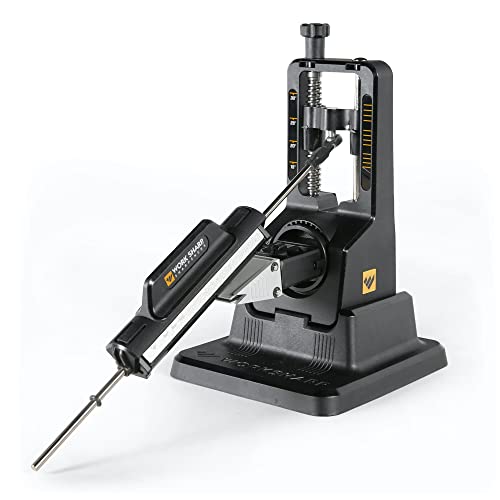 Work Sharp Precision Adjust Knife Sharpener KitCompact6.5 x 9.6 x 5.61 inches0.5 poundsCheck on Amazon
 Lansky Deluxe Knife Sharpening System: 5-Stone Ceramic Knife1 Pack10.25 x 9.75 x 1.5 Inches1.1 PoundsCheck on Amazon

As an Amazon Associate, I earn from qualifying purchases made through links on this page, at no extra cost to you.
A dull knife is not just annoying, it is the most dangerous tool in the kitchen. It skates across tomato skins, crushes herbs instead of slicing them, and forces you to push harder on every cut, which is when slips happen. A complete knife sharpening kit solves the problem at home by giving you every stage of edge care in one box: a coarse abrasive to repair and reshape, a medium stage to build the edge, a fine stage to refine it, and a honing or stropping step to keep it aligned between full sharpening sessions.
The kits in this guide cover the three main sharpening families. Guided systems clamp the blade and hold the angle for you, removing the guesswork that puts most beginners off. Whetstone kits ask more of your hands but reward you with the finest edges and full control over the bevel. Powered belt kits trade a little finesse for serious speed, restoring neglected edges in minutes. All five picks include multiple abrasives and the accessories to use them, so each can serve as a complete edge care station. Read the buying guide first, then match a kit to your knives and the way you like to work.
How to Choose a Knife Sharpening Kit
Match the system to your skill level
Guided clamp systems such as the Work Sharp Precision Adjust and the Lansky hold the blade at a fixed angle while you move the abrasive, so consistent results come quickly. Freehand whetstones demand practice: you hold the angle yourself through every stroke, and early edges may look uneven while muscle memory develops. Belt sharpeners sit in between, because the guide sets the angle but you control the speed of each pass. If you want sharp knives tonight with no learning curve, choose a guided or powered kit. If you enjoy process and want the keenest edge, choose stones.
Understand the grit progression
Complete edge care means working through grits in order. Coarse abrasives, 120 to 400 grit, remove metal quickly to fix chips, rolls, and badly blunted edges. Medium abrasives from 600 to 1,000 grit do the everyday sharpening work and set the working bevel. Fine abrasives from 3,000 to 8,000 grit refine and polish, pushing the edge from sharp to keen. A kit that starts too fine will polish a dull edge without ever making it sharp, so check that any set starts coarse enough for your knives. Diamond plates cut fast and stay flat, ceramic hones feel smooth and wear slowly, and water stones give the finest finish but need soaking and periodic flattening.
Get the angle right for your knives
Most Western kitchen knives are ground near 20 degrees per side, many Japanese knives sit closer to 15 degrees, and heavy outdoor blades run 25 to 30 degrees. A kit with adjustable angles, or a set of guide slots covering that range, lets one station service the whole knife block. Angle consistency matters more than the exact number: a steady 20 degrees beats a wobbling 15, which is why guided systems score so well for beginners.
Check what else is in the box
The extras decide whether a kit is truly complete. Look for a flattening stone with water stone sets, since a dished stone cannot produce a flat bevel. A leather strop with polishing compound removes the last wire edge and stretches the time between sessions. Cut resistant gloves, a stable base, and a storage case make sessions safer and tidier. Finally, confirm the kit handles your blade types: serrated edges need a tapered rod or narrow belt, scissors need an open design or guide, and long chef knives need room to travel.
The 5 Best Knife Sharpening Kits
1. Work Sharp Precision Adjust Knife Sharpener Kit
Specs
- Guided clamp system with angle adjustment from 15 to 30 degrees in 1-degree steps; Tri-Brasive sharpening rod with coarse diamond plates (220, 320, 600 grit), medium diamond plates (400, 600, 800 grit), and a fine ceramic hone; ceramic rod for serrated edges; V-block clamp; model WSBCHPAJ.
The Precision Adjust is our pick for guided results without power cords. The knife locks into the V-block clamp, the sharpening frame pivots smoothly, and the abrasive rod swaps faces with a twist, so you can walk an edge from a 220 grit repair to a polished ceramic finish. Because the angle dials in one-degree increments, the same station handles a 15-degree Japanese gyuto and a 25-degree outdoor blade with equal confidence, and the small footprint stores in a drawer.
Pros:
– Precise angle control in 1-degree increments from 15 to 30 degrees
– Full grit progression from coarse repair to fine ceramic honing
– Dedicated ceramic rod keeps serrated edges in the same routine
– Compact, quiet, and easy to store
Cons:
– Manual strokes are slower than a powered belt on badly damaged edges
– Clamp can flex slightly with very long or thick blades
2. KERYE Professional Japanese Whetstone Sharpener Stone Set

Specs
- Two double-sided water stones covering 400/1000 and 3000/8000 grit; white corundum abrasive; bamboo base with non-slip footing; flattening stone; angle guide and chisel honing guide; leather strop; cut resistant gloves; model KY29.
The KERYE set is the most complete freehand package in this roundup. Four working grits across two stones take a knife from chipped and dull to a mirror-polished 8,000 grit finish, and every support tool a stone user needs is in the box: the flattening stone keeps surfaces true, the angle guide helps beginners find the bevel, the honing guide extends the kit to chisels, and the leather strop delivers that final, clean bite. The gloves are a thoughtful touch for new sharpeners. Stones this capable reward patience, and the first sessions will feel slow, but the edges at the end of the learning curve are the finest in this guide.
Pros:
– Four-grit progression from 400 repair work to 8,000 grit polish
– Flattening stone, strop, guides, and gloves all included
– Water stones produce an exceptionally refined, smooth edge
– Also sharpens chisels and other workshop blades
Cons:
– Steepest learning curve of the five kits
– Stones need soaking before use and flattening over time
3. Sharp Pebble Premium Whetstone Knife Sharpening Stone, 1000/6000 Grit
Specs
- Single double-sided water stone with 1000 and 6000 grit faces; aluminum oxide corundum abrasive; stone measures about 7.25 x 2.25 x 1 inches and weighs about 2.1 pounds; non-slip bamboo base with silicone insert; clip-on angle guide; instruction manual and tips ebook included.
Sharp Pebble trims the whetstone idea down to the two grits most home cooks actually use. The 1,000 grit face restores a working edge on dull kitchen knives, and the 6,000 grit face polishes it to a clean, paper-slicing finish. For knives maintained regularly rather than rescued from neglect, that pairing is enough, and the generous stone size gives long chef knives room to travel. The bamboo base grips the counter well, and the angle guide clips on to steady your first sessions. There is no coarse face for chips and no strop in the box, so add a separate repair stone later if your knives live a hard life.
Pros:
– The two most useful grits for routine kitchen knife care
– Large stone surface suits long chef knives
– Stable bamboo base and a helpful angle guide for beginners
– Simple kit with very little to store or maintain
Cons:
– No coarse grit for repairing chips or heavy damage
– No flattening stone or leather strop included
4. Lansky Deluxe 5-Stone Sharpening System (LKCLX)
Specs
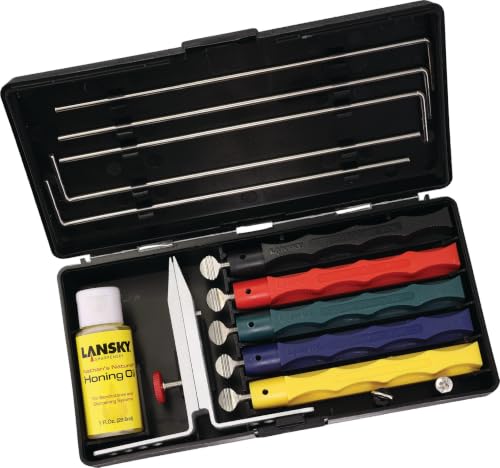
- Five alumina ceramic hones in 70 (extra coarse), 120 (coarse), 280 (medium), 600 (fine), and 1000 (ultra fine) grit; controlled-angle clamp with 17, 20, 25, and 30 degree guide holes; color-coded guide rods; honing oil; molded storage and carrying case; weighs about 1.1 pounds.
The Lansky Deluxe is the classic clamp-and-rod system, refined over decades, and still the benchmark for controlled-angle sharpening. The blade clamps once, the guide rod locks the hone to your chosen angle, and you work through the five stones from extra coarse to ultra fine. That 70 grit hone is an edge saver, able to re-profile a rolled or chipped edge that finer kits would take forever to fix. The whole outfit packs into its case at just over a pound, handy for a camp kitchen or workshop drawer as much as the home knife block. Setup takes a few minutes per knife, so it suits deliberate sessions more than a quick touch-up before dinner.
Pros:
– Five stones including a true extra coarse repair grit
– Four precise angles cover kitchen, fillet, and outdoor knives
– Complete kit with oil and a fitted storage case
– Lightweight and portable at about 1.1 pounds
Cons:
– Clamping and setup add time to every session
– Small hones mean more strokes on long blades
5. Work Sharp Knife and Tool Sharpener, Ken Onion Edition (WSKTS-KO)
Specs
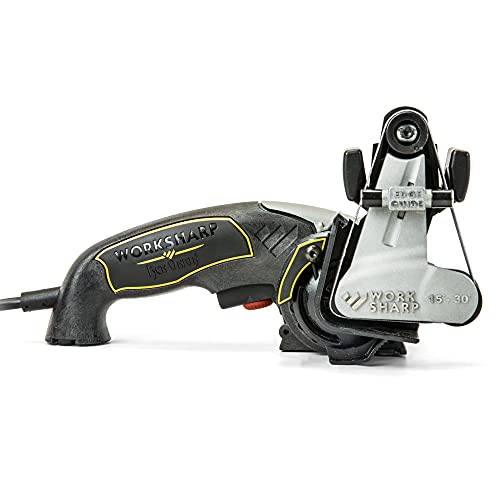
- Electric belt sharpener with variable speed motor from 1,200 to 2,800 surface feet per minute; adjustable sharpening guide from 15 to 30 degrees; five flexible abrasive belts sized 3/4 x 12 inches in P120 extra coarse, X65 coarse, X22 medium, X4 fine, and 6000 extra fine (6000 belt is 1/2 inch wide); sharpens kitchen, pocket, hunting, and serrated knives plus scissors and tools; model WSKTS-KO.
When a drawer holds a dozen neglected blades, the Ken Onion Edition is the fastest route back to a sharp kitchen. The powered belts do in a few passes what stones do in a few hundred strokes, and the variable speed plus adjustable guide keep that speed civilized: slow the belt and narrow the angle for a fine Japanese blade, or open everything up for a workhorse outdoor knife. The flexible belts wrap slightly around the edge, leaving a durable convex bevel, and the narrow extra fine belt reaches into serrations that flat stones cannot touch. Belts wear out and need replacing, but for volume sharpening nothing else here comes close.
Pros:
– Restores very dull edges in minutes rather than sessions
– Adjustable 15 to 30 degree guide with variable belt speed
– Handles serrated knives, scissors, and tools as well as plain edges
– Convex edge profile is durable for heavy daily use
Cons:
– Belts wear out and must be replaced over time
– Motor noise and dust make it a bench tool, not a countertop one
Frequently Asked Questions
What grit progression does a complete knife sharpening kit need?
A complete kit should cover three stages: a coarse stage around 120 to 400 grit for repairing chips and reshaping dull edges, a medium stage around 600 to 1,000 grit for everyday sharpening, and a fine stage from 3,000 grit upward for refining and polishing. A leather strop or fine ceramic hone on top handles the light maintenance that keeps an edge keen between sessions.
Are guided sharpening systems better than whetstones for beginners?
For most beginners, yes. A guided system clamps the blade and holds the angle steady, so the first knife you sharpen comes out well. Whetstones can ultimately produce a finer edge and work on any blade shape, but they ask you to hold a consistent angle by hand, which takes several practice sessions to learn. Many cooks start with a guided kit and add a stone later.
Can one sharpening kit handle serrated knives and scissors too?
Some can. Serrated edges need a tapered ceramic rod or a narrow flexible belt that fits between the teeth, which the Work Sharp kits provide. Scissors need a sharpener whose guides or open frame let the blades pass at their factory angle, something the Ken Onion Edition and open stone work can manage. Standard flat stones and most clamp systems are best kept for plain edges.
How often should I sharpen my kitchen knives with a kit?
For a home cook who uses a chef knife daily, a full sharpening session every two to four months is typical, with light honing or stropping every few uses in between. The real trigger is performance rather than the calendar: when a knife crushes tomato skins or slips on onion skin instead of biting in cleanly, it is time to bring out the kit.
Conclusion
Complete edge care is three habits in one box: repair with a coarse abrasive, sharpen with a medium one, and maintain with a fine hone or strop. The Work Sharp Precision Adjust is our top pick for most kitchens because it guides every stage with precise, repeatable angles. Choose the KERYE set for the full traditional stone experience, the Sharp Pebble for simple two-grit upkeep, the Lansky Deluxe for portable controlled-angle work, or the Ken Onion Edition when speed matters most. Match the kit to how you like to work, and your knives will stay ready for every meal.
More from Amazon
Programs that pair well with the guide above. Offers and eligibility are set by Amazon and may change.
Collect the home and kitchen items you want in one registry that guests can shop from.
Create a wedding registrySet up recurring deliveries of everyday items on eligible products. Terms and savings are set by Amazon.
Explore Subscribe & SaveFree shipping on eligible items, Prime Video and more. Eligible new members can start with a free trial.
Start a Prime free trialAudiobooks and podcasts to listen to on the go. Eligible new members can start with a free trial.
Try Audible freeAs an Amazon Associate we earn from qualifying purchases.


Write Your Review
No reviews yet. Be the first to share your experience!