

Key takeaways
- Find the best measuring cups for precise baking and everyday cooking, from glass liquid cups to stainless dry sets with clear, easy-to-read markings.
As an Amazon Associate, we earn from qualifying purchases made through links on this page, at no extra cost to you.
Ask a pastry chef why a cake sank or a sauce broke, and the answer is rarely the oven. More often, it is the measuring. Baking is chemistry you can eat, and chemistry punishes guesswork: a few extra tablespoons of flour turn a tender crumb dense, while too little liquid leaves a batter that never comes together. Everyday cooking is more forgiving, but even a weeknight soup tastes better when the proportions are right.
The trouble is that not all measuring cups measure the same way. Liquid cups and dry cups are built differently for a reason. A liquid measure has a spout, headroom above the top marking so nothing sloshes out, and graduations you read at eye level. A dry measure is a scoop-shaped cup you fill to the brim and level off with a straight edge, the only reliable way to portion flour, sugar, and cocoa.
In this guide we compare five well-made options that cover both sides of the job: classic glass liquid cups, an angled cup you can read from above, a stainless steel dry set with spoons, a colorful nesting set for small kitchens, and a sturdy American-made glass trio. Each was chosen for legible markings, sensible capacity, and materials that hold up to daily use.
How to Choose the Right Measuring Cups
Start with the liquid-versus-dry distinction. If you bake often, you need both types. Liquid cups handle water, milk, oil, and melted butter; dry cups handle flour and other scoopable ingredients. A kitchen with only one style will always be compromising somewhere.
Match the material to the job. Glass is the classic liquid-cup material: non-porous, resistant to stains and odors, and able to go in the microwave to melt butter or warm milk right in the cup. Stainless steel is the best choice for dry cups: it does not bend at the rim, so your leveling sweep stays true, and engraved markings never fade. Plastic is light and inexpensive, and fine for dry goods, but printed markings can wear over years of dishwashing.
Readability matters more than capacity. Look for markings in more than one unit — cups, ounces, and milliliters cover nearly every recipe — in a contrasting color, with lines for in-between amounts like one-third and two-thirds of a cup. Angled interior markings you can read from above save the crouch to counter level.
Check the details. A dry cup should have a flat, stable base and a rim that stays level. A liquid cup should have a spout that pours in a clean stream rather than dribbling down the side, and a handle that stays comfortable when full and heavy. Nesting designs earn their keep in small drawers, and dishwasher safety keeps the set in rotation.
Think about the sizes you actually use. For liquids, a 2-cup cup handles most recipes, with a 1-cup for small amounts and a 4-cup for batches. For dry goods, a set running from one-quarter cup to one full cup, ideally including the one-third and two-thirds sizes, covers nearly everything without mid-recipe math.
The 5 Best Measuring Cups
1. Pyrex Essentials Glass Measuring Cups, 3-Pack (1, 2 & 4 Cup)
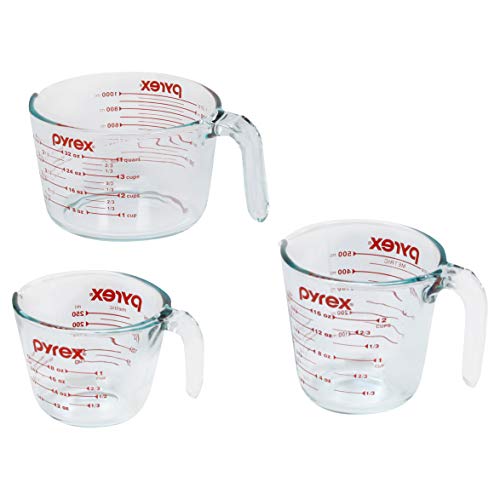
- Specs: Tempered glass; includes 1-cup, 2-cup, and 4-cup liquid measuring cups; red markings in ounces and milliliters; easy-grip handles and curved pouring spouts; microwave, freezer, preheated oven, and dishwasher safe
If you buy one liquid measuring set and keep it for decades, this is the shape it will take. The Pyrex Essentials trio covers the three capacities home cooks reach for most, from a cup of milk to a full quart of batter. The thick glass feels substantial without being clumsy, and the red graduations are bold enough to read quickly while a pot comes to a boil across the stove. Because the glass is non-porous, yesterday’s garlic-infused oil leaves no trace in today’s pancake batter, and you can melt butter or chocolate directly in the cup in the microwave instead of dirtying a second pan.
The curved spout pours in a controlled stream, and the handle stays grippable even with oven mitts on. The 4-cup size doubles as a small mixing bowl for wet ingredients, streamlining recipes that whisk eggs, milk, and vanilla together before they meet the flour.
Pros:
– Three essential sizes cover nearly every recipe
– Bold red markings in ounces and milliliters are easy to read
– Microwave safe for melting and warming in the cup
– Non-porous glass never holds stains or odors
Cons:
– Glass can chip or break if dropped on tile
– Heavier than plastic when the 4-cup cup is full
2. OXO Good Grips 2-Cup Angled Measuring Cup

- Specs: BPA-free plastic; 2-cup (500 ml) capacity; patented angled interior surface lets you read measurements from above; markings in cups, ounces, and milliliters; soft, non-slip handle; dishwasher safe
The OXO angled cup solves the oldest annoyance in measuring liquids: the crouch. Instead of bending down to read the meniscus at eye level, you look straight down into the cup, where a slanted interior ramp carries its own markings that stay readable from above. It sounds minor until you are measuring hot stock for the third time in one recipe and realize you have not hunched over the counter once.
The 2-cup capacity is the sweet spot for everyday cooking — big enough for most sauces, batters, and marinades, small enough to handle precisely. The soft handle is comfortable when the cup is full, and the spout pours cleanly without the dribble that runs down cheaper cups. The plastic body shrugs off drops that would end a glass cup, a smart trait for busy households and anyone cooking with kids at the counter.
Pros:
– Angled surface allows accurate readings from above
– Lightweight and drop-resistant
– Comfortable non-slip handle, even when full
– Markings in cups, ounces, and milliliters
Cons:
– Only one size, so large batches need refills
– Plastic should not be used for very hot liquids straight off a rolling boil
3. Simply Gourmet Measuring Cups and Spoons Set of 12, Stainless Steel

- Specs: 304 stainless steel; six dry cups (1/4, 1/3, 1/2, 2/3, 3/4, and 1 cup) plus six measuring spoons (1/8 tsp to 1 Tbsp); engraved US and metric markings; stackable nesting design with long handles; dishwasher safe
For dry ingredients, stainless steel is the professional standard, and this Simply Gourmet set shows why. The rims stay perfectly round and level year after year, so when you sweep a knife across a cup of flour you get a true measure instead of a heaped guess. The markings are engraved rather than printed, so they cannot fade, peel, or wash away — a real advantage over painted plastic sets that go illegible in the dishwasher.
The size range is the other highlight. Including the often-skipped one-third and two-thirds cups means you can measure a recipe’s exact calls in a single scoop, and the matching spoons run from an eighth teaspoon up to a full tablespoon. Everything nests into one tidy stack, and the long handles reach into narrow canisters and spice jars without dragging your knuckles through the contents.
Pros:
– Engraved markings will never fade or wash off
– Six cup sizes including 1/3 and 2/3 for exact measures
– Rigid rims give accurate level-off measuring for flour
– Cups and spoons nest into one compact stack
Cons:
– Not suited to liquids, which need a spouted cup
– Metal handles are less cushioned than soft-grip styles
4. KitchenAid Universal Measuring Cup and Spoon Set, 9-Piece

- Specs: Durable plastic in Pistachio; four measuring cups (1/4, 1/3, 1/2, and 1 cup) and five measuring spoons (1/4 tsp, 1/2 tsp, 1 tsp, 1/2 Tbsp, and 1 Tbsp); easy-read markings; soft-grip handles; nesting design with hang hole; dishwasher safe
This KitchenAid set is the friendly all-rounder for kitchens that measure dry goods and small amounts more than big batches. The cups and spoons nest together and hang from a single hole, so the set lives on one hook or in one slim drawer slot — no more hunting for the half teaspoon in a cluttered utensil crock. The soft-grip handles are easy on the hands, and flat bases let a filled cup sit steady while you level it.
The markings are printed large and clear, and the cup range includes the one-third size that many budget sets skip. Because the pieces are plastic, they are light and quiet — no clanking against mixing bowls — and forgiving for younger bakers learning their way around a recipe.
Pros:
– Cups and spoons together in one nesting, hangable set
– Includes the useful 1/3 cup size
– Soft-grip handles and stable flat bases
– Lightweight and quiet against bowls and counters
Cons:
– Plastic markings can fade over many years of washing
– Largest cup is 1 cup, so big liquid volumes need a separate cup
5. Anchor Hocking Glass Measuring Cups, 3-Piece Set (1, 2 & 4 Cup)

- Specs: Glass; includes 1-cup, 2-cup, and 4-cup liquid measuring cups; markings in ounces, cups, milliliters, and liters; open handles for easy grip and pouring; microwave, preheated oven, refrigerator, and dishwasher safe; made in the USA
Anchor Hocking has been making glassware in the United States since 1905, and this trio carries that workmanlike heritage. The cups are sturdy, the handles are open and easy to grab, and the measurement scales are the most complete in this roundup: ounces, cups, milliliters, and liters all appear, genuinely useful when you cook from international recipes that jump between systems. The spout pours cleanly, and the glass handles everything from melting butter in the microwave to chilling a marinade in the fridge.
Like the Pyrex set, these cups double as small prep bowls, and their classic look sits comfortably on an open shelf. If you like buying kitchen staples once and keeping them, this is a set that gets handed down rather than replaced.
Pros:
– Four measurement scales including liters for metric recipes
– Sturdy glass made in the USA
– Open handles are easy to grip and pour from
– Safe for microwave, oven, fridge, and dishwasher
Cons:
– Glass requires the usual care against drops and hard knocks
– Three liquid cups only — dry ingredients still need a scoop set
Frequently Asked Questions
Can I use a liquid measuring cup for flour?
You can, but your results will suffer. Flour in a liquid cup cannot be leveled off properly, and dipping the cup into the bag packs the flour down, adding a surprising amount of extra flour to a recipe. For accuracy, spoon flour into a dry cup and level it with a straight edge; save the spouted glass cup for water, milk, and oil, where you read the level at the markings.
Why do my baked goods come out differently every time?
Inconsistent measuring is the most common cause. Small habits — scooping flour straight from the bag, eyeballing liquids from above instead of at the markings, or using a heaped cup instead of a level one — compound into big differences in hydration. Use the right cup for each ingredient and the same technique every time, and most of that variation disappears.
Is glass or stainless steel better for measuring cups?
Each wins at a different job. Glass is better for liquids because you can see the level through the side, and it tolerates microwave heat for melting and warming. Stainless steel is better for dry ingredients because its rigid rim levels cleanly and engraved markings never fade. Most well-equipped kitchens keep both, which is why this guide includes a glass set and a steel set.
How do I read a liquid measurement accurately?
Set the cup on a flat counter, pour, then check the level with the liquid settled — either by crouching to eye level with a standard cup or by looking down at the angled markings of a top-reading design. Always read the bottom of the meniscus, the slight curve at the liquid’s surface, rather than the edges where it climbs the glass.
Conclusion
Accurate measuring is the cheapest skill upgrade in cooking: it costs nothing but a little attention, and the right cups make that attention easy. If you start with one purchase, make it a glass liquid trio like the Pyrex Essentials or Anchor Hocking set, then add the Simply Gourmet stainless set for flour and dry goods — together they cover nearly every recipe you will ever cook. Prefer a single clever cup for daily sauces and batters? The OXO angled design earns its drawer space. Outfitting a first kitchen, the KitchenAid nesting set keeps cups and spoons in one tidy bundle. Whichever you choose, measure with the right tool, level with care, and your baking will reward you with the same good result every time.
More from Amazon
Programs that pair well with the guide above. Offers and eligibility are set by Amazon and may change.
Collect the home and kitchen items you want in one registry that guests can shop from.
Create a wedding registrySet up recurring deliveries of everyday items on eligible products. Terms and savings are set by Amazon.
Explore Subscribe & SaveFree shipping on eligible items, Prime Video and more. Eligible new members can start with a free trial.
Start a Prime free trialAudiobooks and podcasts to listen to on the go. Eligible new members can start with a free trial.
Try Audible freeAs an Amazon Associate we earn from qualifying purchases.

Write Your Review
No reviews yet. Be the first to share your experience!