

Key takeaways
- Compare the best milk frothing pitchers for latte art, from the fluted Fellow Eddy to the Italian Motta Europa, with capacity, spout and steel specs.
The best milk frothing pitcher for most home espresso setups is the Rattleware 20-Ounce Macchiato Pitcher: a stainless steel jug with a drip-resistant spout, enough room to steam milk for two lattes in one round, and a place in the budget tier that has made it a standard training pitcher in coffee bars. If latte art precision matters more than capacity, the Fellow Eddy pairs a fluted spout and a sharp front crease with a tapered body that keeps milk rolling evenly. Below, five steaming pitchers are compared on the published specs that matter most: capacity, spout shape, steel gauge, markings, and grip.
As an Amazon Associate, we earn from qualifying purchases.
Table of Contents
- What Is a Milk Frothing Pitcher?
- How to Choose a Milk Frothing Pitcher
- Rattleware Macchiato Milk Frothing Pitcher, 20 oz
- Fellow Eddy Steaming Pitcher, 12 oz, Graphite
- Motta Europa Professional Milk Pitcher, 17 oz
- Breville Temp Control Milk Jug BES003XL, 16 oz
- Normcore Handleless Milk Pitcher, 15.2 oz, Black
- Pitcher Care Tips
- Frequently Asked Questions
- Conclusion
- Product and ASIN Reference
What Is a Milk Frothing Pitcher?
A milk frothing pitcher, also called a steaming pitcher or milk jug, is the stainless steel vessel a barista uses with an espresso machine steam wand. Cold milk goes in, the wand tip stretches and spins it into a whirlpool, and the result is microfoam: milk with bubbles so fine it pours like wet paint and holds a rosetta or tulip on the surface of a latte. The pitcher is not a frother in itself. Electric frothers heat and whip milk on their own, and handheld wands foam milk in a mug, but a steaming pitcher is a passive tool whose shape does quiet work: the bellied body encourages the vortex, the spout meters the pour, and the steel wall passes heat to the palm, which is why the oldest milk thermometer in any café is a bare hand.
Because steaming expands the milk as foam forms, pitchers are filled only a third to halfway. A 12-ounce pitcher is a one-drink tool, a 20-ounce pitcher covers two drinks, and anything larger belongs to cafes and big households. All five picks below are steam-wand pitchers in stainless steel; electric frothing jugs are a separate appliance category and are not covered here.
How to Choose a Milk Frothing Pitcher
Size the pitcher to the drinks you steam
Match capacity to the milk volume of a single round. A cappuccino or flat white starts with about four to six ounces of cold milk, so a 12-ounce pitcher leaves the headroom steaming needs without wasting milk. Two lattes at once call for a 17- to 20-ounce jug. Oversizing is the common beginner mistake: a small amount of milk in a big pitcher will not roll into a vortex, and the foam comes out bubbly instead of glossy. Households steaming one drink at a time should take the smaller jugs here.
Spout shape decides the pour
The spout is where latte art is won or lost. A classic pointed or tapered spout, like the Rattleware design, gives a forgiving, general-purpose stream that suits hearts and simple tulips. A fluted spout with a crease running down the body, the Fellow Eddy approach, channels milk forward in a narrower, steadier ribbon for finer lines and more detailed patterns. Round spouts pour a softer, wider stream that some baristas prefer for larger base patterns. None of these shapes steams milk better than the others; they only change what happens after the wand comes out.
Steel gauge and markings
Wall thickness changes how the pitcher feels in use. Thinner steel passes heat to the hand quickly, which gives fast temperature feedback but a shorter window before the jug feels hot. A 1-millimeter wall, used by the Normcore pitcher here, slows that transfer and stretches texturing time, which newer steamers often find easier to manage. Interior measurement markings reduce milk waste by making the fill level repeatable, and one pick, the Breville Temp Control Jug, goes further with an indicator strip on the outside wall that shows milk temperature as it climbs, so no separate clip-on thermometer is needed.
Handle, handleless, and finish
A conventional handle keeps fingers off hot steel and suits a relaxed grip at arm’s length from the wand. Handleless pitchers wrap the body in a heat-resistant sleeve and put the hand closer to the center of balance, which many pourers find steadier for slow, detailed work; the trade-off is that the sleeve models are usually hand wash only. Finishes are the last consideration: polished steel shows every fingerprint but hides nothing, while coated finishes such as graphite and matte black wipe clean easily and match darker machine setups.
Rattleware Macchiato Milk Frothing Pitcher, 20 oz

The Rattleware 20-ounce pitcher is the café workhorse of this guide and the easiest recommendation for a first or only steaming jug. Its tapered, drip-resistant spout pours a controlled stream that forgives an imperfect angle, which is exactly what learning microfoam requires, and the 20-ounce body steams enough milk for two lattes or one large drink in a single round. Rattleware supplies professional coffee bars, and this pitcher carries that plain, durable brief: stainless steel, a rolled rim, and no features that do not earn their place. It sits in the budget tier.
There are no interior measurement markings, so consistent fills come from repetition or a scale, and the bare steel handle passes heat as the milk climbs. Those are honest trade-offs at this tier. The same line also comes in 12-ounce and 32-ounce sizes, but the 20-ounce is the versatile middle: big enough for two drinks, small enough that a single latte still rolls into a proper vortex. Choose it if the goal is a proven everyday pitcher for a home machine and the budget matters more than specialty pour geometry.
Specs
- Capacity: 20 fl oz
- Material: stainless steel
- Spout: tapered, drip-resistant
- Model: 07010
- Item weight: 8 oz
- Sizes in the line: 12, 20, and 32 oz
Fellow Eddy Steaming Pitcher, 12 oz, Graphite
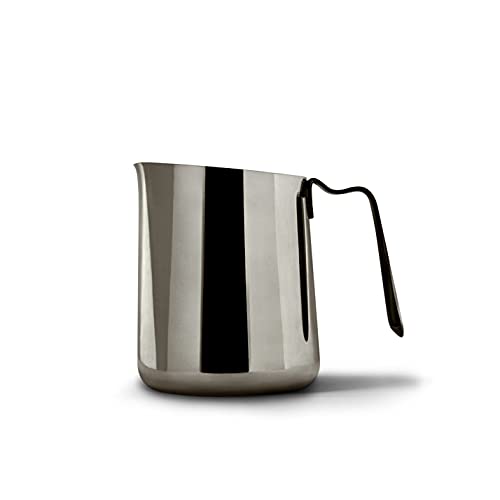
The Fellow Eddy is the precision instrument of the group, built around pour control rather than capacity. Its fluted spout and the sharp front crease that runs the length of the body move milk forward in one continuous ribbon, and the tapered body is shaped to spin milk consistently while steaming. The ribbon handle is designed to accommodate different grips, from a loose hold to a pen-style grasp for detailed patterns. In 18/8 stainless steel with a graphite finish, it is a premium-tier pitcher aimed squarely at drinkers who pour latte art every day and want the jug to stop being the limiting factor.
The 12-ounce size is a single-drink tool: it suits one cappuccino or flat white at a time, with internal measurement markings up to 10 ounces to keep fills repeatable. An 18-ounce version exists in the same line for two-drink rounds. The graphite finish wipes clean and hides water spots that polished steel shows. Choose the Eddy if the drinks are already consistent and the remaining project is sharper lines, cleaner contrast, and patterns that need a narrow, steady stream from the first tilt to the pull-through.
Specs
- Capacity: 12 oz (350 ml)
- Material: 18/8 stainless steel
- Finish: graphite
- Spout: fluted, with a sharp front crease
- Handle: ribbon handle
- Markings: internal measurements up to 10 oz
- Model: Eddy Pitcher 350 ml, graphite
Motta Europa Professional Milk Pitcher, 17 oz

The Motta Europa is the Italian classic: a professional pitcher made in Italy by Metallurgica Motta, a maker whose frothing pitchers have been bar standards in European cafés for decades. The body is 18/10 stainless steel, a grade chosen for corrosion resistance and a bright polish, and the spout is shaped for the drip-free pouring that the Europa line is known for. At 17 fluid ounces (500 ml), it covers one large latte or two small cappuccinos, and it sits in the premium tier on the strength of materials and manufacture rather than added features.
The Europa keeps the traditional formula: a cylindrical body, a modest spout, and thinner walls that give clear heat feedback to the palm, which experienced steamers often prefer. The range runs from 350 ml up to large café sizes, with this 500 ml version the natural home pick. There are no measurement markings and no thermometer, so it rewards an owner who steams by feel. Choose it if a long-lived, single-purpose tool from a specialist maker appeals more than modern pour geometry or coatings.
Specs
- Capacity: 17 fl oz (500 ml)
- Material: 18/10 stainless steel
- Origin: made in Italy
- Spout: shaped for drip-free pouring
- Model: 00901/04
- Sizes in the line: 350 ml, 500 ml, 750 ml and above
Breville Temp Control Milk Jug BES003XL, 16 oz

The Breville Temp Control Milk Jug solves the most common beginner problem, not knowing when to stop steaming, with an integrated thermometer indicator strip on the outside wall. The strip shows temperature markings in Fahrenheit and Celsius across the working range, so the point where milk turns sweet and glossy, before it scalds, is visible on the jug itself instead of living on a separate clip-on thermometer that has to be found, clipped, and read at an angle. Breville builds the jug from thick-gauge stainless steel with a spout designed for pouring latte art, and at 16 ounces it is sized for one generous latte or two smaller drinks. It sits in the mid-range tier.
As an official Breville accessory, it pairs naturally with that maker’s espresso machines, though it works with any steam wand. The capacity is the main boundary: households steaming for a crowd will refill often, and practiced baristas who already read temperature by hand may find the strip redundant. For everyone still learning, it replaces guesswork with a number. Choose it if consistent milk temperature is the weak point in the drinks and a built-in gauge sounds better than another loose thermometer in the drawer.
Specs
- Capacity: 16 fl oz (480 ml)
- Material: thick-gauge stainless steel
- Thermometer: integrated indicator strip on the wall
- Temperature markings: Fahrenheit and Celsius scales
- Model: BES003XL
- Spout: shaped for pouring latte art
Normcore Handleless Milk Pitcher, 15.2 oz, Black
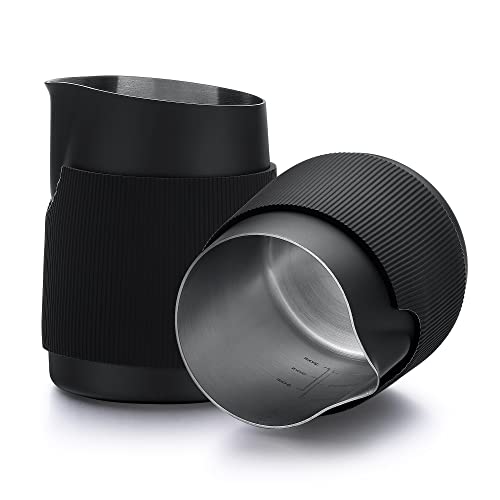
The Normcore Handleless Milk Pitcher removes the handle entirely and replaces it with a heat-resistant silicone grip wrapped around the body. Holding the jug itself, closer to its center of balance, gives the pour a steadier feel for slow patterns, and the exposed base still lets a free hand check milk temperature against the steel. The body is 1-millimeter-thick 18/8 stainless steel under a black non-stick finish, with a round spout that pours a soft, wide stream suited to building the base of a pattern before the detail work. It sits in the mid-range tier and is the modern, café-style option in this guide.
The round spout is less surgical than the Fellow Eddy’s fluted design, so the finest line work is harder here; the Normcore counters with control and comfort over long practice sessions. Capacity is 15.2 ounces (450 ml), right for one large drink or two small ones, and the listing marks the pitcher as hand wash, which is typical for coated, sleeved designs. A sharp-spout version and a larger 20.3-ounce size exist in the same line. Choose the handleless Normcore if grip comfort and balance are the priorities and the pour style leans toward bold, high-contrast patterns rather than fine detail.
Specs
- Capacity: 15.2 oz (450 ml)
- Material: 1 mm thick 18/8 stainless steel
- Finish: black non-stick coating
- Grip: handleless, heat-resistant silicone sleeve
- Spout: round spout
- Care: hand wash
- Dimensions: 3.4 x 4.3 in
Pitcher Care Tips
Milk leaves residue fast, so rinse the pitcher with hot water as soon as the drink is poured, before the milk film dries onto the steel; a dried film bakes on further with every steam cycle and eventually flavors fresh milk. For buildup, a soak in hot water with a milk-line cleaner or a paste of baking soda restores the surface, and steel wool should stay away from coated finishes like graphite and matte black, which scratch. Handleless sleeves and non-stick coatings last longer with hand washing and a soft sponge, while plain polished steel tolerates the dishwasher, though hand drying prevents water spots. Store pitchers dry and unstacked where possible, since a dent near the spout changes the pour.
Frequently Asked Questions
What size milk frothing pitcher should I buy?
Buy for the milk volume of one steaming round, not the finished drink. A 12-ounce pitcher suits a single cappuccino or flat white, a 15- to 17-ounce pitcher covers one large latte, and a 20-ounce pitcher steams for two drinks at once. Pitchers are filled only a third to halfway before steaming, so the right size is roughly double the cold milk a round starts with.
What is the difference between a frothing pitcher and an electric milk frother?
A frothing pitcher is a passive stainless jug used with an espresso machine steam wand; the wand supplies the heat and the motion, and the pitcher shapes the result. An electric milk frother is a countertop appliance that heats and foams milk on its own, with no wand involved. The pitcher route gives finer control over texture and temperature, which is why it is the standard for latte art.
Does spout shape really matter for latte art?
Yes, at the pouring stage. A pointed or fluted spout lays down a narrow stream for fine lines and detailed patterns, while a round spout pours wider and softer, which suits big base shapes. Spout shape does not change how the milk steams, so a beginner can learn microfoam in any of these jugs; the differences show up once the patterns themselves become the project.
How full should I fill a steaming pitcher?
Fill to just below the base of the spout, which usually means a third to half of the pitcher’s stated capacity. Milk expands as air is incorporated and climbs as it heats, so an overfilled jug spills and textures unevenly. An underfilled jug will not form a whirlpool. Interior measurement markings, or a marked fill line learned by repetition, keep the level consistent from drink to drink.
Conclusion
For most home espresso setups, the Rattleware 20-ounce pitcher is the right first jug: a durable café standard in the budget tier with room for two drinks. The Fellow Eddy is the upgrade for pour precision, the Motta Europa is the long-lived Italian classic in 18/10 steel, the Breville Temp Control Jug removes temperature guesswork for learners, and the Normcore Handleless trades a handle for balance and grip comfort. Match the size to a single steaming round, pick the spout for the patterns being poured, and any of the five will steam milk better than the measuring cup it replaces.
More from Amazon
Programs that pair well with the guide above. Offers and eligibility are set by Amazon and may change.
Collect the home and kitchen items you want in one registry that guests can shop from.
Create a wedding registrySet up recurring deliveries of everyday items on eligible products. Terms and savings are set by Amazon.
Explore Subscribe & SaveFree shipping on eligible items, Prime Video and more. Eligible new members can start with a free trial.
Start a Prime free trialAudiobooks and podcasts to listen to on the go. Eligible new members can start with a free trial.
Try Audible freeAs an Amazon Associate we earn from qualifying purchases.









Write Your Review
No reviews yet. Be the first to share your experience!