

Key takeaways
- Compare the best vacuum storage bags for fresh food storage, from precut quart bags to custom rolls and chamber pouches, with sizes and counts explained.
As an Amazon Associate, we earn from qualifying purchases made through links on this page. This helps support our work at no extra cost to you.
Vacuum storage bags are the quiet workhorses behind a well-run kitchen. By pulling air out before sealing, they slow oxidation, hold back freezer burn, and keep fresh food tasting like food instead of like the inside of a freezer. For households that buy meat in bulk, meal prep on Sundays, or cook sous vide, the right bags turn a vacuum sealer from a gadget into a money-saving system.
The catch is that not all vacuum bags are interchangeable. Suction-style sealers, the common countertop clamp machines, need textured bags with embossed air channels so the machine can draw air out. Chamber sealers use smooth, flat pouches instead, and mixing the two types up is the most common reason a seal fails. Within each family you choose between precut bags, which are fast and consistent, and rolls, which let you cut exactly the length you need.
This guide compares five options for fresh food storage: two precut picks for portions, two roll options for custom lengths, and a chamber pouch set. Each entry lists the format, sizes, and material so you can match the bag to your sealer and your shopping habits.
How to Choose Vacuum Storage Bags
Start with your machine. Clamp-style suction sealers from brands like FoodSaver, Weston, Nesco, and Seal a Meal require textured, embossed bags; the channels give air a path out while the machine pulls vacuum. Chamber sealers vacuum the whole chamber instead, and use smooth pouches that are usually cheaper per bag. Confirm your machine type first, because the wrong texture guarantees a weak seal.
Decide between precut bags and rolls. Precut bags are sealed on three sides at the factory, so you fill, vacuum, and seal the open end. They are the fastest route for portioning chicken breasts, burger patties, and blocks of cheese, and they stack tidily in the freezer. Rolls cost less per bag and shine when food varies in size, since you cut only what you need and seal both ends yourself. The trade-off is an extra sealing step. Many heavy users keep both.
Match the size to the food. Pint bags around 6 x 10 inches suit single portions and small cuts. Quart bags, roughly 8 x 10 or 8 x 12 inches, suit steaks, fillets, and meal-prep portions. Gallon bags near 11 x 16 inches handle whole chickens and family-size batches. Leave at least three inches of head space above the food so the sealing strip stays clean and dry, since moisture or fat there is the main cause of leaks.
Look at thickness and material. Bag thickness is measured in mils. Most quality food bags run 3 to 4 mil on the smooth side, often with a slightly thinner textured side on suction bags, and that range resists punctures while staying flexible enough to seal well. Choose bags stated as BPA-free and food grade, and if you plan to cook in the bag, check that they are rated to around 195 degrees Fahrenheit for sous vide.
Count the cost per bag, not the box. A large count of precut bags or a long roll usually works out far cheaper per seal than small retail packs. Bulk formats pay for themselves quickly if you hunt, fish, or split warehouse-club hauls with family. A write-on area for the date and contents saves guesswork months later.
The 5 Best Vacuum Storage Bags
1. FoodSaver Precut Vacuum Sealer Bags, 1 Quart, 44 Count (ASIN: B001U005B8)

- Specs: 44 precut quart bags, 8 x 10 inches each; BPA-free multi-ply plastic; textured channel design for suction sealers; safe for freezer, refrigerator, microwave, simmering, and sous vide up to 195°F
These are the bags most people picture when they think of vacuum storage, and they remain the benchmark for everyday fresh food storage. The quart size is the sweet spot for individual portions: a pair of chicken breasts, two salmon fillets, or a meal-prep serving of stew all fit with room to seal cleanly. The multi-ply material has the embossed channels FoodSaver machines are tuned for, so the vacuum pulls down tight and seals reliably.
Because they are precut, portioning a bulk pack of meat takes minutes, and the bags stack neatly in a chest freezer. The bags are rated for simmering and sous vide cooking as well as freezer storage, so a bag can go from freezer to water bath without repacking. The main limitation is the fixed size: oversized items will not fit, and the per-bag cost runs higher than rolls if you seal in serious volume.
Pros:
– Quart size suits the widest range of everyday portions
– Precut format makes bulk portioning fast and consistent
– Rated for sous vide and simmering as well as freezing
Cons:
– Fixed 8 x 10 inch size cannot handle large roasts
– Higher cost per bag than roll formats
2. FoodSaver Custom Length Vacuum Sealer Bags Multipack, 5 Rolls (ASIN: B0028JURDQ)

- Specs: 5 rolls total, two 8-inch-wide rolls and three 11-inch-wide rolls; BPA-free multi-ply construction; cut-to-length format for suction sealers; safe for freezer, microwave, simmering, and sous vide up to 195°F
If your sealing jobs vary from a handful of herbs to a whole brisket flat, this multipack of rolls is the flexible answer. You pull off the length you need, seal one end to form a bag, fill it, then vacuum and seal as usual. The 8-inch rolls handle portions and produce, while the 11-inch rolls take roasts, racks, and large batches. Because you only use the material the food needs, rolls are the most economical format per bag over time.
The multi-ply material resists punctures around bone edges and seals at standard FoodSaver temperatures. The trade-offs are workflow and waste: every bag needs two seals instead of one, and beginners tend to cut generously until they learn their lengths. For households that seal varied shapes often, this set rarely meets a job it cannot handle.
Pros:
– Custom lengths eliminate wasted material on odd shapes
– Two widths cover portions through large roasts
– Lowest cost per bag over time for frequent sealers
Cons:
– Each bag requires an extra seal to close the bottom
– Easy to over-cut lengths while learning
3. Wevac Vacuum Sealer Bags Rolls, 2 Pack, 8 x 50 ft and 11 x 50 ft (ASIN: B07TSBFJZ1)

- Specs: 2 rolls, one 8 inch x 50 feet and one 11 inch x 50 feet; commercial grade BPA-free material; embossed channels for suction sealers; compatible with FoodSaver, Seal a Meal, and Weston machines; suited to vacuum storage, meal prep, and sous vide
Wevac has built its name on giving heavy users a lot of bag for their money, and this two-roll set is its staple offer. One hundred feet of material across the two most useful widths means hunters and warehouse shoppers can break down a season of food without rationing bags. The embossed channels work with all the major clamp-style sealers, so it is a safe buy if your machine is not a FoodSaver.
The appeal is simple: commercial grade material, long rolls, reliable seals, and a per-foot cost that undercuts name-brand multipacks. As with all rolls, you seal both ends yourself, and the long rolls can be awkward in shallow drawers, so many users store them in a pantry bin. If your sealing volume is high and your foods come in every shape, this is the workhorse choice.
Pros:
– 100 total feet across two widths for high-volume sealing
– Works with FoodSaver, Seal a Meal, Weston, and similar sealers
– Heavy-duty material at a low cost per foot
Cons:
– Long rolls are bulky to store in small kitchens
– Two seals per bag, like all roll formats
4. Avid Armor Chamber Vacuum Sealer Bags, 280 Pack, 6 x 10 and 8 x 12 Inches (ASIN: B0DB5ZYZSG)

- Specs: 280 precut smooth pouches in two sizes, 6 x 10 inches and 8 x 12 inches; 3.5 mil heavy-duty BPA-free material; designed for chamber vacuum sealers; suited to sous vide, freezing, meat storage, and long-term food preservation
Chamber sealer owners should skip textured bags, and this mixed pack from Avid Armor is built for their machines. Chamber pouches are smooth rather than embossed, because the chamber equalizes the pressure, and they cost less per pouch than suction bags. This set splits 280 pouches between a pint-friendly 6 x 10 size and a quart-friendly 8 x 12 size, covering everything from cheese and charcuterie to steaks and marinades.
The 3.5 mil BPA-free pouches suit the jobs chamber machines do best: sealing liquids, sauces, and juicy cuts without drawing moisture into the seal. The critical caveat is compatibility. These pouches will not vacuum properly in a clamp-style suction sealer, because there are no channels for air to escape. Buy them only if you own a chamber machine, and if you do, the per-pouch value is hard to beat.
Pros:
– Two useful sizes in one large 280-count pack
– Smooth 3.5 mil pouches seal liquids and juicy foods cleanly
– Very low cost per pouch for chamber owners
Cons:
– Not compatible with suction-style clamp sealers
– No gallon size in the assortment
5. Weston Vacuum Sealer Bags, Gallon, 11 x 16 Inches, 100 Count (ASIN: B001BAE0A4)
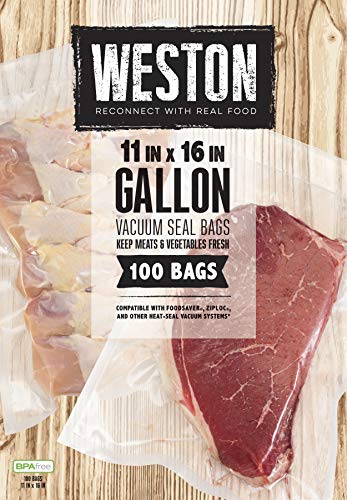
- Specs: 100 precut gallon bags, 11 x 16 inches each; 2-ply, 3 mil thick material; BPA-free; compatible with FoodSaver, NutriFresh, and other heat-seal vacuum systems; suited to meal prep and sous vide
When the job is a whole chicken, a pork shoulder, or a family-size batch of chili, quart bags run out of room and this gallon format takes over. Weston’s precut bags measure 11 x 16 inches, giving big cuts the head space they need for a clean, dry seal, and the 100-count box keeps the cost per bag sensible.
The 2-ply, 3 mil material resists punctures from sharp bones and frozen edges, and the textured design works across heat-seal systems from Weston, FoodSaver, and similar brands. The downside is simply scale: a gallon bag is wasteful for small portions, and the box is bulky. Pair this box with a quart option and the two sizes cover nearly every fresh food storage job in a home kitchen.
Pros:
– Gallon size fits whole chickens, roasts, and large batches
– 3 mil 2-ply material resists bone punctures
– Works with most major heat-seal vacuum systems
Cons:
– Oversized for small portions
– Large box needs real pantry or drawer space
FAQs
Do vacuum storage bags really keep food fresh longer in the freezer?
Yes, removing the air before sealing is what makes the difference. Freezer burn is caused by air and moisture loss at the food surface, and a tight vacuum seal blocks both, so meats, fish, and produce hold their texture and flavor for months instead of weeks. Keep the sealing area dry and leave head space above the food, because seal quality matters as much as the bag.
Are vacuum storage bags safe for sous vide cooking?
Use bags stated as BPA-free, food grade, and rated for simmering temperatures; all five picks here carry sous vide or simmer ratings up to about 195 degrees Fahrenheit. Standard sous vide cooking happens well below that ceiling. Avoid bags that are not rated for heat, and never reuse a bag that held raw meat for a cook.
Can I reuse vacuum storage bags after washing them?
You can reuse bags that held dry or cooked foods if you wash them thoroughly with hot soapy water and dry them completely inside and out. Bags that held raw meat, fish, or oily marinades are safer to discard, because residue can hide in the textured channels. Each reuse costs a little length when you cut the old seal off, one more reason rolls suit people who reuse bags.
Will these bags work with any vacuum sealer?
Textured bags with embossed channels work with clamp-style suction sealers from FoodSaver, Weston, Nesco, Seal a Meal, and similar brands. Chamber sealers are the exception: they need smooth pouches like the Avid Armor set, and they cannot use textured bags. Check your machine type before ordering.
Conclusion
The best vacuum storage bags are the ones matched to your machine and your menu. For most households with a clamp-style sealer, the FoodSaver quart precut bags handle daily portions with the least fuss, and pairing them with the Weston gallon box covers the big jobs. If you seal in volume or in awkward shapes, the FoodSaver multipack and the Wevac two-roll set cut both your cost per bag and your waste. Chamber sealer owners should go straight to the Avid Armor pouches and enjoy the lowest per-bag cost of all. Stock the formats you reach for most, keep the seal area clean and dry, and fresh food storage becomes a system that pays you back every week.
More from Amazon
Programs that pair well with the guide above. Offers and eligibility are set by Amazon and may change.
Collect the home and kitchen items you want in one registry that guests can shop from.
Create a wedding registrySet up recurring deliveries of everyday items on eligible products. Terms and savings are set by Amazon.
Explore Subscribe & SaveFree shipping on eligible items, Prime Video and more. Eligible new members can start with a free trial.
Start a Prime free trialAudiobooks and podcasts to listen to on the go. Eligible new members can start with a free trial.
Try Audible freeAs an Amazon Associate we earn from qualifying purchases.


Write Your Review
No reviews yet. Be the first to share your experience!