

Key takeaways
- Compare the best wine corkers for home bottling, from double lever hand corkers to Italian and Portuguese floor corkers, with specs and buying tips.
As an Amazon Associate, I earn from qualifying purchases made through links on this page, at no extra cost to you.
Introduction
Bottling day is when a home winemaker finds out whether months of patience end in well-sealed wine or bottles leaking around a badly seated cork. A good corker compresses the cork evenly, drives it to a consistent depth, and leaves the cork top flush enough to sit cleanly under a capsule. A poor one chews the cork, pushes it in crooked, or leaves it standing proud of the lip, and each flaw shortens the life of the wine inside.
Corkers fall into three broad families. Hand corkers are the smallest and simplest, working one bottle at a time with direct arm pressure. Double lever corkers grip the bottle neck and use two handles to multiply your force, making them the most popular step up for beginners. Floor corkers stand on their own legs, hold the bottle on a spring-loaded seat, and use a long lever and iris jaws to compress the cork before the plunger drives it home. They cost more and take up more room, but past a case or two per session, their speed and consistency are hard to give up.
This guide compares five corkers across the full range, from a compact Portuguese double lever tool that ships with starter corks to Italian and Portuguese floor models built for long sessions. Each pick was chosen for build quality, cork compatibility, and fit with how home winemakers actually work.
How to Choose
Start with batch size, because it rules out whole categories at once. If you bottle a few gallons a year, a hand or double lever corker is plenty, and it stores in a drawer. If you regularly bottle ten gallons or more in a sitting, your shoulders will argue for a floor corker long before the session ends. Floor models also seat every cork at the same depth for a uniform row of finished bottles.
Cork compatibility is the second filter. Most home corkers are built around straight wine corks in the common sizes, from the slimmer #7 up to the standard #9 used in most 750 ml bottles. Check that the model you like handles the cork size your bottles need, and pay attention to synthetic corks. Some floor corkers with metal iris jaws can crease a synthetic cork during compression, and a creased cork can weep once the bottle is laid on its side. If you plan to use synthetics, choose a model whose maker states they are supported, or one with gentler plastic or resin jaws.
Adjustability is the third point. An adjustable plunger nut lets you set exactly how deep the cork sits, which helps when you switch between bottle styles or cork lengths. Fixed-depth hand corkers are simpler, but they rely on your technique to stop at the right point, and beginners often leave corks slightly high at first.
Finally, think about frame and footprint. Welded legs are the most rigid option on a floor corker, while removable legs store flatter. Round steel frames tend to feel steadier under heavy bottles than light vertical risers. Height matters too: taller frames mean less bending and easier magnum clearance. Whatever you choose, plan a clear, level patch of floor or bench where bottle, corker, and corks all sit within reach.
The 5 Best Corkers for Home Bottling
1. FastRack Double Lever Corker with 20 Corks
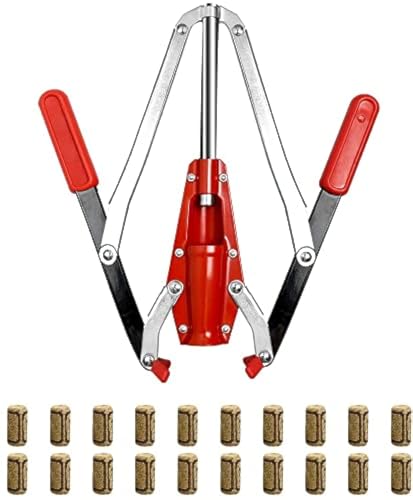
Specs
- Type: double lever hand corker; Material: stainless steel; Height: 14 in; Weight: about 1.16 kg; Cork sizes: #7, #8, and #9; Includes: 20 corks; Origin: Portugal
The FastRack double lever corker is the classic first upgrade from a basic plunger hand corker, thanks to a mechanism that does most of the work for you. Two long handles fold down on either side of the bottle neck, and the gearing behind them compresses the cork and drives it in one smooth stroke. Because both arms move together, the cork goes in straight rather than tilting as it can with one-handed tools, and straight corks seal and look better under a capsule.
Made in Portugal from stainless steel, it stands about 14 inches tall and handles #7, #8, and #9 agglomerated corks for standard 750 ml bottles. The box includes twenty #8 corks, so a first small batch can be bottled the day the tool arrives. At just over a kilogram, it stores easily in a cupboard between seasons.
Pros:
– Dual-lever action needs far less effort than a simple hand corker
– Seats corks straight and at a repeatable depth
– Starter corks included for a first batch
– Compact stainless build stores easily
Cons:
– Arm fatigue builds up on very large batches
– Best suited to standard bottle sizes rather than oversized formats
2. Italian Floor Wine Bottle Corker
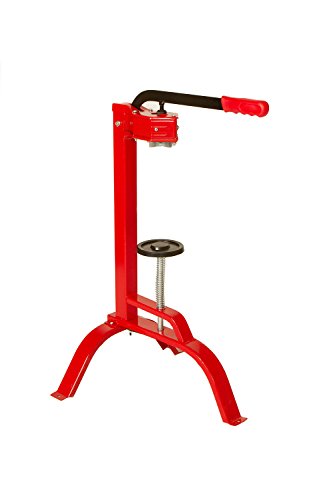
Specs
- Type: floor corker; Material: rolled steel frame; Cork sizes: #7, #8, and #9; Feature: adjustable plunger depth; Operation: long lever press; Origin: Italian design
This Italian floor corker is the tool most home winemakers picture when they get serious about bottling day. The rolled steel frame stands on its own, the bottle sits on a seat under the jaws, and one pull of the long lever compresses the cork in the iris and drives it home. Repeated bottle after bottle, that is where a floor corker earns its keep: fast rhythm, identical depth every time, and a fraction of the arm work a hand corker demands.
Its standout feature is the adjustable plunger depth. A nut on the plunger lets you dial in how far the cork sits below the lip, useful when you move between cork lengths or want a consistent finish across a mixed run. It accepts standard #7, #8, and #9 corks, and the sturdy frame does not walk or flex under load.
Pros:
– Fast, repeatable corking with minimal effort
– Adjustable plunger gives precise control of cork depth
– Rigid rolled steel frame stays stable in use
– Handles the standard range of home cork sizes
Cons:
– Takes up floor and storage space a hand corker does not
– More tool than a very small-batch winemaker needs
3. Portuguese Floor Corker in Burgundy

Specs
- Type: floor corker; Material: round steel; Height: 31 in; Bottle clearance: 14 3/8 in; Bottles: up to 1.5 L magnums; Cork sizes: straight corks up to #9; Origin: Portugal
The Portuguese floor corker in the taller burgundy finish solves a complaint shorter floor models hear often: bottling at a height that forces you to stoop. At 31 inches, it stands roughly three inches higher than the standard red Portuguese frame, a difference that adds up across a few cases of bottles. Its round steel frame replaces thin vertical risers with horizontal supports, giving it a planted, steady feel even with a full magnum on the seat.
Clearance is the other headline. The 14 3/8 inch working height swallows tall specialty bottles and 1.5 L magnums that shorter corkers struggle with, and it works with all straight corks up to size #9. The proven Portuguese mechanism uses compressing jaws and a plunger that seats each cork cleanly, while the spring-loaded seat keeps the bottle centered without a second pair of hands. For mixed standard and large-format bottling, this is the most accommodating frame in the group.
Pros:
– Taller frame reduces back strain during long sessions
– Generous clearance fits magnums and tall bottles
– Round steel build feels stable under heavy bottles
– Proven mechanism seats corks evenly
Cons:
– Tallest and bulkiest model here to store
– Overkill for winemakers who only use standard 750 ml bottles
4. North Mountain Supply Wine Bottle Floor Corker

Specs
- Type: floor corker; Material: steel; Origin: Portugal; Design: built for fast, high-volume bottling; Corks: natural and synthetic; Operation: single-person lever press
North Mountain Supply built its floor corker for winemakers whose batches keep growing, up to small producers bottling for local sale. The Portuguese-made steel frame is designed to be run by one person at a steady pace, and it is built for a throughput that leaves standard home models behind, making it a sensible pick when bottling day runs to hundreds of bottles rather than dozens.
A practical strength is cork flexibility. It handles both natural and synthetic corks, which is not true of every iris-jaw floor corker, so you choose corks based on the wine rather than the tool. The lever action is a single smooth pull, the seat keeps each bottle aligned under the jaws, and the steel frame shrugs off the repetitive load of volume work season after season. It is the same motion as a basic floor corker, engineered to keep doing it all day.
Pros:
– Built for high-volume, single-operator bottling
– Works with natural and synthetic corks
– Heavy steel frame suited to frequent use
– Smooth lever action keeps a fast rhythm
Cons:
– Sized and priced for producers rather than occasional bottlers
– Still needs dedicated floor space during use
5. Double Lever Wine Corker, Heavy-Duty Metal

Specs
- Type: double lever hand corker; Material: heavy-duty metal; Operation: twin-lever system; Corks: standard wine corks; Use: hand corking for home batches
This heavy-duty metal double lever corker sits at the budget-friendly end of the lever family, built around the same twin-handle idea as the FastRack with an emphasis on simple, solid construction. Set it over the bottle mouth, the jaws grip the neck, and pressing both levers together compresses the cork and pushes it in with one motion. The two-handed action spreads the effort across both arms, noticeably easier than forcing a cork in with a straight plunger.
The all-metal build appeals to buyers who have snapped a plastic hand corker mid-batch. There is little to adjust and little to go wrong, and it wipes clean and goes back in a drawer afterward. It is aimed at standard bottles and standard corks, exactly the job most home winemakers need done. If your batches are modest and storage space is tight, this is the sensible place to start.
Pros:
– Sturdy all-metal construction at an entry-level position in the range
– Twin levers make hand corking much easier
– Simple mechanism with almost nothing to maintain
– Stores in a drawer between batches
Cons:
– No depth adjustment beyond your own technique
– Slower than any floor corker on bigger runs
FAQs
What size corks should I buy for standard 750 ml wine bottles?
Most standard 750 ml bottles take a #9 cork, the size most home corkers are designed around. Bottles with narrower necks, and some smaller formats, use a #8 or #7 instead. Match the cork size range of your corker to your bottles before ordering corks in bulk, because an oversized cork fights the jaws on every bottle.
Can a floor corker handle synthetic corks?
Some can and some should not. Metal iris-style jaws can crease a synthetic cork as they compress it, and the crease can let wine weep once the bottle is stored on its side. If you plan to use synthetic corks, choose a model whose maker states that synthetics are supported, such as the North Mountain Supply floor corker in this guide, or one fitted with resin jaws.
How many bottles can a home corker seal in an hour?
A practiced user with a double lever corker can work through a few dozen bottles an hour once bottles are filled and lined up. A floor corker is faster and far less tiring, since the lever and jaws compress in one pull, and high-volume models sustain that pace for hours. In practice, filling the bottles neatly usually takes longer than corking them.
Do I need to soak natural corks before bottling?
A long soak is not necessary and can do harm by waterlogging the cork. Many winemakers use natural corks straight from a fresh, sealed bag, while others give them a brief rinse or a short stand in sanitizing solution before bottling. Follow the cork maker guidance for your corks, keep them clean and covered while you work, and avoid handling the ends that will touch the wine.
Conclusion
The right corker is the one that matches your batch size and your corks. For a first tool for years of modest batches, the FastRack double lever corker is the balanced pick, with the heavy-duty metal double lever model as the simpler, drawer-friendly alternative. Once bottling day stretches past a case or two, a floor corker changes the whole job: the Italian model brings adjustable cork depth and a rigid frame, the taller Portuguese burgundy frame adds comfort and magnum clearance, and the North Mountain Supply unit is the choice for natural or synthetic corks at real volume. Pick the frame that fits your cellar, and the last step of winemaking becomes the easiest one.
More from Amazon
Programs that pair well with the guide above. Offers and eligibility are set by Amazon and may change.
Collect the home and kitchen items you want in one registry that guests can shop from.
Create a wedding registrySet up recurring deliveries of everyday items on eligible products. Terms and savings are set by Amazon.
Explore Subscribe & SaveFree shipping on eligible items, Prime Video and more. Eligible new members can start with a free trial.
Start a Prime free trialAudiobooks and podcasts to listen to on the go. Eligible new members can start with a free trial.
Try Audible freeAs an Amazon Associate we earn from qualifying purchases.

Write Your Review
No reviews yet. Be the first to share your experience!