

Key takeaways
- Compare the best wine thermometers for perfect serving temps, from snap-on cuffs and smart app monitors to digital bottle gauges for reds and whites.
As an Amazon Associate, I earn from qualifying purchases made through links in this article.
Serving temperature is the quiet detail that decides whether a bottle tastes dull or alive. A red poured too warm turns soft and alcoholic, with the fruit buried under heat. A white poured straight from the fridge goes the other way, its aromas locked down and its acidity shrill. The trouble is that the two places wine usually waits, a counter and a refrigerator, are both wrong for most styles. Room temperature in a modern heated home sits well above the cellar conditions the old rules assumed, and a standard fridge over-chills most whites and nearly all reds.
A wine thermometer removes the guesswork. Instead of timing fridge stints or trusting the feel of the glass, you get a real number to check against the range your wine needs. The five models below cover the main styles worth owning: a battery-free snap cuff, a smart monitor that talks to your phone, a fast digital cuff, an in-bottle chiller with a built-in gauge, and a stainless bracelet. Each suits a different drinker, from the casual weeknight pourer to the collector who tracks every bottle.
How to Choose a Wine Thermometer
Start with how the device measures. Cuff and bracelet models read through the glass from outside the bottle, so they are non-invasive and work before opening. Because glass insulates, their readings trail the liquid slightly. In-bottle designs measure the wine itself and react faster, but only work once the bottle is open. Smart monitors split the difference: a sensor band streams readings to an app, so you can watch a bottle approach its target without hovering over the fridge.
Speed and resolution come next. Liquid crystal cuffs show a band of temperature rather than a precise figure, which is enough to tell a too-warm red from a ready one. Digital models resolve to a tenth of a degree and refresh every few seconds, which matters when pulling a bottle from an ice bath at exactly the right moment. Accuracy of about one degree Fahrenheit is typical for good digital cuffs, and plenty for serving decisions.
Power and fit are the practical checks. Battery-free cuffs and bracelets never die in a drawer; digital and smart models need cells or charging but reward you with clearer displays and alerts. Check that the band flexes enough for wider Burgundy and champagne bottles, not just Bordeaux shapes. Finally, weigh extras you will actually use: a printed serving guide, a bottle-logging app, or a chilling rod.
As a reference while you shop: full-bodied reds show best around 60 to 65 degrees Fahrenheit, lighter reds around 55 to 60, most whites between 45 and 55, and sparkling wines coldest at roughly 38 to 45 degrees.
Vacu Vin Snap Thermometer

Specs
- Liquid crystal display; flexible snap-on cuff; serving temperature index printed on the back; no batteries required; fits standard wine and champagne bottles; model 3630360
The Vacu Vin Snap Thermometer is the simplest tool on this list, and for many drinkers the only one they need. The flexible band snaps around the bottle and hugs the glass, and within a short wait the liquid crystal panel shows the current temperature. The back carries a serving index matching wine styles to their ideal ranges, so the cuff both measures and tells you what the number should be.
With no electronics and no batteries, it is effectively indestructible: thin and light enough to live in a picnic hamper or cutlery drawer, and tough enough to shrug off knocks that would kill a digital display. It fits champagne bottles as happily as still wine bottles. The trade-off is precision: the panel reads in steps rather than tenths of a degree, and it reflects the glass surface, so a bottle fresh from a warm car needs a few minutes to settle. For everyday drinking, where the question is just whether a wine is in the right zone, that is more than enough.
Pros:
– No batteries or electronics, so it is always ready
– Serving temperature index printed on the back
– Slim, light, and tough enough for travel and picnics
– Fits champagne bottles as well as standard wine bottles
Cons:
– Reads in steps rather than exact tenths of a degree
– Measures the glass surface, so freshly moved bottles need settling time
Kelvin K2 Smart Wine Thermometer

Specs
- Sensor band with Bluetooth link to a free iOS and Android app; alerts when the wine reaches its target temperature; temperature history and tasting log; supports up to six sensors in one app
The Kelvin K2 is the pick for drinkers who like data with their wine. A sensor band clips onto the bottle and connects to a smartphone app, which tracks the temperature continuously rather than at a single glance. Pick the wine style and the app alerts you when the bottle reaches its target range, ending the cycle of opening the fridge door every ten minutes to check on a chilling white.
The app keeps a history of monitored bottles, building a tasting log alongside the temperature curves, so you can see how a wine warmed across a long dinner. Enthusiasts can pair up to six K2 sensors with one app, handy for tastings where a red, a white, and a sparkling move toward service at different speeds. The build quality is a step above basic cuffs. The costs of the smart approach are real, though: it depends on a phone, a charged battery, and an app staying supported, and Bluetooth range shrinks behind a thick fridge door. If you enjoy the ritual more than the data, a simpler cuff will serve you just as well.
Pros:
– Continuous monitoring with an alert at the target temperature
– App logs temperature history and tasting notes per bottle
– Handles up to six bottles at once for tastings and parties
– Wine library guides target temperatures by style
Cons:
– Needs a smartphone and a charged battery to do anything
– Bluetooth range drops when the bottle is inside a fridge
Cork Genius Wine Bottle Digital Thermometer with LCD

Specs
- Slip-on digital cuff in a gunmetal finish; large LCD display; reading in about 2 seconds; accuracy within 1 degree Fahrenheit; 0.1 degree resolution; refreshes every 10 seconds; automatic on and off; battery powered
The Cork Genius takes the familiar cuff shape and gives it a proper digital brain. Slip it onto the bottle and it wakes by itself, shows a reading in about two seconds, and keeps refreshing every ten seconds, so you can watch a bottle warm on the table or cool in an ice bath in real time. The large LCD is easy to read in a dim dining room, and the tenth-of-a-degree resolution makes it the most precise tool here.
That precision is useful for white wines, which punish small errors: a few degrees too cold and the aromatics vanish, a few too warm and the wine turns flabby. Accuracy within one degree Fahrenheit is strong for a surface reader, and automatic on and off means no buttons to fumble with mid-service. It is shaped for wine bottles only, so it will not double as a kitchen thermometer, and like every battery device it will eventually need a fresh cell. None of that undermines its core appeal: fast, exact numbers with zero setup, in a finish that looks smart next to good glassware.
Pros:
– Fastest readings here, at about two seconds
– Tenth-of-a-degree resolution with one-degree accuracy
– Live updates every ten seconds while chilling or warming
– Automatic on and off, with a large, clear display
Cons:
– Battery powered, so the cell needs replacing eventually
– Shaped for wine bottles and little else
Soireehome Tempour

Specs
- Four-in-one pourer, aerator, stopper, and thermometer; gel-filled stainless steel chilling rod stored in the freezer; set includes two chilling rods; fits standard 750 ml bottles
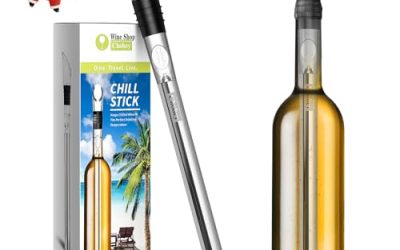
The Tempour works from the opposite direction: instead of only measuring the wine, it changes and holds the temperature while showing where things stand. The gel-filled stainless rod lives in your freezer. Once a bottle is opened, the rod drops into the neck, the pourer top with its built-in thermometer and aerator fits over it, and the wine chills from the inside while every pour passes through the aerating spout; a stopper seals the bottle between glasses.
Internal chilling is far more effective than wrapping the outside of the glass, and it is especially valuable for whites and rosés served outdoors, where a bottle on a warm table can climb out of range in minutes. The thermometer reads the wine itself, so the number you see is the number you taste. Two rods let you rotate one into service while the other refreezes, or run two open bottles at once. The compromises are planning and upkeep: the rod must be frozen ahead of time, the parts need washing, and the system does nothing for an unopened bottle. For long, warm evenings, though, nothing else here covers as many jobs in one piece.
Pros:
– Chills, aerates, pours, seals, and measures in one tool
– Reads the wine directly for a true serving temperature
– Two rods in the set keep a second bottle or a rotation going
– Excellent for outdoor dining where bottles warm quickly
Cons:
– Rod must be frozen in advance to chill
– More parts to wash than a simple cuff
Stainless Steel Wine and Beer Temperature Bracelet Thermometer

Specs
- Stainless steel bracelet band; LCD readout in about 15 seconds; printed serving temperature guides for wine styles on the band; no batteries required; flexible arc fits most wine and beer bottles
This bracelet thermometer borrows its shape from a wristwatch: the curved stainless band springs open, clasps around the bottle, and shows the temperature on its LCD panel in about fifteen seconds. Printed serving guidance for wine styles sits right beside the reading. It is battery-free and reusable.
Stainless steel gives it a durability and clean, professional look that plastic cuffs cannot match, and the flexible arc adapts to a wide range of bottle diameters, beer bottles included. It wipes clean in seconds and stores flat in a drawer. Like every surface reader, it reports glass temperature rather than the liquid, in steps instead of digital precision. The fit can be loose on unusually slim bottles. For hosts who want a quick, good-looking sanity check before pouring, it is an easy tool to recommend and an even easier one to gift.
Pros:
– Sturdy stainless steel build with a watch-like design
– Readout in about fifteen seconds, no batteries ever
– Serving guides for wine styles printed right on the band
– Fits beer bottles as well as wine bottles
Cons:
– Step-style readout rather than digital precision
– Can sit loosely on very slim bottles
FAQs
What temperature should red wine be served at?
Full-bodied reds such as Cabernet Sauvignon and Syrah show best between 60 and 65 degrees Fahrenheit, while lighter reds like Pinot Noir and Gamay prefer 55 to 60 degrees. Serving reds slightly cool is safer than warm, because the wine gains a few degrees in the glass as you drink.
What temperature should white and sparkling wine be served at?
Most whites sit in a 45 to 55 degree Fahrenheit window, with crisp, light styles colder and fuller oaked styles a little warmer. Sparkling wines are best colder still, around 38 to 45 degrees, which keeps the bubbles fine and the acidity lively.
Do cuff thermometers measure the wine or the bottle?
Cuffs and bracelets measure the glass surface, not the liquid directly. Once a bottle has rested for a while, glass and wine are effectively at the same temperature, so the reading is reliable. A bottle just moved between a warm room and a cold fridge needs several minutes for the two to equalise.
How long does a wine thermometer take to give a reading?
Digital cuffs are fastest, showing a number in about two seconds and updating every few seconds. Bracelet and snap cuffs need fifteen seconds to a few minutes, because the sensor must settle against the glass. In-bottle gauges read the wine itself and stabilise within seconds of being inserted or poured through.
Conclusion
The right wine thermometer depends on how you drink. If you want a tool that lives in a drawer and always works, the Vacu Vin Snap Thermometer or the stainless bracelet will keep you in the right zone for years. If precision is the point, the Cork Genius delivers fast, exact readings, and the Kelvin K2 adds monitoring, alerts, and a tasting log. If your problem is wine warming up at the table, the Soireehome Tempour solves the serving side in a single piece. Whichever style you choose, the upgrade is the same: bottles opened at the temperature the winemaker intended, and no more guessing.
More from Amazon
Programs that pair well with the guide above. Offers and eligibility are set by Amazon and may change.
Collect the home and kitchen items you want in one registry that guests can shop from.
Create a wedding registrySet up recurring deliveries of everyday items on eligible products. Terms and savings are set by Amazon.
Explore Subscribe & SaveFree shipping on eligible items, Prime Video and more. Eligible new members can start with a free trial.
Start a Prime free trialAudiobooks and podcasts to listen to on the go. Eligible new members can start with a free trial.
Try Audible freeAs an Amazon Associate we earn from qualifying purchases.

Write Your Review
No reviews yet. Be the first to share your experience!