

Key takeaways
- Compare the best hamburger bun pans for evenly shaped homemade burger buns, from perforated bakery trays to flexible silicone molds and ring pans.
As an Amazon Associate, we earn from qualifying purchases made through links on this page. This helps support our work at no extra cost to you.
A great burger falls apart long before it reaches the grill if the bun cannot hold up its end of the deal. Store-bought buns rarely match the size of a homemade patty, and they tend to go soggy or crumble under a juicy burger. Baking your own buns solves the freshness problem, yet free-forming dough balls on a flat sheet pan creates a new one: uneven rounds that spread sideways, merge into each other, and bake up in whatever size they feel like that day.
A hamburger bun pan fixes that inconsistency. Each cavity or ring holds the dough in a defined circle while it proofs and bakes, so every bun comes out the same diameter as the patties you shaped to match: uniform buns with even browning, flat bottoms that toast cleanly, and tops sturdy enough to slice without tearing.
The five pans below cover the main styles worth considering: a perforated carbon steel pan for bakery-style crusts, a perforated silicone sheet that mimics professional bakery molds, flexible silicone trays that release delicate dough without a fight, and a high-capacity slider pan for feeding a crowd.
How to Choose a Hamburger Bun Pan
Diameter comes first, because it decides what the bun can hold. Cavities around 3 to 3.25 inches suit sliders and small sandwiches. Four-inch cavities are the standard match for quarter-pound patties and most home burger recipes. Five-inch cavities are built for large pub-style burgers, chicken sandwiches, and oversized brioche buns. Match the pan to your usual patty size, since a bun that is too small leaves the patty hanging over the edge and a bun that is too large swallows the filling.
Material shapes both the crust and the cleanup. Carbon steel conducts heat efficiently and produces firmer, more deeply browned bottoms, and nonstick coatings help enriched dough release without tearing. Silicone is naturally flexible, so buns pop out with a gentle push from below, and the pans fold or stack for storage. Perforated designs, in either material, let steam escape from under the dough, encouraging a crisper base and a more even rise.
Capacity and footprint matter on bake day. A 12-cavity pan turns out a full party batch in one oven load, while two smaller 4-cavity pans give flexibility for mixed sizes. Flexible silicone trays bake most evenly on a firm sheet pan.
Finally, look at depth and care. Shallow cavities around 0.7 to 0.8 inches produce classic flat-topped sandwich buns, while deeper molds closer to 1.6 inches give taller, domed buns. Most of these pans are dishwasher safe, but hand washing nonstick steel preserves the coating longer.
The 5 Best Hamburger Bun Pans
1. YQGQSUAK 2 Pack Hamburger Bun Pan, 5 Inch Carbon Steel (ASIN: B0FZ3Z2QPL)

- Specs: Set of 2 pans; carbon steel with nonstick coating; 4 cavities per pan; cavity size 5 x 5 x 0.7 inches; pan size 10.7 x 10.7 x 0.7 inches; perforated cavity bases; model YQGQ-BunPan-2p4c-blk.
Most bun pans top out at four inches, which leaves anyone grilling big pub burgers to improvise. This YQGQSUAK set solves the size problem directly: each cavity measures a full five inches across, so the buns match thick steakhouse patties, crispy chicken sandwiches, and loaded breakfast sandwiches without the filling spilling past the bread. With two pans in the set, you can bake eight large buns in a single oven load.
The carbon steel body is the other half of the appeal. Steel heats quickly and evenly, and the perforations let moisture escape from the base of the dough as it bakes, giving a firmer, better-browned bottom crust than a solid silicone mold usually delivers. The nonstick coating keeps enriched doughs from grabbing the surface, so buns lift out with their sides intact.
The shallow 0.7-inch depth keeps these buns in classic sandwich territory rather than tall domed rolls, which is exactly right for stacking burgers. If your household standard is a genuinely large burger, this is the pan that finally matches it.
Pros:
– True 5-inch cavities fit large pub-style patties
– Perforated carbon steel browns bottoms evenly
– Two pans bake eight buns per oven load
– Nonstick coating releases enriched dough cleanly
Cons:
– Too large for sliders or standard small buns
– Hand washing recommended to protect the coating
2. Meajore Silicone Hamburger Bun Pan, Perforated 8 Cup (ASIN: B091R4J1GT)

- Specs: Silicone-coated glass fiber construction; 8 cavities; fits a half sheet pan at 17.2 x 12.2 x 1.6 inches; perforated mold surface; oven safe up to 250 degrees Celsius; includes food tongs.
The Meajore pan borrows its design from the perforated fiberglass molds professional bakers use, scaled down for a home half sheet pan. The mold is silicone-coated glass fiber, which holds its shape far better than floppy silicone trays while still releasing bread without greasing. Eight cavities across a single sheet means a full batch proofed and baked together, with identical results from the first bun to the last.
Perforation is the working principle here. The fine holes let heat circulate and steam escape, so the crumb sets evenly and the crust develops the light crispness that makes a bun feel bakery-made rather than homemade-soft. The mold can also go straight from freezer to oven, suiting bakers who freeze shaped dough ahead of a busy weekend.
Because the sheet is flexible, it rolls or folds for storage and wipes clean or goes in the dishwasher. It does need a baking tray for stability when loaded with wet dough. For weekly bun bakers who want consistent, professional-looking rounds, this is the most capable design on the list.
Pros:
– Professional perforated fiberglass-style mold
– Holds shape better than plain silicone trays
– Eight cavities fit a standard half sheet pan
– Freezer-to-oven safe for make-ahead dough
Cons:
– Needs a supporting tray when filled
– Larger footprint needs roomy storage
3. Dootafy Hamburger Bun Molds, 2 Pack 4 Inch Silicone (ASIN: B0BVGM8RGZ)

- Specs: Set of 2 silicone pans; 4-inch round cavities; 12 cups total across both pans; red food-grade silicone; oven safe up to 230 degrees Celsius; dishwasher safe; model BG-010.
Four inches is the diameter most burger recipes are written for, and this Dootafy set is built around that standard. Two pans with six shallow round cavities each give you a dozen buns per bake, each the right size for a quarter-pound patty, a chicken sandwich, or a breakfast egg sandwich. The shallow disc shape doubles as a muffin top pan, so the same set turns out whoopie pies, small layer cakes, tarts, and custards when burgers are not on the menu.
Silicone makes this the easiest set for beginners. The flexible walls release soft brioche and potato dough without tearing, and a gentle push from underneath frees each bun. There is no coating to scratch and nothing to season, and the pans rinse clean or go straight into the dishwasher.
The trade-off is structure. Filled pans should ride on a sheet pan for handling, and silicone never browns bottoms quite as firmly as steel. But for families who want a forgiving, versatile, standard-size bun pan that also covers dessert duty, this two-pack is the practical pick.
Pros:
– Standard 4-inch size matches most patties
– Twelve buns per bake across two pans
– Flexible silicone releases sticky dough easily
– Doubles as a muffin top and mini cake pan
Cons:
– Needs a sheet pan underneath for support
– Bottoms brown more softly than steel pans
4. Abizarch Silicone Hamburger Bun Mold, 2 Pack 4 Cavity (ASIN: B0D7LX9HRX)
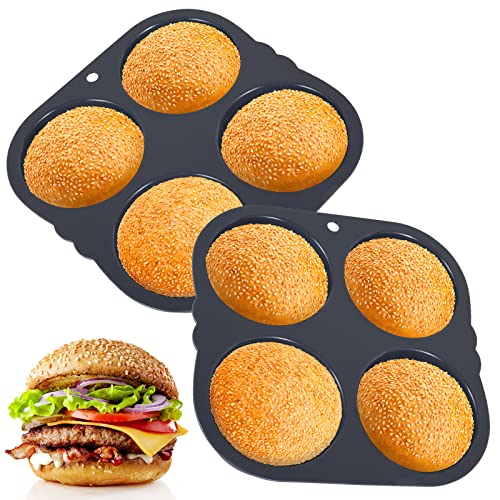
- Specs: Set of 2 silicone molds; 4 cavities per mold; cavity diameter 3.94 inches; cavity depth 1.6 inches; mold size 9.25 x 9.25 x 1.6 inches; food-grade silicone; dark grey; machine washable.
Where most silicone bun pans are shallow discs, the Abizarch molds are noticeably deep. Each cavity runs about 1.6 inches deep, so dough has room to rise upward into a taller, domed bun instead of spreading flat. That profile suits bakers who like a substantial bun with a soft crown, the kind that holds up to saucy pulled pork or a stacked club sandwich without compressing to nothing.
The cavity diameter of just under four inches keeps the buns in standard territory, and with two molds in the set you can bake eight at once or run two different doughs side by side. Finished buns release with a simple twist and push, and the molds are machine washable, so cleanup after an egg-wash bake is painless.
Both molds fit side by side on one oven rack and stack in a drawer afterward. If your complaint about homemade buns is that they always come out flat, the extra depth here is the direct answer.
Pros:
– Deep cavities produce tall, domed buns
– Compact footprint suits small ovens
– Two molds bake eight buns at once
– Flexible silicone releases cleanly and washes easily
Cons:
– Taller profile is less classic for flat sandwiches
– Silicone needs tray support when filled
5. FTNESGYM Hamburger Bun Pan, 12 Cavity Silicone with Basting Brush (ASIN: B0DD7R4PN4)
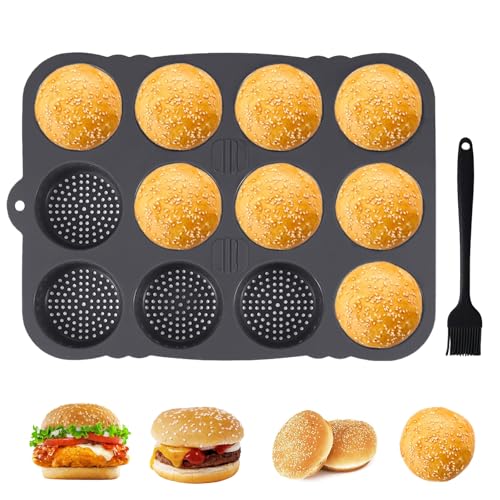
- Specs: Single silicone pan; 12 cavities; cavity diameter 3.15 inches; cavity depth 1.2 inches; pan size 11.42 x 15.55 inches; heat resistant up to 446 degrees Fahrenheit; includes silicone basting brush; dishwasher safe; model FT83947.
When the guest list grows, slider-size buns are the smart move, and this FTNESGYM pan is built for exactly that job. Twelve cavities of just over three inches each turn out a full tray of uniform mini buns in one bake, sized for sliders, small sandwiches, and kids’ burgers. The included basting brush earns its place too, since a quick swipe of milk or butter before baking gives small buns their glossy, appetizing tops.
The pan itself is soft food-grade silicone that folds for storage and pops buns out cleanly thanks to its natural nonstick surface. It is oven safe to 446 degrees Fahrenheit, goes in the dishwasher, and at under fourteen ounces is light enough to handle one-handed even when loaded.
The smaller cavity size is the one real limitation: these are not full-size burger buns, and adults expecting a standard sandwich will want two. The flexible pan also bakes best on a supporting sheet. But as a dedicated high-capacity slider pan that stores in almost no space, it fills its role well.
Pros:
– Twelve cavities for party-size batches
– Includes a basting brush for glossy tops
– Folds for compact storage
– Lightweight and dishwasher safe
Cons:
– Slider size only, not full-size buns
– Flexible silicone needs a supporting sheet
FAQs
What size hamburger bun pan do I need for standard burgers?
Most home burger recipes and quarter-pound patties match a 4-inch bun, so a pan with 4-inch cavities is the safest standard choice. Choose 3 to 3.25-inch cavities for sliders, and 5-inch cavities for large pub-style burgers and oversized chicken sandwiches. Matching the cavity to your usual patty size keeps the filling and the bread in proportion.
Are silicone or metal bun pans better?
Metal pans, especially carbon steel, brown bun bottoms more firmly and give a crisper base, while silicone pans release delicate enriched dough more easily and store in less space. Perforated versions of either material let steam escape for a more even crust. Choose based on whether you value crust and structure or effortless release and flexible storage.
How do I keep buns from sticking or spreading in the pan?
Lightly grease metal pans even when they are nonstick, and let dough proof until it nearly fills the cavity before baking, which encourages it to rise up rather than spill over. Keep portions evenly sized so every bun bakes at the same rate. A brief rest after baking lets the crumb set, so buns release cleanly instead of tearing.
Can I use a hamburger bun pan for other baking?
Yes, these pans are versatile beyond burgers. The shallow round cavities work well for muffin tops, whoopie pies, mini layer cakes, egg sandwiches, tarts, and small quiches, while deeper molds also handle dinner rolls. Just watch bake times, since smaller portions cook faster than a full loaf.
Conclusion
The right hamburger bun pan turns bun baking from a guessing game into a repeatable routine. If you grill large burgers, the YQGQSUAK carbon steel set is the only pick here with true five-inch cavities and the browning power to match. Weekly bakers who want bakery-style consistency should look at the perforated Meajore sheet, while the Dootafy two-pack covers the standard four-inch size with the easiest release. The deep Abizarch molds answer anyone whose buns come out too flat, and the FTNESGYM twelve-cavity pan is the crowd feeder of the group. Match cavity size to your patties, let the pan shape the dough, and every bake gives uniform, grill-ready buns.
More from Amazon
Programs that pair well with the guide above. Offers and eligibility are set by Amazon and may change.
Collect the home and kitchen items you want in one registry that guests can shop from.
Create a wedding registrySet up recurring deliveries of everyday items on eligible products. Terms and savings are set by Amazon.
Explore Subscribe & SaveFree shipping on eligible items, Prime Video and more. Eligible new members can start with a free trial.
Start a Prime free trialAudiobooks and podcasts to listen to on the go. Eligible new members can start with a free trial.
Try Audible freeAs an Amazon Associate we earn from qualifying purchases.

Write Your Review
No reviews yet. Be the first to share your experience!