

Key takeaways
- Compare the best kefir makers for culturing milk and water kefir at home, from all-in-one fermenter jars and mason jar lids to complete starter kits.
As an Amazon Associate, we earn from qualifying purchases made through links on this page. This helps support our work at no extra cost to you.
Kefir is one of the easiest fermented drinks to make at home, but the daily routine of covering a jar with cloth and straining every batch can wear down even an enthusiastic beginner. A dedicated kefir maker tidies up that routine. The best designs hold the grains in a built-in strainer or basket, let air reach the culture, and pour cleanly so the grains go straight back to work in fresh milk or sugar water.
The five products in this guide cover the main ways people culture kefir at home: a large all-in-one glass fermenter from Kefirko, a compact Microbiota fermenter with grains included, a grain container set that turns a mason jar you already own into a fermenter, a pair of straining lids from Masontops, and a complete starter kit built around live milk kefir grains. The right choice depends on your batch size, your counter space, and whether you already own jars and grains.
How to Choose a Kefir Maker
Decide between milk kefir and water kefir first. The two cultures look similar but live differently. Milk kefir grains feed on lactose and produce a tangy, pourable drink much like a thin yogurt. Water kefir grains feed on sugar water and make a light, slightly fizzy drink that takes well to fruit in a second ferment. Many makers handle both, but lids and strainers sized for one grain type do not always suit the other, so check that the product names your culture.
Capacity. A single person drinking a glass a day does well with a fermenter in the 0.6 to 0.9 liter range. Households, smoothie makers, and anyone culturing for several people should look at 1.4 liters or a half gallon mason jar setup. Remember that grains multiply over time, and a jar that feels roomy in the first month can feel crowded by the third.
How the grains are contained. This feature separates a kefir maker from a plain jar. Built-in strainer lids let you pour off finished kefir while the grains stay behind. Basket designs hold the grains in a removable cage that lifts out. Loose-grain kits need a separate fine mesh strainer, ideally nylon or plastic rather than metal for long contact. Contained grains mean faster straining and fewer grains lost down the sink.
Airflow and lids. Kefir cultures need some air exchange, especially water kefir in its first ferment. Good lids vent while keeping out fruit flies and dust. A stick-on thermometer strip helps in kitchens that run warm or cool, since kefir ferments best at ordinary room temperature and slows noticeably in a cold room.
Grains included or not. Some kits ship with live or dehydrated grains, which saves a separate order. Others are equipment only, which suits people whose grains are already thriving. Dehydrated grains need a few activation batches before they produce drinkable kefir, while live grains usually culture well from the first jar.
Materials and cleaning. Glass jars are non-reactive, do not hold odors, and let you watch the ferment. Plastic parts should be food grade and BPA free. Favor designs that come apart fully, because dried kefir in a lid seam is the most common complaint with every style of maker.
The 5 Best Kefir Makers
1. Kefirko Complete Kefir Starter Kit, 1.4 Litres (ASIN: B07F36V5SW)

- Specs: 1.4 L glass jar with a concave grip; strainer lid and secure cover lid; citrus juicer attachment; swizzle stick and scraper tool; user guide and recipe booklet; for milk kefir and water kefir
Kefirko, a Slovenian company devoted entirely to home fermentation, designed this jar to replace the whole clutter of cloth covers, rubber bands, and separate strainers. The strainer is built into the lid and has two pouring zones, a wider one for thick milk kefir and a finer one for water kefir and smaller grains, so straining a finished batch is a single pour. The top lid can sit slightly open to allow airflow during fermentation and close tight for storage in the fridge.
The 1.4 liter size is the sweet spot for a household batch, large enough for several glasses a day without dominating the counter. The juicer attachment is a thoughtful extra for water kefir drinkers, since a squeeze of citrus goes into most second ferment recipes. If you want one purpose-built tool rather than a drawer of accessories, this is the most complete fermenter in this guide.
Pros:
– Built-in two-zone strainer lid removes the need for a separate strainer
– Large 1.4 L capacity suits daily household batches
– Handles both milk kefir and water kefir
– Includes juicer, swizzle stick, scraper, guide, and recipes
Cons:
– Lid parts are plastic rather than glass or steel
– Tall jar can be awkward to wash by hand
2. Microbiota Kefir Fermenter, 0.6L/20oz, with Kefir Grains (ASIN: B00UHA23BM)

- Specs: 0.6 L (20 oz) fermenter; kefir grains included; patented grain container design; model 102; made by Microbiota, Inc.; about 4 x 4 x 10 inches
Microbiota takes a different approach: instead of straining after the fact, its fermenter keeps the grains inside a perforated inner container from the start. You add the grains, pour in milk, and let the jar sit for roughly a day. When the kefir is ready, the finished drink pours out while the grains stay in their chamber, ready for the next fill with no strainer to wash and no grains to hunt for in the sink.
The 0.6 liter capacity makes this the compact pick for one person or for a first experiment with kefir, and because grains are included, the box is a genuine starting point. The trade-off is flexibility: the chamber fixes the grain-to-milk ratio within a narrower band than loose culturing, and daily drinkers will refill often. For a tidy, low-effort daily glass, though, the design is hard to beat.
Pros:
– Grains stay contained, so there is no separate straining step
– Kefir grains included for an immediate first batch
– Compact footprint for small kitchens and dorms
– Simple routine encourages a consistent daily habit
Cons:
– 0.6 L volume is small for families
– Fixed grain chamber limits batch scaling
3. Microbiota Kefir Fermenter Set with Large 120cc Container (ASIN: B07YDZQ929)

- Specs: 120 cc grain container; fits wide mouth mason jars; food-grade, BPA-free plastic; hand wash only; jar not included; set name Kefir Fermenter Set
This set is the budget-friendly sibling of the full Microbiota fermenter. It gives you the same contained-grain idea, a 120 cc container that holds the grains, but designed to drop into a wide mouth mason jar you already own. That makes the batch size flexible: a pint jar for a small culture, a quart jar when your grains have multiplied.
Keeping grains in the container protects them from being poured away by a distracted cook and makes the daily transfer a lift-and-move job. The container is food-grade plastic and BPA free, and it is hand wash only, a minor chore given its size. Because no jar is included, the set only makes sense if your cupboard already holds wide mouth jars, but for the many kitchens that do, it is a simple route to contained-grain culturing.
Pros:
– Works with wide mouth mason jars you already own
– Batch size scales with the jar you choose
– Contained grains are hard to lose or damage
– Small, light, and easy to store
Cons:
– Jar is not included
– Hand wash only
– Plastic construction rather than glass or steel
4. Masontops Kefir Caps, Wide Mouth Mason Jar Lids, 2 Pack (ASIN: B07RDXY2CV)

- Specs: Two lids for wide mouth mason jars; one blue and one green; two-piece design with measuring cup top and sieve bottom; model KC2WGB; jars not included
Masontops built its name on mason jar accessories, and these caps show the same practical thinking. Each cap is two pieces: the clear top doubles as a measuring cup sized for a typical portion of grains, and the bottom piece is a sieve that keeps the grains in the jar when you pour. Twist the cap open and air circulates for fermentation; twist it closed and the jar is sealed for the fridge.
Getting two caps in different colors is more useful than it sounds. One jar can hold the batch that is ready to drink while the second cultures the next one, and the colors keep milk kefir and water kefir jars from being mixed up. The caps work for both cultures, but they include neither grains nor jars, so this is an upgrade for people with a basic setup rather than a first purchase.
Pros:
– Strainer and measuring cup built into each lid
– Two color-coded caps support a two-jar rotation
– Fits standard wide mouth mason jars
– Works for both milk and water kefir
Cons:
– Jars and grains are not included
– Sieve openings may let the smallest young grains slip through
5. The Spirit Of The Forest Original Live Milk Kefir Grains Starter Kit (ASIN: B0B61YPK49)
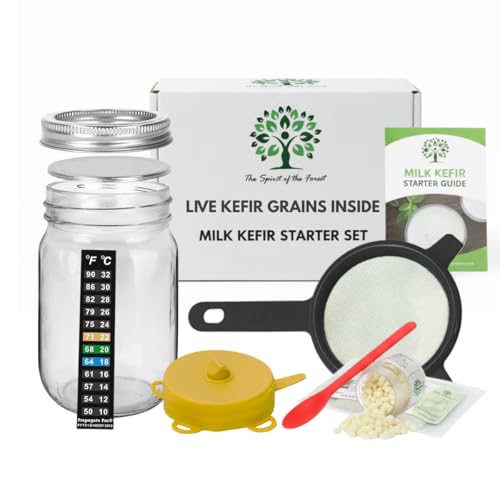
- Specs: Live milk kefir grains in the Lebanese tradition; fermentation jar; fermentation lid; spoon; thermometer; strainer; for whole, almond, or coconut milk
Where the other picks focus on hardware, this kit leads with the culture itself: live, active milk kefir grains rather than a dehydrated starter. Live grains usually settle into a reliable rhythm faster than dried ones, and the kit surrounds them with the tools a beginner otherwise has to gather one by one, including a fermentation jar and lid, a spoon, a thermometer for checking that the kitchen is in the culturing range, and a strainer for harvest day.
The grains are a traditional Lebanese style culture, and the kit supports dairy and non-dairy batches, including coconut and almond milk kefir, which suits mixed households. Because the grains are a living product, they need prompt attention when the package arrives and a few gentle first batches in fresh milk.
Pros:
– Live grains culture reliably without a long activation period
– Complete tool set with jar, lid, spoon, thermometer, and strainer
– Supports dairy, coconut, and almond milk batches
– Good single purchase for a true beginner
Cons:
– Live grains need attention soon after delivery
– Focused on milk kefir rather than water kefir
– More pieces to wash and store than a lid-only setup
FAQs
How long does homemade kefir take to ferment?
Most batches culture in about 24 hours at ordinary room temperature. Warm kitchens finish faster, cool kitchens slower, and a longer ferment produces a tangier, thicker result.
Do kefir grains need metal-free tools?
Brief contact with a stainless steel spoon or strainer does not harm healthy grains, but long contact with reactive metals is best avoided. That is why most makers in this guide use plastic, nylon, or glass for the parts that sit in the ferment, and why fine mesh plastic strainers are the common choice.
Can one maker handle both milk kefir and water kefir?
The equipment usually can, but the grains cannot switch back and forth freely. Milk kefir grains and water kefir grains are different cultures with different food needs. If you want both drinks, keep two jars and two grain colonies, and color-coded lids make the separation easy.
How do I know when kefir is ready to strain?
Milk kefir is ready when it has thickened slightly, smells pleasantly tangy, and just begins to show small pockets of whey at the sides of the jar. Water kefir is ready when it tastes less sweet than the sugar water you started with. Straining a little early beats letting a batch over-culture into a sharp, separated ferment.
Conclusion
The right kefir maker is the one that removes the step you dislike most. If straining is the chore, the Kefirko fermenter and the Masontops caps both build the strainer into the lid. If you want the grains managed for you, the two Microbiota designs keep them contained, one as a complete small fermenter with grains included and one as a set that upgrades jars you already own. And if you are starting from nothing, the Spirit Of The Forest kit pairs live grains with every tool a beginner needs. A contained, repeatable routine is what turns a first jar of kefir into a daily habit.
More from Amazon
Programs that pair well with the guide above. Offers and eligibility are set by Amazon and may change.
Collect the home and kitchen items you want in one registry that guests can shop from.
Create a wedding registrySet up recurring deliveries of everyday items on eligible products. Terms and savings are set by Amazon.
Explore Subscribe & SaveFree shipping on eligible items, Prime Video and more. Eligible new members can start with a free trial.
Start a Prime free trialAudiobooks and podcasts to listen to on the go. Eligible new members can start with a free trial.
Try Audible freeAs an Amazon Associate we earn from qualifying purchases.



Write Your Review
No reviews yet. Be the first to share your experience!