

Key takeaways
- Compare the best bougatsa pans for crisp, golden phyllo pies, from a true stainless tepsi tray set to large round and rectangular bakery pans.
As an Amazon Associate, we earn from qualifying purchases made through links on this page. This helps support our work at no extra cost to you.
Bougatsa is built in a pan before it is ever built on the plate. In Thessaloniki bakeries, the semolina custard version and its savory cousins with cheese, spinach, or minced meat are layered into wide, shallow round trays, baked until the phyllo shatters, then cut into portions straight from the tray. That tray is called a tapsi in Greek and a tepsi across the wider region, and its shape is the whole point: broad across the base so the custard sets in an even, sliceable layer, and shallow enough that the top phyllo crisps before the filling overcooks.
One honesty note before the picks. No Amazon listing is literally sold as a bougatsa pan, so this guide takes the practical route: one genuine tepsi set sold under that name on Amazon’s German store, plus the large, shallow round and rectangular bakery pans that bougatsa and the other Greek phyllo pies are actually baked in at home. Every pick is sized for a full tray of pie, every one is metal rather than glass so the bottom leaves brown properly, and every ASIN was checked against the rest of our catalogue so none repeats a pan already used in our baklava, basbousa, or revani guides.
How to Choose a Bougatsa Pan
Size comes first, because bougatsa is a tray bake. A round pan of 14 to 16 inches, or a rectangular pan around 13 by 18 inches, holds a full pack of phyllo and a family-sized layer of custard or greens. Smaller 9 and 10 inch pans force the filling too deep, and a deep filling steams the bottom leaves instead of crisping them. Depth matters for the same reason. Traditional tapsi trays are barely an inch deep, and 2 inches is the practical ceiling for custard bougatsa. Save 3 inch pans for thick savory pies such as galaktoboureko-style bakes or spinach pies with a heavy filling that needs the support.
Material decides how the bottom crust behaves. Bare or anodized aluminum is the bakery standard because it heats fast, browns evenly, and releases buttered phyllo cleanly once the pie rests. Stainless tepsi trays are heavier and slower to heat but shrug off the knife work of portioning in the tray, which is how bougatsa is served. Dark nonstick finishes can scorch the sugar in custard fillings, so bright metal is the safer match.
Shape is a matter of tradition and storage. Round pans mirror the bakery tapsi and suit the spiral and layered village pies. Rectangular pans use oven space better, line up neatly with the dimensions of packaged phyllo sheets, and make portioning into even squares simpler. Either works, provided the corners and seams are tight enough that butter and custard cannot leak through.
Finally, think about the rim and the wash-up. A rolled rim gives you something to grip when a full, hot, butter-heavy tray comes out of the oven, and seamless construction means no crevices for syrup or custard to bake into. Most bakery aluminum is hand wash only, while stainless tepsi sets usually tolerate the dishwasher.
The 5 Best Bougatsa Pans
1. Almina Stainless Steel Tepsi Round Tray Set, 28/32/36 cm (ASIN: B0942NPHGJ)

- Specs: Set of 3 round trays at 28, 32, and 36 cm diameter; stainless steel; shallow tepsi profile; dishwasher safe; sold through Amazon’s German store.
This is the only pick sold under the tray’s real name, and it shows. The three graduated rounds follow the tepsi format used for borek, baklava, and bougatsa across the Balkans and Anatolia: wide, shallow, and plain, with no coating between the metal and the pastry. The 36 cm tray is the bougatsa size, big enough for a full custard pie cut into bakery portions, while the 32 and 28 cm trays cover smaller household pies and reheating.
Stainless steel heats a little more slowly than aluminum, so give the tray a few extra minutes and let the pie rest before cutting, and the base still crisps well because the profile is so shallow. The steel also tolerates a knife or metal spatula when you portion in the tray, which aluminum owners have to be more careful about. Because this set ships from a European storefront, expect slower delivery than a domestic listing.
Pros:
– A genuine tepsi set sold under its traditional name
– Three graduated sizes cover small pies through a full 36 cm tray bake
– Stainless steel stands up to portioning with a knife in the tray
– Dishwasher safe, unlike most bakery aluminum
Cons:
– Ships from Amazon’s German store, so delivery is slower
– Stainless browns the base a touch more gently than aluminum
2. Winco HAC-162 Round Cake Pan, 16-Inch (ASIN: B00C0N8BZ6)

- Specs: 16 inch diameter by 2 inches deep; hard anodized aluminum; 18-gauge, 1 mm construction; commercial bakery grade; straight sides with a flat base.
Winco builds this pan for commercial bakeries, and that plain, heavy round is very close to the workhorse tapsi of a Greek bakery kitchen. Sixteen inches across gives custard bougatsa the wide, thin layer it wants, the 2 inch wall keeps buttered phyllo and filling contained, and the hard anodized surface resists scratching from spatulas and portioning knives far better than bare aluminum.
The anodized finish also releases phyllo reliably once the pie has rested, and it will not react with lemon, spinach, or cheese fillings during longer bakes. The pan looks strictly industrial, so this is a tool rather than a serving piece, and you will move the pie to a board or platter for the table. For a baker who makes tray pies often and wants one big round that simply lasts, this is the dependable choice.
Pros:
– True bakery dimensions at 16 inches wide and 2 inches deep
– Hard anodized surface resists scratches and acidic fillings
– Heavy 18-gauge build resists warping in a hot oven
– Straight sides give clean, even portions
Cons:
– Utilitarian look, not a pan for serving at the table
– Hand wash care suits the anodized finish best
3. AME D’ESSENCE Aluminum Round Pan, 16 x 2 Inch (ASIN: B08P3SQZC1)

- Specs: 16 inch diameter by 2 inches deep; commercial grade aluminum; model ALUCP1602; straight-sided round layer pan.
This bright aluminum round from AME D’ESSENCE takes the opposite approach to the Winco: plain, light, fast-heating metal in the same generous 16 by 2 inch format. Bare aluminum is what most bakeries actually bake phyllo pies in, because it responds quickly, browns the underside evenly, and lets the butter in the pastry do the releasing once the pie cools for a few minutes.
The light weight matters more than it sounds. A 16 inch tray of bougatsa is awkward once filled, and a pan you can lift and rotate one-handed halfway through the bake gives a more even color on top. The trade-offs are the usual ones for bare aluminum: it can dent if dropped, acidic fillings should not be stored in it overnight, and hand washing keeps the surface bright.
Pros:
– Large 16 inch round in the classic 2 inch bougatsa depth
– Lightweight aluminum is easy to lift, rotate, and store
– Bright metal browns phyllo bases evenly
– Commercial grade construction for regular use
Cons:
– Bare aluminum can dent and discolor over time
– Not suited to storing acidic fillings in the pan
4. Fat Daddio’s PRD-163 Round Cake Pan, 16 x 3 Inch (ASIN: B0000VLII2)

- Specs: 16 inch diameter by 3 inches deep; 16-gauge anodized aluminum; seamless construction with a rolled rim; oven safe to high baking temperatures; hand wash recommended.
Every other pick here is 2 inches deep or shallower, and this Fat Daddio’s round earns its place as the deep option. Some Greek tray bakes genuinely need the wall height: a spinach pie packed with greens, a meat bougatsa with a thick layer of filling, or a syruped galaktoboureko that must hold its syrup without sloshing over the rim. At 16 inches across and 3 inches deep, this pan holds those bakes in the same wide format the cuisine expects.
The anodized aluminum is seamless, so custard and syrup cannot creep into joints, and the rolled rim makes a full pan easier to move with oven mitts. The honest caution is that custard bougatsa in a 3 inch pan needs care: fill it shallower than the pan allows, or the center will set slowly and the base will soften. Used with that restraint, it is the most versatile pan on this list.
Pros:
– Deep 3 inch walls suit thick savory pies and syruped bakes
– Seamless anodized aluminum with an easy-grip rolled rim
– 16 inch width keeps the traditional wide tray format
– Built for commercial bakery workloads
Cons:
– Too deep for a classic thin custard layer if filled to the top
– Hand wash only to protect the finish
5. Nordic Ware Prism High-Sided Sheet Cake Pan, 13 x 18 Inch (ASIN: B00XYAH65A)
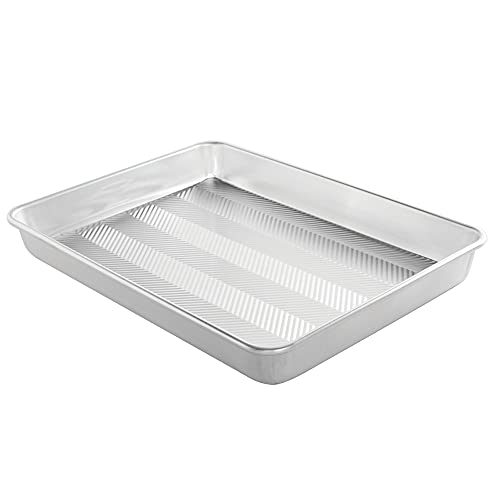
- Specs: Exterior 13 x 17.9 x 2 inches, interior about 12.4 x 17.3 x 2 inches; natural aluminum with an embossed prism texture; encapsulated steel rim; hand wash recommended.
The rectangular pick on the list, and the one that fits packaged phyllo best. Standard phyllo sheets are roughly 12 by 17 inches, so this high-sided half sheet takes them with almost no trimming, and its 2 inch walls hold a proper layer of custard or greens instead of the puddle a rimmed cookie sheet would give you. Portioning is simpler too, since a rectangular bougatsa cuts into the even squares bakeries sell.
The embossed prism pattern on the base lifts the pastry microscopically off the metal, which encourages an even, crisp bottom, and the steel-reinforced rim keeps a big pan from twisting when loaded. Like most natural aluminum it prefers hand washing, and the textured base takes a moment longer to clean after a syrupy bake.
Pros:
– Rectangular footprint matches packaged phyllo sheets with little trimming
– 2 inch sides hold a real filling layer, unlike a flat sheet pan
– Embossed base promotes an evenly crisped bottom crust
– Reinforced rim resists warping under a full load
Cons:
– Textured base needs a little more care when washing
– Too large for small ovens, so measure before buying
FAQs
What size pan is best for bougatsa?
A round pan of 14 to 16 inches, or a rectangular pan near 13 by 18 inches, suits most home recipes. Bougatsa is a wide, shallow bake, so the filling should spread into a layer roughly an inch thick rather than sitting deep in a small pan. If you bake half batches often, a graduated tepsi set lets you match the tray to the amount of filling.
Can I bake bougatsa in a glass dish instead of a metal pan?
You can, but the result is different. Glass heats slowly and holds heat long after the pie leaves the oven, so the bottom phyllo tends to stay pale and soft while the custard keeps cooking in the residual heat. Metal, especially aluminum, gives the crisp base and clean release that define a bakery bougatsa, which is why every pick in this guide is metal.
How do I keep the bottom phyllo crisp in a large pan?
Bake on a preheated heavy sheet or in the lower third of the oven so the base gets direct heat, brush each phyllo layer with butter rather than drowning the stack, and let the finished pie rest in the pan for ten minutes before cutting so the bottom sets. A shallow layer of filling helps as well, because excess custard is the most common cause of a soggy base.
Should the pan be greased before layering the phyllo?
Yes, a thorough brushing of melted butter or oil across the base and walls is standard practice. The first phyllo sheet should overhang the edges so it can fold back over the filling, and each following sheet gets its own light brushing. With buttered phyllo in a metal pan, sticking is rarely a problem once the pie has rested.
Conclusion
Bougatsa rewards the pan shape it grew up in: wide, shallow, and metal. Choose the Almina tepsi set for the genuine tray in graduated sizes, the Winco HAC-162 for a scratch-resistant commercial round, or the AME D’ESSENCE for the lightest classic aluminum option. Pick the Fat Daddio’s PRD-163 when your pies run thick and syruped, and the Nordic Ware Prism half sheet if your kitchen thinks in phyllo-sheet rectangles and feeds a crowd. Any of the five gives a home baker the crisp base, even custard, and clean portions that make this pastry worth baking.
More from Amazon
Programs that pair well with the guide above. Offers and eligibility are set by Amazon and may change.
Collect the home and kitchen items you want in one registry that guests can shop from.
Create a wedding registrySet up recurring deliveries of everyday items on eligible products. Terms and savings are set by Amazon.
Explore Subscribe & SaveFree shipping on eligible items, Prime Video and more. Eligible new members can start with a free trial.
Start a Prime free trialAudiobooks and podcasts to listen to on the go. Eligible new members can start with a free trial.
Try Audible freeAs an Amazon Associate we earn from qualifying purchases.
Write Your Review
No reviews yet. Be the first to share your experience!