

Key takeaways
- Best for small repairs and paver preparation: a 90–110 lb forward plate with about 1,500–2,000 lbf of compaction force.
- Best all-around choice: a 150–200 lb forward plate producing roughly 2,000–3,000 lbf.
- Best for deeper gravel and base layers: a 300–550 lb reversible plate with approximately 4,000–7,000 lbf.
- Best for frequent professional work: a reversible plate from a commercial manufacturer such as Wacker Neuson, BOMAG, Husqvarna, Mikasa, or Multiquip, selected for service access and parts availability.
- Best for indoor or low-emission work: a battery-powered plate compactor, where the job size and charging arrangements suit its shorter operating window.
The best plate compactors depend on the surface and workload: choose a light forward plate for occasional paver and path work, a reversible plate for deeper aggregate beds, and a heavy-duty machine when you need faster coverage and repeated daily use.
Our top picks


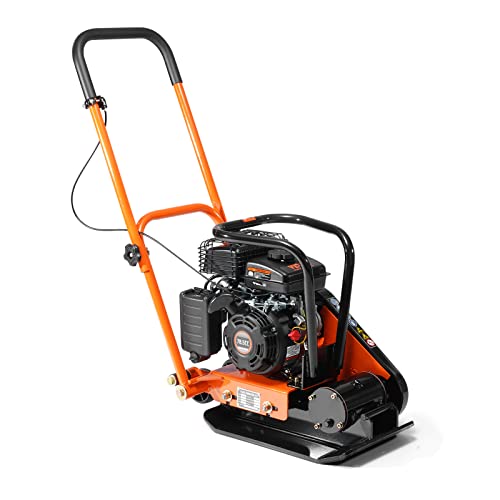
As an Amazon Associate we earn from qualifying purchases at no extra cost to you. Ratings are shown as listed on Amazon.
Best plate compactors by job
- Best for small repairs and paver preparation: a 90–110 lb forward plate with about 1,500–2,000 lbf of compaction force.
- Best all-around choice: a 150–200 lb forward plate producing roughly 2,000–3,000 lbf.
- Best for deeper gravel and base layers: a 300–550 lb reversible plate with approximately 4,000–7,000 lbf.
- Best for frequent professional work: a reversible plate from a commercial manufacturer such as Wacker Neuson, BOMAG, Husqvarna, Mikasa, or Multiquip, selected for service access and parts availability.
- Best for indoor or low-emission work: a battery-powered plate compactor, where the job size and charging arrangements suit its shorter operating window.
What matters more than the headline compaction force
Compaction force is important, but it does not tell the whole story. A machine that is too heavy for a narrow path may be slower than a smaller unit, while excessive force can damage delicate pavers or push material sideways instead of consolidating it.
Compaction force and vibration frequency
Higher force is useful for crushed stone, road base, and thicker aggregate lifts. Light force is usually sufficient for bedding sand, thin gravel repairs, and interlocking pavers. Vibration frequency, commonly stated in vibrations per minute, affects how the material responds. A high-frequency plate can leave a smooth finish on granular material, while a lower-frequency, heavier machine may penetrate more effectively.
Do not treat maximum force as a recommended depth. Compacting a 10-inch layer in one pass rarely works, even with a powerful machine. Place aggregate in lifts—often 2 to 4 inches at a time—and compact each lift separately.
Plate size and operating weight
A wider plate covers more ground per pass, but it is harder to maneuver around walls, edging, posts, and tight garden paths. Operating weight affects both penetration and fatigue. A compact 12-by-18-inch plate may be easier to control than a 20-by-24-inch plate, even when the larger machine appears more productive on paper.
Forward or reversible travel
- Forward plates: simple, lighter, less expensive, and well suited to small areas and occasional use.
- Reversible plates: travel forward and backward, making them easier to use in confined spaces and more effective for deeper base work.
- Remote-controlled plates: useful where visibility, trench access, or long operating periods justify the additional cost and complexity.
Plate compactor comparison
The figures below describe useful buying classes rather than one specific model. Manufacturer specifications vary, so confirm the exact data before purchasing.
| Machine class | Typical plate size | Operating weight | Compaction force | Typical engine or power source | Best suited to |
|---|---|---|---|---|---|
| Compact forward | 12 x 18 to 15 x 20 in | 90–130 lb | 1,500–2,200 lbf | 2.5–4 hp gasoline | Pavers, walkways, small patches |
| Standard forward | 16 x 20 to 20 x 24 in | 140–220 lb | 2,000–3,500 lbf | 4–6 hp gasoline | Driveways, patios, routine landscaping |
| Heavy reversible | 18 x 22 to 24 x 26 in | 300–550 lb | 4,000–7,000 lbf | 5–9 hp gasoline or diesel | Thicker aggregate and commercial site work |
| Battery forward | 14 x 20 to 20 x 24 in | 150–260 lb | 1,800–3,000 lbf | Battery-electric drive | Noise-sensitive or enclosed work |
Best choices by buyer situation
| Your situation | Recommended specification | Why | What to avoid |
|---|---|---|---|
| One patio project | 90–160 lb forward plate, 1,500–2,500 lbf | Lower purchase cost and easier transport | Large reversible units that are difficult to load |
| Several landscaping jobs each year | 150–220 lb forward plate with a water tank option | Good balance of coverage, control, and value | Very small plates that make large areas tedious |
| Frequent contractor use | Reversible plate, 300 lb or more, serviceable commercial engine | Faster coverage and better depth capability | Consumer machines with limited parts support |
| Tight gates or narrow paths | Plate narrower than the access route, often 12–16 inches | Prevents repeated lifting or dismantling | Choosing by plate area without measuring access |
| Indoor or noise-sensitive work | Battery-electric plate with adequate spare batteries | No direct exhaust and reduced routine engine maintenance | Assuming one battery will cover a full commercial shift |
Gasoline, diesel, or battery power?
Gasoline engines
Gasoline is the common choice for light and medium forward plates. Engines from Honda and similar established small-engine suppliers are widely supported, and replacement parts are generally easy to find. The trade-offs are fuel storage, oil changes, exhaust, and noise. A gasoline machine should never be operated in an enclosed area or where exhaust can accumulate.
Diesel engines
Diesel power is more common on larger commercial compactors. It can suit long, demanding work, but the machine is usually heavier, more expensive, and less convenient for a homeowner. Consider diesel only when the additional durability and extended duty cycle have practical value.
Battery-electric machines
Battery plates can simplify starting, reduce routine engine service, and work well where exhaust or noise is a concern. Their limitations are purchase price, battery replacement cost, charging time, and runtime. Check whether the battery and charger are included. A claimed runtime may change substantially with material density, ambient temperature, and continuous versus intermittent operation.
Vibration control and operator comfort
Look for a handle with rubber isolation mounts, a well-balanced frame, and controls that do not require constant force to hold the machine in place. Vibration-isolated handles reduce the vibration transmitted to the operator, but they do not make prolonged exposure harmless. Take breaks, keep both hands in the intended position, and follow the manufacturer’s operating guidance.
Useful convenience features include a foldable handle, lifting points, wheel kit, engine protection frame, and a water-distribution system. A water tank or sprinkler bar helps prevent asphalt or damp bedding material from sticking to the plate. For pavers, use a manufacturer-approved protective mat when appropriate; bare steel can scuff or chip some surfaces.
A simple coverage calculation
Suppose a plate is 20 inches wide and travels at an effective 100 feet per minute. Allowing for overlaps and turning, estimate an effective width of 1.5 feet rather than the full 1.67 feet. The theoretical coverage is:
1.5 feet × 100 feet per minute = 150 square feet per minute.
That is about 9,000 square feet per hour before stops, refueling, repositioning, and repeated passes. If the job requires four passes, the practical compacting capacity is much lower. This is why a wider plate does not automatically finish a small, irregular patio faster: maneuvering and overlap can dominate the schedule.
Ownership costs and durability realities
Entry-level forward compactors commonly fall in the general market range of about $500–$1,200, while heavier reversible or commercial machines often range from roughly $1,500 to more than $5,000. Battery models can cost more initially once batteries and chargers are included. Rental may be more economical for a single project, especially when transportation and storage are difficult.
The wear items are usually the drive belt, rubber engine mounts, vibration isolators, exciter bearings, plate edges, wheels, and protective mats. Dust and loose aggregate accelerate wear. Before buying, check whether belts and isolators are stocked locally, whether the exciter oil has a specified replacement interval, and whether the manufacturer publishes a parts diagram.
Basic maintenance routine
- Before each use: inspect fasteners, the belt guard, lifting points, fuel or battery connections, and the condition of the plate.
- Clean after use: remove soil and aggregate from the plate and cooling areas. Do not direct high-pressure water at bearings, electrical components, or engine controls.
- Check lubrication: follow the manual for engine oil, exciter oil, and bearing service. Using the wrong lubricant can shorten component life.
- Inspect vibration mounts: replace cracked or distorted rubber before excessive vibration reaches the handle or frame.
- Store correctly: stabilize or drain gasoline as specified, keep the machine dry, and store batteries at the manufacturer’s recommended charge level.
Bottom line
For most homeowners, the best plate compactor is a manageable 90–200 lb forward model with around 1,500–3,000 lbf of force, a useful handle isolation system, and readily available parts. Choose a reversible 300 lb-or-heavier machine when you regularly compact deep aggregate or need two-way control. Match the plate width to the access route, use several thin lifts instead of one thick layer, and treat serviceability as seriously as compaction force.







Write Your Review
No reviews yet. Be the first to share your experience!