

Key takeaways
- Large bowl: More surface area helps concentrated reds release fruit, spice and oak aromas.
- Moderately narrow opening: A tapered rim concentrates aromas rather than letting them disperse immediately.
- Tall profile: The height leaves space between the wine and the nose and encourages gentle swirling.
- Thin rim: A fine edge makes the glass feel less intrusive when tasting, although it is usually more vulnerable to chips.
- Useful fill level: A 150 ml pour should occupy only the lower part of a large Bordeaux bowl, leaving substantial headspace.
The best Bordeaux wine glasses for full-bodied reds combine a bowl of roughly 600–900 ml, a gently tapered rim, a stable but slender stem, and crystal that is thin enough for aroma without being impractical to wash.
For most drinkers, the Riedel Vinum Bordeaux is the sensible all-round choice: its approximately 610 ml bowl gives Cabernet Sauvignon room to open while its machine-made construction and dishwasher-safe design make it easier to replace and maintain. Choose the Zalto Denk’Art Bordeaux for maximum delicacy and aromatic lift, the Spiegelau Definition Bordeaux for a lighter large-bowl glass at a more moderate market price, or a Schott Zwiesel Tritan Bordeaux glass when durability matters more than an ultra-thin rim.
Our top picks
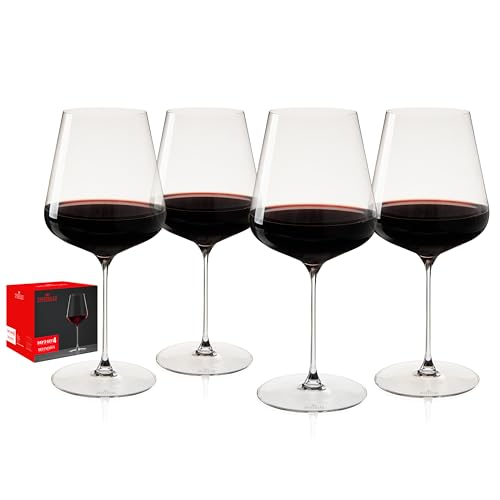

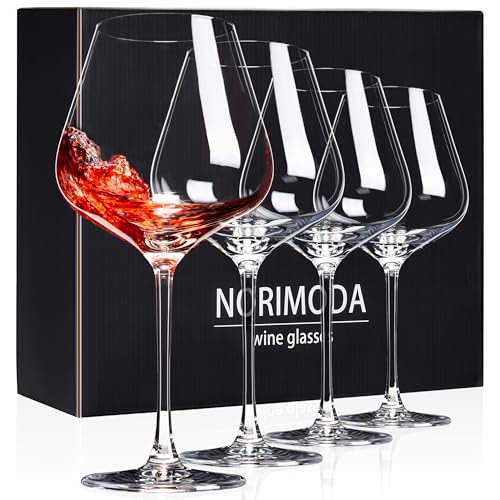

As an Amazon Associate we earn from qualifying purchases at no extra cost to you. Ratings are shown as listed on Amazon.
What a Bordeaux glass needs to do
Bordeaux varieties such as Cabernet Sauvignon, Merlot, Cabernet Franc and Petit Verdot tend to be structured, aromatic and tannic. A suitable glass does not soften tannins chemically, but its shape can make the wine seem more balanced by directing aromas upward and allowing oxygen contact as you swirl.
- Large bowl: More surface area helps concentrated reds release fruit, spice and oak aromas.
- Moderately narrow opening: A tapered rim concentrates aromas rather than letting them disperse immediately.
- Tall profile: The height leaves space between the wine and the nose and encourages gentle swirling.
- Thin rim: A fine edge makes the glass feel less intrusive when tasting, although it is usually more vulnerable to chips.
- Useful fill level: A 150 ml pour should occupy only the lower part of a large Bordeaux bowl, leaving substantial headspace.
Best Bordeaux wine glasses compared
| Glass or glass type | Approx. capacity | Construction | Stem and rim character | Dishwasher practicality | Best for |
|---|---|---|---|---|---|
| Riedel Vinum Bordeaux | 610 ml | Machine-made crystal | Moderately thin rim; traditional tall stem | Generally dishwasher safe; use a secure rack | Regular Cabernet drinking and first quality set |
| Zalto Denk’Art Bordeaux | 765 ml | Handmade lead-free crystal | Very thin rim; exceptionally light, tall stem | Dishwasher use is possible according to care guidance, but hand washing is lower risk | Experienced tasters prioritizing detail and lightness |
| Spiegelau Definition Bordeaux | 750 ml | Machine-made lead-free crystal | Thin rim; lightweight modern stem | Dishwasher safe | Large-bowl performance without handmade-glass pricing |
| Schott Zwiesel Tritan Bordeaux | About 600 ml | Machine-made Tritan crystal glass | Slightly more substantial rim and sturdy stem | Designed for frequent dishwasher use | Busy households, entertaining and commercial-style durability |
| Large universal red-wine glass | 500–650 ml | Machine-made crystal or glass | Usually shorter and less specialized | Often very good, depending on model | Small cupboards and mixed wine collections |
Capacities are measured to the rim, not recommended serving volume. In practice, a 150 ml pour in a 750 ml bowl uses only one-fifth of the nominal capacity. That is useful: the remaining space is what allows the wine to collect and evolve aromas.
Head-to-head: large handmade bowls versus practical machine-made glasses
Zalto Denk’Art Bordeaux: the specialist choice
The Zalto Bordeaux glass has a very large, high-shouldered bowl and an unusually fine rim. Its low mass makes it pleasurable for slow tasting, and the narrow upper opening helps focus Cabernet’s cassis, cedar and savory notes. The trade-off is ownership anxiety: a thin stem and delicate rim demand careful handling, generous cabinet space and a drying routine that does not twist the bowl against the stem.
It is a strong choice when the glass is part of the tasting experience and used by attentive adults. It is less convincing for crowded dinner parties, frequent moves or a household where glasses are routinely loaded without checking for contact points.
Riedel Vinum Bordeaux: the balanced everyday pick
The Vinum Bordeaux is less fragile-feeling than the finest handmade alternatives while retaining the basic Bordeaux geometry: a broad lower bowl, narrowing shoulders and a defined rim. Its approximately 610 ml capacity is enough for a generous aroma chamber without requiring the cabinet height of a very large 750–900 ml glass.
This is the better decision when one set must cover weeknight Cabernet, restaurant-style dinners and occasional tasting. It also makes sense for newer wine drinkers who want a recognizable improvement over a small red-wine glass but do not want to manage an especially delicate stem.
Spiegelau Definition Bordeaux: lightweight value
The Definition Bordeaux combines a large bowl with machine-made production and lead-free crystal. It is aimed at drinkers who want the visual and aromatic advantages of a tall, capacious Bordeaux shape while keeping replacement costs more manageable than premium handmade glass.
Its thin construction still calls for sensible care. “Dishwasher safe” does not mean “indestructible”: contact with other glasses, cutlery or a hard spray jet can damage a fine rim even when the material itself tolerates dishwasher temperatures.
Schott Zwiesel Tritan Bordeaux: the durability choice
Tritan crystal glass is the practical option for frequent use. The material is valued for clarity and resistance to breaking and scratching, while the stem and rim generally feel more substantial than those of ultra-light handmade glasses. It may not provide the same barely-there lip or low weight, but the difference is worthwhile for large households, catered events and anyone who wants to use the dishwasher routinely.
Decision matrix by situation
| Your situation | Choose | Why |
|---|---|---|
| Budget-conscious but serious about red wine | Machine-made 600–750 ml crystal | Gives adequate bowl volume and a thin-enough rim without premium replacement cost |
| Mostly Cabernet with occasional tasting flights | Riedel Vinum Bordeaux or similar 600 ml design | Large enough for aroma development but easier to store and handle than oversized bowls |
| Experienced taster, careful hand washing | Zalto Denk’Art Bordeaux | Very thin rim, low weight and large aromatic chamber |
| Frequent dishwasher use | Schott Zwiesel Tritan or sturdy machine-made crystal | More forgiving construction and fewer worries about routine handling |
| Limited cupboard height | 500–650 ml universal red glass | Still suitable for full-bodied reds while avoiding a tall specialty stem |
| Hosting eight or more guests | Durable machine-made set | Consistent replacement availability matters more than the last increment of thinness |
Crystal type: does lead-free matter?
Modern wine glasses commonly use either lead-free crystal, traditional crystal formulations, or proprietary materials such as Tritan crystal glass. For drinking performance, bowl geometry, rim quality and manufacturing consistency matter more than the word “crystal” alone.
Lead-free crystal is a convenient default because it can provide clarity and a fine profile without intentionally adding lead. Traditional crystal can also be clear and refined, but buyers should follow the manufacturer’s care instructions, particularly if the glass is used for long-term storage of liquid. Tritan-style formulations emphasize durability rather than extreme thinness.
Do not select a glass solely because it is described as “crystal.” Check whether it is machine-made or handmade, its stated capacity, whether the maker permits dishwasher cleaning, and whether replacement bowls or individual glasses are readily available.
Dishwasher durability and care realities
The part most likely to wear first is usually the rim, followed by the narrow stem where it joins the bowl. Thermal shock, glass-to-glass contact and twisting the bowl while drying create more risk than ordinary warm water.
- Leave space between glasses: Prevent rims from touching during the wash cycle.
- Use a stable upper rack when approved: The glass should not sit where a spray arm can strike it.
- Select a moderate cycle: Avoid sudden temperature changes when moving a hot glass into cold water.
- Do not twist the bowl and stem: Hold the bowl gently while drying the stem, or let the glass air-dry on a stable rack.
- Inspect the rim under bright light: A tiny chip can become a cut hazard and is a reason to retire the glass.
For a simple ownership calculation, consider a set of four glasses used twice a month for five years: that is 480 individual uses. A moderately priced set costing $60 works out to about 13 cents per use before breakage. A premium $200 set used only 40 times has a much higher cost per use, while the same set used weekly for five years drops below 20 cents per use. The practical choice is therefore determined by frequency and breakage risk, not purchase price alone.
Final recommendation
Choose the Riedel Vinum Bordeaux as the safest all-purpose recommendation for Cabernet and other full-bodied reds. Select the Zalto Denk’Art Bordeaux when lightness and tasting precision outweigh care requirements, the Spiegelau Definition Bordeaux for a large-bowl machine-made alternative, and Schott Zwiesel Tritan when dishwasher durability and regular entertaining come first. Whatever the brand, prioritize a 600–750 ml bowl, a clearly tapered rim, a stable stem and care instructions that fit the way your household actually washes glassware.

Write Your Review
No reviews yet. Be the first to share your experience!