

Key takeaways
- For everyday meals: Choose smooth stainless steel, wood, ceramic, or resin rings in a four- or six-piece set. A 1.5- to 1.75-inch opening and a weight of roughly 0.5 to 1.5 ounces per ring is practical.
- For formal dinners: Select brass-tone, silver-tone, crystal-accented, or sculptural metal rings. Six or eight pieces work well for larger place settings, but avoid very tall decorations that block conversation.
- For thick linen napkins: Look for an opening of at least 1.75 inches, especially if the napkins are heavily hemmed, embroidered, or folded rather than rolled.
- For casual cotton or paper napkins: A 1.25- to 1.5-inch opening is usually sufficient. Lightweight wood, woven fiber, or resin keeps the setting relaxed.
- For outdoor dining: Favor heavier metal, stoneware, or dense resin rings. Avoid very light hollow pieces that can tip or blow away.
- For seasonal decorating: Four-piece sets are economical if the rings are used only occasionally. Choose a motif that can be stored easily and does not depend on fragile glued-on details.
The best decorative napkin ring set for most dining tables is a four- or six-piece set with a 1.5- to 1.75-inch inner opening, moderate weight, and a finish that complements—not competes with—the napkins and dinnerware.
The right choice depends less on ornament than on fit. A ring that is too small will crease or crush folded fabric, while one that is too large may slide down a loosely rolled napkin. Material also affects stability, cleaning, storage, and how formal the table feels. Use the comparison below to narrow the field before choosing a style.
Our top picks
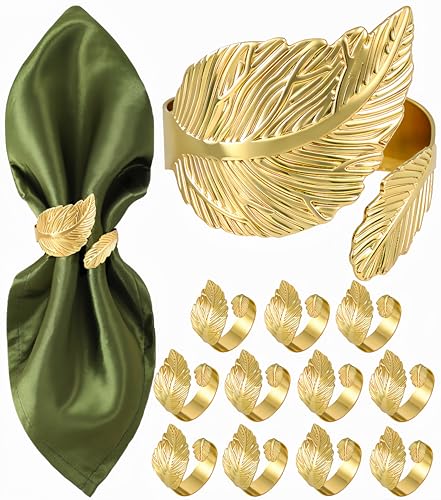


As an Amazon Associate we earn from qualifying purchases at no extra cost to you. Ratings are shown as listed on Amazon.
Best decorative napkin ring sets by table-setting situation
- For everyday meals: Choose smooth stainless steel, wood, ceramic, or resin rings in a four- or six-piece set. A 1.5- to 1.75-inch opening and a weight of roughly 0.5 to 1.5 ounces per ring is practical.
- For formal dinners: Select brass-tone, silver-tone, crystal-accented, or sculptural metal rings. Six or eight pieces work well for larger place settings, but avoid very tall decorations that block conversation.
- For thick linen napkins: Look for an opening of at least 1.75 inches, especially if the napkins are heavily hemmed, embroidered, or folded rather than rolled.
- For casual cotton or paper napkins: A 1.25- to 1.5-inch opening is usually sufficient. Lightweight wood, woven fiber, or resin keeps the setting relaxed.
- For outdoor dining: Favor heavier metal, stoneware, or dense resin rings. Avoid very light hollow pieces that can tip or blow away.
- For seasonal decorating: Four-piece sets are economical if the rings are used only occasionally. Choose a motif that can be stored easily and does not depend on fragile glued-on details.
Head-to-head comparison of decorative napkin ring materials
| Material | Typical weight per ring | Common opening | Best quality | Main drawback |
|---|---|---|---|---|
| Stainless steel | 0.8–2.0 oz | 1.5–1.75 in | Durability and easy cleaning | Can feel too modern or develop visible fingerprints |
| Brass or brass-finish metal | 0.7–1.8 oz | 1.5–2.0 in | Warm, formal appearance | Finish may tarnish or wear at contact points |
| Wood | 0.3–1.0 oz | 1.5–1.75 in | Natural texture and low visual formality | Should not be soaked or placed in a dishwasher unless labeled safe |
| Ceramic or stoneware | 1.5–3.5 oz | 1.5–2.0 in | Substantial feel and decorative color | Can chip, crack, or take up more storage space |
| Resin or acrylic | 0.4–1.5 oz | 1.5–2.0 in | Wide range of shapes and colors | May scratch, cloud, or look less refined at close range |
| Woven fiber or rattan | 0.2–0.7 oz | 1.75–2.25 in | Relaxed texture and generous fit | Food particles and moisture can collect between fibers |
These are useful buying ranges rather than universal standards. Decorative shapes can have a wide outer diameter while retaining a surprisingly narrow opening, so check the inner opening—not just the overall dimensions.
Opening size: the measurement that determines fit
Napkin rings are generally sized by their inside diameter. To estimate the required size, roll the napkin as you intend to use it and measure the widest part of the roll. Add about 0.25 inch for an easy slide-on fit.
For example, if a folded cotton napkin produces a 1.35-inch roll, a ring with a 1.5- to 1.625-inch opening should hold it without forcing the fabric. A thick linen napkin that rolls to 1.65 inches will be more comfortable in a 1.875- to 2-inch opening. If you want to use the same rings with several napkin types, size for the thickest one, then use a looser fold or tuck for thinner napkins.
Very large openings are not automatically more versatile. A 2-inch ring may look balanced with a bulky napkin but allow a thin cotton napkin to slide down onto the plate. For mixed linens, a gently tapered or slightly flexible design can hold more securely than a rigid, oversized cylinder.
How set count affects value
Match the set count to the number of places you normally set, not the number of chairs at the table. A four-piece set suits a small household or a two-person table with two spares. Six pieces cover a standard family table and provide a replacement if one ring is lost. Eight or twelve pieces make sense for frequent entertaining, long tables, or tables where napkins are used as part of a complete place setting.
Consider storage as well. A set of twelve bulky ceramic rings can occupy more room than twelve slim metal rings and may require individual wrapping. If a decorative set costs $24 for six pieces, its cost is $4 per ring. Used twice a month for three years, each ring is used approximately 72 times, making the purchase cost about 5.6 cents per ring-use before considering cleaning or replacement. A seasonal set used only six times a year has a much higher cost per use, so inexpensive resin or wood may be the more sensible choice.
Decision matrix for choosing a set
| Your priority | Recommended specification | Material types to consider | What to avoid |
|---|---|---|---|
| Lowest budget | Four-piece set, 1.5–1.75 in opening | Resin, wood, basic stainless steel | Complex glued embellishments |
| Frequent weekly use | Six-piece set, 0.8 oz or more per ring, washable surface | Stainless steel, glazed ceramic | Unsealed wood and delicate plating |
| Formal entertaining | Six- or eight-piece set, 1.5–2 in opening | Brass-tone metal, polished metal, crystal-accented designs | Oversized pieces that obstruct place settings |
| Thick linen napkins | 1.75–2 in opening, smooth interior | Metal, ceramic, woven fiber | Small rigid rings under 1.5 in |
| Outdoor table | At least 1 oz per ring or a broad stable base | Dense resin, stainless steel, stoneware | Light hollow metal and loose hanging parts |
| Limited storage | Stackable or slim rings, four- to six-piece set | Metal, flat wood, low-profile resin | Bulky figurines and fragile ceramics |
Features worth paying for—and features that often disappoint
Smooth interiors
The inside edge touches the napkin repeatedly, so it matters more than a highly detailed exterior. Look for rounded or polished interiors without burrs, sharp seams, or rough casting. These defects can catch threads, particularly on linen and loosely woven cotton.
Stable weight
Heavier is useful outdoors, but excessive weight can make a ring awkward to handle and more likely to chip a plate if dropped. For indoor dining, 0.5 to 1.5 ounces per ring is usually enough. Wide bases and low centers of gravity can provide better stability than a narrow, top-heavy ornament.
Finish quality
Metal plating commonly wears first on the lower edge and inside opening because those areas contact plates, napkins, and storage surfaces. A finish described as color-coated or plated should be hand-washed if the care instructions recommend it. Uncoated stainless steel is generally the safer choice for repeated washing.
Secure decorative details
Leaves, beads, animals, and seasonal figures add personality, but check whether they are molded as one piece or attached separately. Small glued components can loosen before the main ring fails. This matters when the set will be used around children or stored in a crowded drawer.
Cleaning and ownership tips
- Remove crumbs before washing. Brush or shake out debris so it does not lodge in textured designs or woven fibers.
- Use the material-appropriate method. Wash stainless steel and glazed ceramic with mild dish soap. Wipe wood with a damp cloth and dry it immediately. Clean brass-tone or plated pieces according to the finish instructions rather than assuming they are dishwasher-safe.
- Dry completely. Trapped moisture can stain wood, encourage odor in woven materials, and accelerate tarnish on some metals.
- Store fragile pieces separately. A shallow divided box or soft cloth between ceramic or plated rings prevents chips and rubbing.
- Inspect the napkin contact area. Discontinue a ring if a crack, sharp edge, flaking finish, or exposed wire can snag fabric.
The most common mistake is cleaning every material in the same way. Dishwasher heat and detergent can dull plated finishes, soften some adhesives, fade painted resin, and damage unsealed wood. Another frequent error is buying based on the outer diameter alone; a large decorative ring may still have an opening too small for a thick napkin.
Bottom line
For a dependable all-purpose choice, select a six-piece stainless steel or smooth resin set with a 1.5- to 1.75-inch opening and moderate weight. Choose wood or woven fiber for a relaxed, natural table; ceramic for visual presence; and brass-tone or polished metal for formal settings. Before buying, measure your thickest rolled napkin, count the places you regularly set, and check how the finish should be cleaned. Those three details usually matter more than the decorative motif.


Write Your Review
No reviews yet. Be the first to share your experience!