

Key takeaways
- Compare six electric wine openers by battery life, charging base, foil cutter and accessories, with plain picks for everyday use and gifting.
The best electric wine opener for most people is the Cuisinart CWO-25: a brand-name rechargeable opener on a charging base, rated by the maker for roughly 50 bottles per charge, with a foil cutter stored in the base. If you want more charges between plug-ins, the VINABON lists up to 100 bottles per charge, and if you want a ready-made gift with a vacuum pump and pourer, the CIRCLE JOY 7-in-1 set is built for that. An electric wine opener is a battery-powered corkscrew that grips the cork, pulls it out at the press of a button and releases it, which suits people with weak wrists, arthritis or a crowd of bottles to open.
Quick List
- Cuisinart CWO-25 – best for a trusted brand name and a charging base with a built-in foil cutter spot
- VINABON One-Touch Opener – best for the longest listed battery life per charge
- Secura Electric Wine Opener – best for a simple stainless steel body and foil cutter
- Moocoo Electric Wine Opener Set – best for a charging base plus aerator, pourer and vacuum stoppers
- CIRCLE JOY 7-in-1 Gift Set – best for gifting with a vacuum pump and aerator included
- Oster Cordless Electric Opener – best for a no-frills opener with a foil cutter
Which One Is Right for You?
| If you… | Choose |
|---|---|
| Want a recognized small-appliance brand | Cuisinart CWO-25 |
| Open many bottles and hate charging | VINABON One-Touch |
| Are buying a present for a wine lover | CIRCLE JOY 7-in-1 Gift Set |
| Want an aerator and pourer along with the opener | Moocoo Electric Opener Set |
| Prefer a sleek stainless body for a countertop | Secura Electric Wine Opener |
| Need a basic tool for occasional use | Oster Cordless |
Think first about how often you open bottles and whether you will use the extras. A charging base keeps the opener topped up and sitting upright on the counter, while accessories such as pourers and vacuum stoppers only matter if you leave bottles partly full. If your wines come with synthetic or natural corks, any of these can handle them, but very old or crumbly corks can still be best removed by hand.
All 6 Picks in Detail
1. Cuisinart CWO-25 – Best for a trusted brand and a charging base
As an Amazon Associate we earn from qualifying purchases at no extra cost to you.

The Cuisinart CWO-25 is the straightforward choice for buyers who prefer a known appliance brand. Cuisinart’s information states it opens up to 50 bottles on a full charge and that the foil cutter stores in the charging base. It has two controls, one for removing the cork and one for ejecting it, which makes the operation easy to learn. The company recommends a long first charge, around 12 hours, and says to use it only on 120-volt outlets. Cuisinart’s own page shows it as discontinued, so availability varies by seller and you should confirm the current version on the product page.
- Rechargeable NiMH battery pack, about 50 bottles per charge per the maker
- Charging base that stores the foil cutter
- Two switches, one to remove the cork and one to eject it
- Stainless steel finish
- Roughly 10 inches tall on the base, per product information
Before you buy, confirm the current model and its charge indicator, since the manufacturer lists the line as discontinued. Make sure the charging base is included and that the foil cutter fits snugly in its slot.
Pros
- Recognizable brand and simple controls
- Base keeps the opener upright and charged
- Foil cutter has a defined home
Cons
- Fewer bottles per charge than the VINABON listing
- Older design with a NiMH pack rather than newer battery types
Best use: a household that opens a few bottles a week and wants the opener standing ready on the counter. Leave it on its base between uses, and give it the long first charge the maker recommends so the battery starts in good condition. Because the foil cutter has a home in the base, it is less likely to go missing in a drawer.
Compared with the Oster, it adds a dedicated charging base and a more complete setup, but it takes up more counter space.
2. VINABON One-Touch Opener – Best for the longest battery life

VINABON positions this opener as updated for 2026, with one-touch automatic operation and a rechargeable battery rated for up to 100 bottles per charge. That figure is the highest on the list, and it matters for people who open bottles at parties or in a restaurant-style setting. The listing text is truncated after the battery claim, so check which accessories are included, such as a foil cutter, charging cable or stand. As with any claim of bottles per charge, real life results vary with cork type and battery age.
- One-touch automatic cork removal
- Rechargeable, with up to 100 bottles per charge per listing
- Corkscrew-style worm that threads into the cork
- Charging method and accessories: confirm on listing
- Foil cutter: confirm on listing
Before you buy, confirm which accessories come in the box and how the opener is charged, whether by cable or stand. A claim of 100 bottles per charge is attractive, but it is the maker’s figure under ideal conditions.
Pros
- Highest stated number of bottles per charge in this list
- Single-button operation is easy to learn
- Updated model name suggests a current design
Cons
- Less-known brand with limited published details
- Battery claim is the maker’s estimate, not independently confirmed
Best use: a host who opens many bottles at dinner parties, tastings or holidays and does not want to think about the battery for months. Charge it fully before a big event anyway, since the figure assumes ideal conditions, and keep a manual corkscrew nearby as a backup for any stubborn cork.
It offers longer stated runtime than the Cuisinart, though the Cuisinart has the more established name.
3. Secura Electric Wine Opener – Best for a simple stainless steel body

Secura sells a stainless steel automatic wine opener with a foil cutter and a rechargeable battery. It is the sort of opener that sits on a counter in its charging stand and looks tidy next to a wine rack. The listing states the stainless steel construction and rechargeability but not battery capacity, so confirm the number of bottles per charge and the charging method on the product page. It suits an occasional host who wants an electric option that is neither bulky nor novelty-looking.
- Stainless steel exterior
- Automatic corkscrew action
- Foil cutter included
- Rechargeable battery, capacity to confirm
- Charging stand details: confirm on listing
Before you buy, confirm battery capacity, run time and whether the stand is included. Stainless finishes show fingerprints, so a quick wipe keeps the opener looking presentable on a bar cart.
Pros
- Clean, sleek appearance
- Foil cutter included
- Rechargeable, so no disposable batteries
Cons
- Battery capacity not stated in the listing
- No wine accessories listed, unlike the gift sets
Best use: a kitchen where the opener lives on display next to the wine rack. Look at the finish and the stand before you buy, since the listing leaves out battery capacity, and decide whether you want a gadget that holds a charge for months or one you top up each week.
It is plainer than the Moocoo set, which adds an aerator and stoppers, but it takes up less space.
4. Moocoo Electric Wine Opener Set – Best for accessories and a charging base
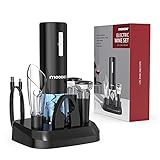
The Moocoo listing describes a cordless opener with a charging base, a two-in-one aerator and pourer, a foil cutter and two vacuum preservation stoppers. That is a bundle for people who open a bottle, pour a glass and then want to save the rest. The aerator can soften young red wines by adding air as you pour, and vacuum stoppers help slow oxidation, though the exact number of days of preservation depends on the wine and is only a rough guide. Confirm the included accessories and their materials on the product page.
- Cordless opener with a charging base
- 2-in-1 aerator and pourer
- Foil cutter included
- Two vacuum preservation stoppers named in the listing
- Battery capacity and bottles per charge: confirm on listing
Before you buy, confirm the pourer and stopper materials, and whether the stoppers are intended for still wine only. Never use a vacuum stopper on sparkling wine, and check that the base accepts the opener firmly.
Pros
- Several accessories in one box
- Stoppers help with half-finished bottles
- Base keeps the opener ready
Cons
- Extras add clutter if you do not use them
- Battery claims are not in the title
Best use: someone who finishes most bottles but occasionally saves half for the next night. The aerator pourer opens up young reds as you pour, and the stoppers keep the rest tidy. Wash the pourer and stoppers by hand so the seals last.
Next to the CIRCLE JOY gift set, it has fewer pieces but a charging base that keeps the opener on the counter.
5. CIRCLE JOY 7-in-1 Gift Set – Best for gifting with a vacuum pump

The CIRCLE JOY listing calls this a rechargeable seven-in-one set that includes an automatic opener, an electric vacuum pump, a foil cutter and an aerator pourer, with further pieces named in the truncated title. It is built for gifting: the package is meant to be given as a complete wine kit. The vacuum pump is the feature most openers lack. It pulls air out of a stopper to slow spoilage, which helps if you rarely finish a bottle in one sitting. Confirm the full contents and the battery information on the product page.
- Rechargeable automatic wine opener
- Electric vacuum pump for preservation
- Foil cutter and aerator pourer
- Seven-piece set per the title; exact contents to confirm
- Charging cable or base: confirm on listing
Before you buy, confirm every piece in the seven-piece set and how each one charges. A set that uses several different cables can be inconvenient, so look for common USB charging.
Pros
- Most complete kit in the list
- Gift-ready packaging concept
- Vacuum pump adds practical value
Cons
- More components to charge and keep track of
- Not the most compact choice for a small drawer
Best use: a birthday, a housewarming or a holiday present for a friend who enjoys wine but has no gadgets yet. Before wrapping it, charge each rechargeable part once so the recipient can use it straight away, and tell them which stopper fits which bottle.
It has more accessories than the Moocoo set, while the Moocoo is simpler and centered on the charging base.
6. Oster Cordless Electric Wine Bottle Opener – Best for a no-frills opener

The Oster listing is brief: a cordless electric wine bottle opener with a foil cutter in silver. That simplicity is the point. It suits someone who wants an easy-to-use electric opener and has no need for pourers or pumps. Because the title does not state battery type, bottles per charge or whether a charging base is included, confirm those on the product page before buying. It is also the oldest design in this group, so check that the current version still matches photos and photos you have seen.
- Cordless electric operation
- Foil cutter included
- Silver finish
- Battery type and bottles per charge: confirm on listing
- Charging base: confirm on listing
Before you buy, confirm the battery type, whether the batteries are replaceable and whether a charging cradle is included. A sparse listing means the product page is the place to look for details.
Pros
- Simple and uncluttered
- Recognized small-appliance brand
- Foil cutter included
Cons
- Sparse listing information
- No extras for preserving or pouring
Best use: a guest-room bar cart, a boat or a camper where a minimal tool is enough and counter space is tight. Check how it is charged and whether the battery is replaceable, because those details decide how long the opener will serve you.
It lacks the charging base and brand detail of the Cuisinart but keeps the same simple job.
Specs Compared
| Model | Power | Bottles per charge | Foil cutter | Charging base | Extras |
|---|---|---|---|---|---|
| Cuisinart CWO-25 | Rechargeable NiMH | Up to 50 (maker) | Yes, stored in base | Yes | None listed |
| VINABON One-Touch | Rechargeable | Up to 100 (listing) | Confirm on listing | Confirm on listing | Confirm on listing |
| Secura | Rechargeable | Confirm on listing | Yes | Confirm on listing | None listed |
| Moocoo Set | Rechargeable | Confirm on listing | Yes | Yes | Aerator and pourer, 2 vacuum stoppers |
| CIRCLE JOY 7-in-1 | Rechargeable | Confirm on listing | Yes | Confirm on listing | Vacuum pump, aerator pourer, more |
| Oster Cordless | Cordless; battery type to confirm | Confirm on listing | Yes | Confirm on listing | None listed |
How We Chose These
We built this guide from the six openers in the catalog set for this topic and compared them using listing titles, brand product pages and general guidance on cordless small appliances. Criteria were: stated bottles per charge, whether a charging base is included, foil cutter inclusion, included accessories, build material and how clearly the listing states the details. We did not operate any of these openers ourselves, so we do not claim performance beyond what the maker states. Where a listing is silent on battery life or contents, we say “confirm on listing” instead of guessing.
What to Look For
Battery type and bottles per charge
Most electric openers use a rechargeable lithium-ion or nickel-metal hydride pack. Lithium-ion packs are lighter and hold a charge longer when idle; NiMH packs are common in older designs and may take longer to charge. Manufacturers state bottles per charge under ideal conditions, usually with fresh natural corks, so treat 50 as a realistic upper range and 100 as a best case. Worked example: if you open two bottles a week, a 50-bottle charge lasts about 25 weeks, so you would recharge twice a year. If you host parties of 10 bottles, even 50 bottles per charge is plenty for the season.
Cork type and bottle fit
Standard corks are about 24 millimeters across and 1.75 to 2 inches long. Natural corks, synthetic corks and some composite closures all work with a worm-style corkscrew, but synthetic corks can grip hard and may drain a battery faster. Very old or dry corks can crumble; for those, remove them by hand with a two-prong cork puller. Screw caps and glass stoppers do not need an opener. Check that the opener’s height works with tall bottles, such as sparkling wine bottles with wire hoods, which should be opened with a different method for safety.
Foil cutter, base and accessories
A foil cutter is a small circular blade that slices the capsule beneath the lip. It saves a step and a stray knife slip. A charging base keeps the opener upright and charged, so it is ready for guests. Accessories like aerators, pourers and vacuum stoppers are useful only if you will use them. Vacuum stoppers slow oxidation, but the preservation window varies, and most sources suggest finishing a bottle within a few days. Do not use a vacuum stopper on sparkling wine.
Safety and care
Charge only with the supplied adapter or cable, and stop using any unit that overheats, swells or smells of burning. Keep it away from water and do not immerse it. Keep fingers away from the worm while it is spinning, and hold the opener straight over the bottle. Store it in the base or a dry drawer. Wipe the worm with a damp cloth after use to remove cork dust.
Counter space, noise and ease of use
Electric openers are small, but a charging stand adds a footprint of roughly four inches square and stands about ten inches tall, which is worth checking against the shelf space under your cabinets. Most units make a short whirring noise while the worm turns, so they are unobtrusive in a dining room but audible in a quiet kitchen. Look for a design where one button pulls and another ejects: it is easier to learn than a single toggle, and it lets you stop partway if the cork seems stuck. Weight matters too. A heavier unit feels stable on the bottle, but a light one is easier for a person with limited grip strength to hold in line.
Gift sets versus single openers. A gift set looks generous, but the extra pieces only matter if they match your habits. A vacuum pump suits someone who often saves half a bottle, an aerator suits a drinker of young reds, and a foil cutter is useful in every case. If you already own a favorite stopper or pourer, a single opener with a charging base is the cleaner buy. If you are shopping for a person you do not know well, a set avoids guessing which accessory they lack. Whatever you pick, remember that every rechargeable item in the box needs charging before first use, and a drawer full of cables is the hidden cost of the largest sets.
Opening a bottle, step by step. Remove the capsule with the foil cutter by gripping the bottle neck, turning the cutter around the lip and peeling the foil away. Set the bottle on a flat surface, center the opener over the cork and press the button to drive the worm in. Keep the opener vertical and let it run: the motor reverses and lifts the cork out, and a second button or the same switch ejects it. Stop if the opener tilts or the cork begins to crumble, then finish with a manual corkscrew. Wipe the neck of the bottle before pouring to remove any cork dust or foil residue.
When a cork will not cooperate. Dry, brittle corks can break under power, and plastic or composite corks can grip the worm. If the worm spins without grabbing, remove it, reposition the opener and try again. If a cork breaks into pieces, push the remaining piece into the bottle gently and strain the wine through a fine filter when pouring. Store wine bottles on their sides so the cork stays slightly damp, which also lowers the chance of crumbling. For rare or old bottles, a two-prong cork puller is gentler than any motor, and many collectors keep one on hand even if they use an electric opener for everyday wine.
Questions
Are electric wine openers worth it?
They are worth it if you open bottles often, entertain, or have limited hand strength. For occasional use, a quality manual waiter’s corkscrew is simpler and takes no charging.
How long does the battery last?
Makers list roughly 50 to 100 bottles per charge for the models that state a figure. The Cuisinart is stated at about 50, and the VINABON listing at up to 100. Real results depend on cork type and battery age.
Can electric openers handle synthetic corks?
Most can, though synthetic corks grip the worm more tightly and may reduce bottles per charge. If a cork resists, stop and use a manual method rather than forcing it.
Do I need the vacuum pump and aerator?
No, they are optional. They help if you often leave bottles half full or pour young red wines, but they add parts to store and charge.
Can I use one on sparkling wine?
No. Sparkling wine corks are under pressure and have wire hoods, and they should be removed by hand with controlled pressure.
How should I clean the opener?
Wipe the outside with a damp cloth and clear cork dust from the worm. Do not submerge it or run it through a dishwasher.
Update History
- October 20, 2026 – Initial publication; product set drawn from current catalog listings.
- Check the product page for current specifications and availability before buying.
Sources
- Manufacturer product information for Cuisinart
- Retailer listing titles and specification fields for each opener
- General guidance on cork sizes and wine closures from wine-service references







Write Your Review
No reviews yet. Be the first to share your experience!