

Key takeaways
- Porcelain: Usually lighter and less porous than earthenware, with a polished appearance suitable for formal dining. It can chip if knocked against a sink or stacked without care.
- Stoneware: Heavier and often more substantial, with good heat retention and many glaze options. Its weight matters when carrying several loaded platters.
- Glass: Easy to inspect for cleanliness and often resistant to food odors. Tempered glass is preferable, but sudden temperature changes can still cause damage.
- Melamine: Lightweight and resistant to ordinary knocks, making it practical outdoors. It should not be used in a microwave, and many manufacturers recommend avoiding very hot foods.
- Stainless steel: Durable, nonporous, and useful for transport or buffet service. It can show fingerprints and scratches, and it provides less visual warmth than ceramic.
- Wood or bamboo: Attractive for bread, cheese, and dry snacks. These materials require prompt hand-washing and thorough drying; they are less suitable for wet foods left out for long periods.
The best appetizer serving platter set is a three- to five-piece set with at least one 12–14-inch platter, removable or built-in compartments, a stable rim, and materials that tolerate your normal cleaning routine.
The right choice depends less on decoration than on how you serve: a compact ceramic set suits occasional dinners, divided trays help keep dips and dry snacks organized, and lightweight melamine or stainless steel is more practical for large outdoor gatherings. Before buying, compare usable surface area, not just the number of pieces.
Our top picks


As an Amazon Associate we earn from qualifying purchases at no extra cost to you. Ratings are shown as listed on Amazon.
Best appetizer serving platter set choices by hosting situation
| Hosting situation | Best set format | Useful specifications | Typical market range |
|---|---|---|---|
| Small apartment or occasional use | Three-piece ceramic or porcelain set | 10–12-inch platters; stackable; 4–7 lb total | $25–$55 |
| Frequent dinner parties | Four- or five-piece divided set | One 14-inch platter, two 10–12-inch pieces, 3–5 compartments | $45–$100 |
| Large indoor gatherings | Multi-piece ceramic or porcelain serving collection | 18–30 inches of combined serving length; 12–24 oz dip bowls | $60–$150 |
| Patio, poolside, or family use | Melamine divided trays | 12–16 inches; under 2 lb per tray; dishwasher-safe top rack | $20–$70 |
| Buffet service or frequent transport | Stainless-steel or reinforced plastic trays | 14–18 inches; raised edge; nesting or lidded storage | $35–$120 |
What size platter do you actually need?
A 10-inch platter is suitable for roughly 8–12 bite-size appetizers, such as stuffed olives, deviled eggs, or small pastries. A 12-inch platter generally holds 16–24 pieces without forcing food into a tall pile. A 14-inch platter gives enough room for 24–36 pieces, depending on their size and whether you include a bowl for dip.
For a party of 12, plan on about six appetizer portions per guest if the food precedes a meal. That is 72 portions. Three 12-inch platters holding 24 portions each provide the needed capacity while keeping each platter focused on one category. For a cocktail-style gathering where appetizers are the main food, plan closer to 10–12 portions per guest and add a fourth platter or replenish in batches.
Measure the table before choosing an oversized set. A 14-inch round platter occupies about 154 square inches before accounting for clearance. Four such platters require more than 600 square inches, so a narrow buffet may work better with two long rectangular trays and smaller bowls placed between them.
Compartment layouts: useful organization or wasted space?
Single open platters
Open platters offer the most usable area and are easiest to arrange. They work well for sandwiches, pastry, sliced vegetables, and foods that do not need separation. Their weakness is that crackers can become damp when placed beside juicy fruit or vegetables, and different flavors can mingle.
Three-section and five-section trays
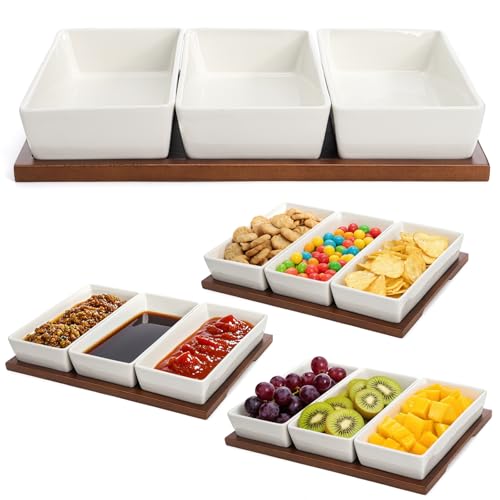
Divided trays are useful when you want a ready-made arrangement: crackers in the large section, cheese or vegetables in the smaller sections, and a dip bowl in the center. Look for compartments at least 2 inches deep and wide enough to retrieve food with ordinary serving tongs. Very narrow sections may look attractive but hold only a handful of olives or nuts.
Removable bowls and center inserts
A platter with removable dip bowls is more flexible than a permanently molded design. You can wash the bowls separately, use the platter for dry food, or replace a bowl with a small ramekin. Check that inserts sit securely; loose bowls slide when guests scoop from them.
Materials compared: appearance, weight, and upkeep
- Porcelain: Usually lighter and less porous than earthenware, with a polished appearance suitable for formal dining. It can chip if knocked against a sink or stacked without care.
- Stoneware: Heavier and often more substantial, with good heat retention and many glaze options. Its weight matters when carrying several loaded platters.
- Glass: Easy to inspect for cleanliness and often resistant to food odors. Tempered glass is preferable, but sudden temperature changes can still cause damage.
- Melamine: Lightweight and resistant to ordinary knocks, making it practical outdoors. It should not be used in a microwave, and many manufacturers recommend avoiding very hot foods.
- Stainless steel: Durable, nonporous, and useful for transport or buffet service. It can show fingerprints and scratches, and it provides less visual warmth than ceramic.
- Wood or bamboo: Attractive for bread, cheese, and dry snacks. These materials require prompt hand-washing and thorough drying; they are less suitable for wet foods left out for long periods.
Dishwasher safety is more complicated than “dishwasher-safe”
Confirm whether the label applies to every component. A ceramic platter may be dishwasher-safe while its silicone feet, wooden handles, painted decoration, or metal trim require hand-washing. Top-rack guidance is especially important for melamine and plastic pieces because heat and pressure can cause warping.
Do not place a cold glass or ceramic platter directly into a hot dishwasher after serving warm food. Let it cool first. Avoid abrasive powders on glossy glazes, and do not use metal utensils on surfaces that scratch easily. If a serving set has hairline cracks, chipped glaze, or a loose bonded base, retire the damaged piece rather than continuing to wash it repeatedly.
Storage: stacking height matters more than piece count
Measure the complete stacked height, including handles and raised feet. A five-piece set that stacks to 9 inches may be harder to store than three flat platters totaling 4 inches. Soft separators or felt pads reduce edge-to-edge contact, especially with stoneware.
Rectangular platters often store more efficiently in a cupboard because they can stand vertically in a rack. Round platters are easier to rotate while arranging food but consume more shelf depth. If cabinet space is limited, prioritize nesting pieces, removable bowls, and a design without permanently attached center towers.
Decision matrix for choosing confidently
| Priority | Choose | Avoid | Why |
|---|---|---|---|
| Lowest upfront cost | Three-piece ceramic set | Large specialty collection | Fewer pieces cover basic serving needs and are easier to replace individually. |
| Limited storage | Flat, nesting platters with removable bowls | Raised multi-level towers | Lower stacked height and fewer awkward shapes. |
| Beginner host | Three-section tray with a center bowl | Several identical open platters | Compartments make portions and food separation easier to manage. |
| Weekly use | Porcelain, stainless steel, or robust melamine | Delicate painted or wooden surfaces | Frequent washing exposes decorative finishes and porous materials to more wear. |
| Outdoor entertaining | Lightweight melamine with a broad rim | Heavy glass or unsealed wood | Lower breakage risk and easier carrying from kitchen to patio. |
Durability and ownership details that product photos miss
Edges usually wear before the center of a platter. Repeated contact with sink basins, dishwasher racks, and other dishes can create small chips. Glazed decoration may fade or develop fine scratches, while wooden pieces can dry, stain, or absorb onion and garlic odors. Silicone feet may loosen after repeated washing, and removable dip bowls are easy to misplace.
To extend the life of a set, do not overload a platter beyond what you can carry safely. Load heavy dip bowls near the center, keep one hand under the base, and use a tray for transporting multiple pieces. Store clean platters completely dry. For wood, apply the manufacturer’s recommended food-safe conditioner occasionally, but do not soak the piece.
How to build a practical appetizer spread
- Choose one large platter for the main food, such as sandwiches, pastries, or sliced vegetables.
- Add a divided tray for dry items that benefit from separation, such as crackers, nuts, olives, and dried fruit.
- Reserve a bowl or compartment for wet foods so moisture does not soften crisp items.
- Leave approximately 1 inch of visible space around the platter edge for cleaner handling.
- Put serving spoons, tongs, or picks beside the food rather than burying them in the arrangement.
For most households, the best appetizer serving platter set is not the largest collection. A durable, dishwasher-compatible set with one 14-inch platter, two smaller platters, and one or two removable bowls provides useful capacity for both everyday snacks and a 10–12-person gathering, while remaining manageable to wash and store.






Write Your Review
No reviews yet. Be the first to share your experience!