

Key takeaways
- Subtle grain: A calmer appearance hides minor scratches and works well with simple tableware.
- High-contrast grain: More decorative and visually striking, but scratches and uneven fading may be easier to notice.
- Thick walls: Usually feel more substantial and resist flexing, although they add weight.
- Thin walls: Reduce weight and cost but can feel less stable and may show dents or splits sooner.
Best Acacia Wood Serving Bowls
The best acacia wood serving bowl for most homes is a 12- to 14-inch bowl with a food-safe oil finish, a stable foot or thick base, moderate weight, and a smooth interior that can handle salads, snacks, and shared side dishes without becoming difficult to wash.
There is no single ideal size for every table. A 10-inch bowl is easier to store and suits snacks or two-person salads, while a 16-inch bowl makes sense for a large family or buffet but needs more cupboard space and careful handling. The most useful comparison is therefore between diameter, capacity, grain, finish, weight, care, and how often you expect to use the bowl.
Our top picks
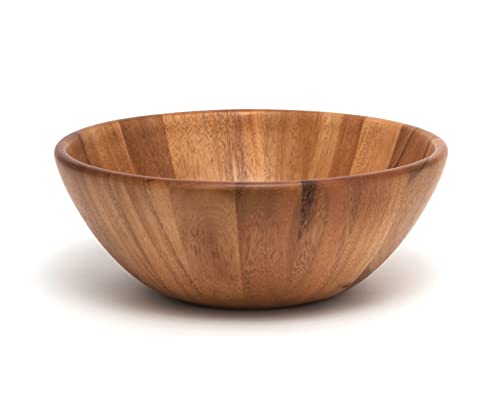
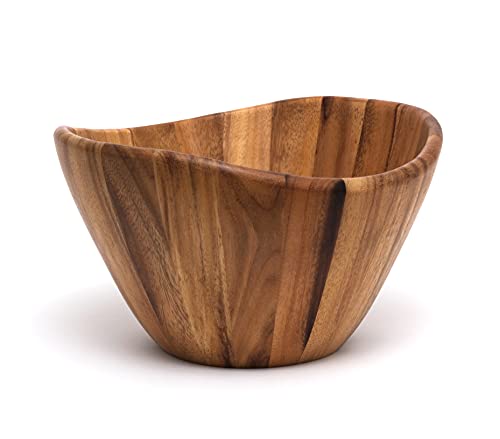


As an Amazon Associate we earn from qualifying purchases at no extra cost to you. Ratings are shown as listed on Amazon.
Quick comparison: which specification matters most?
| Bowl type | Typical diameter | Approximate capacity | Typical weight | Best use | Main compromise |
|---|---|---|---|---|---|
| Compact snack bowl | 8–10 inches | 1.5–3 quarts | 1–2.5 lb | Nuts, fruit, popcorn, small salads | Too small for a shared main dish |
| Everyday salad bowl | 12–14 inches | 4–7 quarts | 2.5–5 lb | Family salads and side dishes | Needs hand washing and cupboard space |
| Large serving bowl | 15–16 inches | 7–10 quarts | 4.5–8 lb | Buffets, pasta, large gatherings | Heavier and more vulnerable to awkward handling |
| Deep round bowl | 11–14 inches | 4–8 quarts | 3–6 lb | Rice, pasta, grain salads, shared dishes | Can be less convenient for serving with a wide utensil |
Capacity varies with the bowl’s height and wall shape, so diameter alone is not enough. A broad, shallow 14-inch bowl may hold less than a deep 12-inch bowl. Check both measurements when cabinet space is tight.
Best by situation
Best for most households: a 12- to 14-inch everyday bowl
This is the most versatile choice. It is large enough for a salad serving four to six people, a side dish at a family meal, or snacks for a gathering, but it is not so large that it becomes difficult to lift when full. Look for a rounded interior, a base at least 5 inches across, and a weight around 3 to 5 pounds.
A broad rim is useful for tossing greens without spilling. A deeper profile is better for pasta, rice, and dishes with dressing. If you want one acacia bowl rather than a matching set, this diameter range offers the best balance of capacity and storage.
Best for small spaces or occasional use: an 8- to 10-inch bowl
Choose this size for one or two people, apartment kitchens, snack service, or a table that already has several serving dishes. A smaller bowl is easier to wash and less likely to be left sitting wet. It will not comfortably hold a full family salad, however, and a narrow bowl can make tossing more awkward than its capacity suggests.
Best for entertaining: a 15- to 16-inch bowl
Large bowls create useful serving capacity for buffet meals, but filled acacia is not lightweight. Eight quarts of food can add roughly 12 to 16 pounds to the bowl, depending on the dish. That makes a thick, stable base and two-handed lifting especially important. A large bowl is worthwhile if you regularly serve six or more people; otherwise, two medium bowls are often easier to carry and refrigerate.
Wood grain and finish: appearance versus ownership
Acacia grain ranges from relatively straight lines to dramatic swirls, knots, and contrasting bands of golden brown, reddish brown, and dark brown. End-grain patterns can look particularly varied. This is part of the appeal, but it means two bowls made from the same species will not look identical.
- Subtle grain: A calmer appearance hides minor scratches and works well with simple tableware.
- High-contrast grain: More decorative and visually striking, but scratches and uneven fading may be easier to notice.
- Thick walls: Usually feel more substantial and resist flexing, although they add weight.
- Thin walls: Reduce weight and cost but can feel less stable and may show dents or splits sooner.
For a bowl used with dressed salads, choose a smooth, food-contact-safe finish with no rough interior patches. Many acacia bowls are sold with a penetrating oil or oil-and-wax finish rather than a thick glossy coating. That finish emphasizes the grain and can be renewed, but it requires periodic care. A lacquered or sealed surface may resist staining more effectively at first, yet a damaged coating can be harder to repair invisibly.
Do not assume that “natural” means maintenance-free. The important questions are whether the finish is intended for food contact, whether the manufacturer specifies mineral oil or a particular conditioner, and whether the bowl is sealed on the inside as well as the outside.
Decision matrix for buying
| Your situation | Recommended specification | Why |
|---|---|---|
| Budget-conscious occasional user | 8–12 inches, 1.5–3 lb, simple oil finish | Lower material cost and easier storage; occasional conditioning is manageable |
| Frequent family meals | 12–14 inches, 3–5 lb, thick base, smooth interior | Balances capacity, stability, and handling |
| Frequent entertainer | 15–16 inches or two 12-inch bowls, reinforced base | Provides volume; two medium bowls reduce lifting and serving strain |
| Limited cupboard space | 10–12 inches, stackable profile, lower rim height | Fits more easily and can serve both snacks and small salads |
| First wooden serving piece | 12 inches, moderate weight, oil-and-wax finish | Forgiving size and a finish that can usually be refreshed |
Durability: what wears first?
Acacia is a dense hardwood, so a well-made bowl can remain attractive for years. Its durability still depends on construction and moisture exposure. The finish commonly shows wear before the wood itself does. Dry, pale patches may appear where the bowl is handled frequently, while knife marks, fork scratches, and dark stains are most visible on a smooth or lightly colored interior.
The rim and base deserve particular attention. A thin rim can chip if knocked against a sink, and a narrow base can rock when the bowl is being tossed. Small hairline cracks are more likely when the wood repeatedly absorbs water and dries quickly. A bowl that feels slightly flexible, has rough end grain, or shows open splits at the rim is a poorer long-term choice than a heavier bowl with uniform construction.
General market pricing is often about $20–$45 for a small or medium acacia bowl, $40–$90 for a substantial 12- to 14-inch bowl, and $75–$160 or more for a large, thick-walled decorative piece. Price is not a guarantee of longevity; construction, finish quality, and care instructions matter more.
How to care for an acacia serving bowl
- Remove food promptly. Acidic dressings, tomato, berries, and strongly pigmented sauces can stain or dull the finish if left for hours.
- Wash by hand. Use lukewarm water, a small amount of mild dish soap, and a soft sponge. Avoid soaking the bowl.
- Dry immediately. Wipe all surfaces, including the underside, and let the bowl finish air-drying upright or on a rack.
- Condition when the surface looks dry. Apply a thin layer of food-safe mineral oil or the conditioner specified by the maker. Leave it for several hours, then wipe away excess.
- Keep it away from heat. Do not use an acacia serving bowl in an oven, microwave, refrigerator, or dishwasher unless the specific manufacturer explicitly permits it.
As a practical ownership estimate, a frequently used bowl may need conditioning every four to eight weeks, while an occasional-use bowl may need it only two to four times a year. The visual test is more useful than a calendar: if water no longer beads briefly, the grain looks ashy, or the surface feels rough, it may be time to refresh the finish.
Common buying mistakes
- Choosing by diameter alone: Check height, usable capacity, and base width.
- Buying the largest bowl for a small table: A full large bowl can be difficult to pass safely.
- Confusing decorative bowls with food-service bowls: Confirm that the interior finish is intended for food contact.
- Expecting dishwasher convenience: Heat, detergent, and prolonged water exposure can warp or split wood.
- Ignoring storage clearance: Measure shelf height and the path from cabinet to table before buying a 16-inch bowl.
Final recommendation
For one dependable all-purpose choice, select a 12- to 14-inch acacia bowl weighing roughly 3 to 5 pounds, with a stable base, smooth food-safe finish, and enough depth for both tossed salads and shared dishes. Choose a smaller 8- to 10-inch model when storage and easy cleaning matter most, or move to a large 15- to 16-inch bowl only when you regularly serve a crowd. The best bowl is not simply the one with the most dramatic grain; it is the one whose capacity, weight, finish, and care routine match how your table actually operates.


Write Your Review
No reviews yet. Be the first to share your experience!