

Key takeaways
-
Very wide shot glasses: convenient, but poor at concentrating nuanced aroma.
-
Huge brandy balloons: often excessive for a 25- to 40-milliliter pour and easy to warm by hand.
-
Extremely tall, narrow stems: elegant but less stable and more vulnerable to breakage.
-
Heavy decorative rims: they can distract from the sip and make small pours feel clumsy.
-
Unverified “crystal” claims: prioritize bowl geometry, rim quality, and care instructions over the label alone.
Best Grappa Glasses for Italian Spirits
The best grappa glasses for Italian spirits are small tulip-shaped glasses with a rounded bowl, a gently narrowed rim, a stable stem, and a capacity of roughly 4 to 6 ounces (120 to 180 milliliters)—large enough to collect aroma but not so large that the spirit warms too quickly.
What makes a grappa glass work?
Grappa is a grape pomace spirit, and its aroma can range from floral and delicate to peppery, herbal, fruity, or intensely alcoholic. The right glass does not change the spirit; it controls how its vapors reach your nose and how comfortably you can sip it.
Our top picks
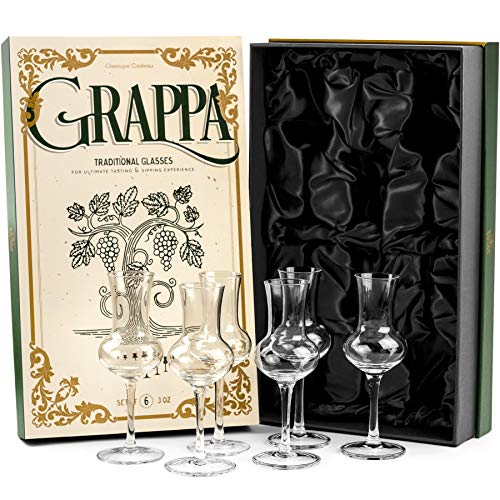

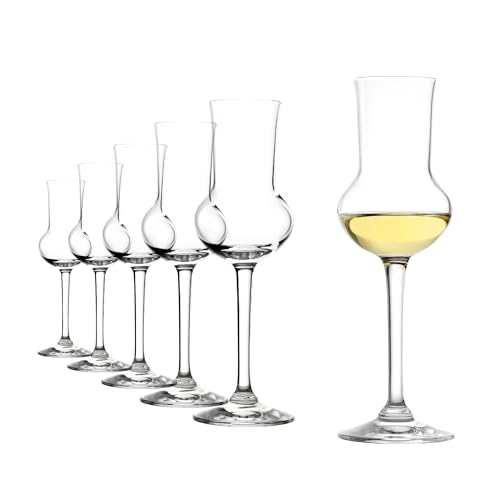

As an Amazon Associate we earn from qualifying purchases at no extra cost to you. Ratings are shown as listed on Amazon.
Tulip bowl shape: the most important feature
A tulip bowl is wider at the lower half and narrows toward the opening. This shape gives grappa room to release aromas while concentrating those aromas near the rim. A straight-sided shot glass offers much less room for swirling and sends a concentrated burst of alcohol directly upward, which can obscure subtle notes.
The bowl should have enough width for a small pour to sit below the widest point. That leaves an air space above the liquid where aromas can collect. A narrow, elongated tulip is especially suitable for young or aromatic grappas; a slightly rounder bowl can be more comfortable for aged grappa, whose vanilla, spice, and dried-fruit notes benefit from a little more air.
Narrow rim: concentration without discomfort
A narrowed rim directs vapor toward the nose and helps prevent the liquid from spreading too broadly across the tongue. However, extremely narrow openings are not automatically better. If the rim is barely wider than a straw, the alcohol may feel overly concentrated and the glass can be awkward to clean.
For most drinkers, an opening around 38 to 50 millimeters across is a useful compromise. A rolled or polished rim is preferable to a visibly sharp edge because it makes small sips easier and is less vulnerable to chipping during washing.
Stem height: temperature control and handling
Grappa is commonly served cool but not ice-cold, often around 12 to 16°C (54 to 61°F), depending on the style. A stem keeps your hand away from the bowl, reducing heat transfer. It also makes it easier to swirl the spirit without warming it immediately.
A practical grappa glass has a stem roughly 45 to 75 millimeters long and a foot wide enough to resist tipping. Very tall stems look elegant but can be unstable in a crowded dining setting. A shorter stem is a sensible choice for casual use, small cabinets, or households where glasses are handled frequently.
Capacity: do not confuse size with serving volume
A glass’s total capacity is not the amount you should pour. A 150-milliliter glass may be ideal for a 25- to 40-milliliter serving because the remaining space allows aromas to develop. Oversized brandy snifters can hold 300 milliliters or more, but they are usually unnecessary for grappa and may encourage an overly large pour.
Look for a bowl that is about three to four times larger than your usual serving. For a standard 30-milliliter pour, a 120- to 180-milliliter bowl provides useful headspace without making the spirit look lost at the bottom.
Glass thickness: thin for precision, thicker for everyday durability
Thin crystal or glass rims make the transition from nose to palate feel precise and unobtrusive. They are particularly enjoyable when tasting a delicate, clear grappa. The trade-off is durability: thin stems and rims are more likely to chip or snap if crowded into a dishwasher or knocked against a sink.
Thicker soda-lime glass is usually less expensive and better suited to frequent after-dinner use. It retains heat slightly more than a very thin glass, but the difference is modest compared with the effect of holding the bowl. A well-shaped, moderately thin glass is generally a better purchase than an exceptionally delicate glass with an awkward bowl.
Best grappa glass types by situation
| Situation | Recommended glass specification | Why it fits | Typical market range |
|---|---|---|---|
| First dedicated grappa glass | 120–160 ml tulip bowl, 45–65 mm rim, medium-thin glass | Balances aroma, comfort, and durability | $8–$20 per glass |
| Frequent after-dinner use | 100–150 ml bowl, shorter stem, dishwasher-rated glass | Less fragile and easier to replace as a set | $5–$15 per glass |
| Comparative tasting | 150–180 ml tulip bowl, matching set of at least four | Consistent shape makes aroma comparisons fairer | $12–$35 per glass |
| Aged or barrel-finished grappa | 160–220 ml rounded tulip bowl, 50–65 mm rim | Extra headspace supports oak, spice, and dried-fruit aromas | $15–$45 per glass |
| Small cabinet or limited storage | 100–140 ml compact bowl, stem under 60 mm | Uses less shelf space and is easier to protect | $6–$20 per glass |
My practical picks by drinking style
Best all-purpose choice: the medium tulip
Choose a 120- to 160-milliliter tulip with a narrow but not constricted rim, a medium-length stem, and a polished edge. This is the most versatile design for clear, aromatic, and lightly aged grappa. It offers enough headspace for smelling while remaining stable at a dinner table.
Best for beginners: a durable tulip set
If you are building a bar collection, prioritize shape over crystal designation. A dishwasher-rated set of four medium tulips is usually more useful than two highly delicate glasses. Matching glasses also help new drinkers compare different grappas without changing the vessel between pours.
Best for serious tasting: thin-rimmed, consistent glasses
For tasting several spirits, buy identical glasses rather than mixing a snifter, shot glass, and wine glass. Look for bowls within the same 10- to 20-milliliter capacity range and rims with similar diameters. Consistency matters because a wider opening can make one grappa seem less alcoholic simply by dispersing its vapors more quickly.
Best for aged grappa: a roomier rounded bowl
Aged grappa can be more expressive and structured than a young, clear bottling. A 160- to 220-milliliter rounded tulip gives it extra air space while still concentrating aroma. Avoid an enormous balloon glass: too much empty bowl can make a small serving difficult to swirl and may encourage warming the spirit in your hand.
How to use the glass for better aroma and temperature
-
Serve a measured pour. Start with 25 to 30 milliliters. This leaves enough empty bowl for aroma collection and makes comparisons easier.
-
Check the temperature before swirling. If the glass feels warm from storage, rinse it with cool water and dry it completely. Avoid chilling the glass so aggressively that condensation obscures the spirit’s appearance.
-
Smell from a slight distance first. Place the glass on the table and take a gentle impression of the aroma. Then bring it closer. This reduces the chance that a sharp alcohol note dominates your first impression.
-
Swirl lightly by the stem or foot. One or two small rotations are enough. Vigorous swirling can release a large alcohol burst, especially from young grappa.
-
Use the bowl only briefly. If you need to warm the spirit, cup the bowl for a few seconds, then release it. Holding it continuously can move the drink above its intended serving temperature.
Cleaning, storage, and durability realities
The rim and stem are usually the first parts to suffer damage. Do not stack stemmed tulip glasses unless the manufacturer specifically designs them for stacking. Leave space between glasses in a cabinet, and store them upright so the rim is not bearing the weight of the bowl.
Hand-wash delicate thin-rimmed glasses with warm water, a small amount of mild detergent, and a soft brush. Do not twist the bowl against the stem while drying; hold the bowl and stem separately when wiping. For dishwasher-rated glasses, use a low-temperature cycle, keep them away from metal utensils, and avoid strong detergent doses that can leave a cloudy film.
A simple ownership calculation helps put price in perspective. If a $48 set of four glasses is used twice a month for five years, that is 120 uses of the set, or about 480 individual glass uses. The purchase works out to roughly 10 cents per glass-use before breakage. A less expensive set may be the better value if its shape suits you and it survives regular washing.
What to avoid when choosing
-
Very wide shot glasses: convenient, but poor at concentrating nuanced aroma.
-
Huge brandy balloons: often excessive for a 25- to 40-milliliter pour and easy to warm by hand.
-
Extremely tall, narrow stems: elegant but less stable and more vulnerable to breakage.
-
Heavy decorative rims: they can distract from the sip and make small pours feel clumsy.
-
Unverified “crystal” claims: prioritize bowl geometry, rim quality, and care instructions over the label alone.
Bottom line
For most people, the best grappa glasses for Italian spirits are medium-sized tulips holding 120 to 160 milliliters, with a gently narrowed 38- to 50-millimeter rim, a stable 45- to 75-millimeter stem, and a rim thin enough for comfortable sipping but sturdy enough for regular washing. Choose a durable version for frequent dinners, a consistent thin-rimmed set for tasting, or a roomier rounded bowl for aged grappa. The shape and handling habits will influence aroma and temperature far more than a prestigious material name alone.

Write Your Review
No reviews yet. Be the first to share your experience!