

Key takeaways
- Clarity: Clear glass makes sediment, color, and wine level easy to inspect. Lead-free crystal can be exceptionally bright and thin, while ordinary soda-lime glass is often thicker and more forgiving. Avoid decorative tinting if you want to judge a wine’s color.
- Base stability: A broad, heavy foot reduces the chance of a tall decanter tipping when a table is bumped. A narrow, sculptural base may look striking but deserves more clearance around it.
- Neck width: A narrow neck helps direct the pour and limits splashing. A wider neck is much easier to fill, scrub, rinse, and dry. For frequent use, a mouth of roughly 55 to 75 millimeters is a useful compromise.
- Pour spout: A gently flared rim can reduce drips without creating a fragile projection. A sharply pointed spout may pour accurately but is more vulnerable to knocks and can be difficult to wipe clean.
- Cleaning access: Look for a neck that accepts your hand or a soft bottle brush. A beautiful decanter that cannot dry fully is likely to develop water spots and stale aromas.
- Capacity: Capacity is not the same as the amount of wine you should pour into it. A decanter needs headspace for air movement, so a 1.5-liter vessel is usually best with one standard 750-milliliter bottle, not two.
Best Hand Blown Wine Decanters
The best hand blown wine decanter for most people is a 1.2- to 1.5-liter lead-free crystal or soda-lime glass model with a broad, stable base, a neck wide enough for easy cleaning, and a controlled pour that does not drip. Choose a smaller 750- to 900-milliliter decanter for one bottle and limited storage, or a 1.8- to 2.0-liter model when you regularly decant magnums or want extra room for vigorous aeration.
What matters more than an unusual shape
Hand-blown glass can produce elegant, individual shapes, but craftsmanship alone does not determine whether a decanter works well. The practical differences are clarity, balance, opening size, pouring control, and how easily the vessel can be washed and dried.
Our top picks
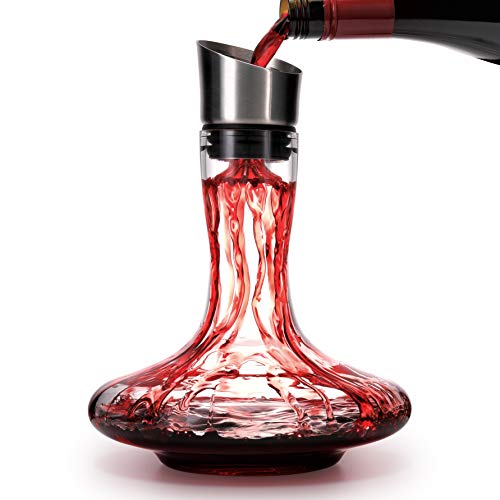
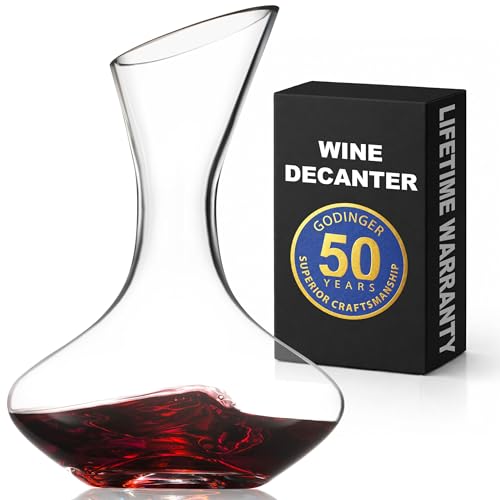


As an Amazon Associate we earn from qualifying purchases at no extra cost to you. Ratings are shown as listed on Amazon.
- Clarity: Clear glass makes sediment, color, and wine level easy to inspect. Lead-free crystal can be exceptionally bright and thin, while ordinary soda-lime glass is often thicker and more forgiving. Avoid decorative tinting if you want to judge a wine’s color.
- Base stability: A broad, heavy foot reduces the chance of a tall decanter tipping when a table is bumped. A narrow, sculptural base may look striking but deserves more clearance around it.
- Neck width: A narrow neck helps direct the pour and limits splashing. A wider neck is much easier to fill, scrub, rinse, and dry. For frequent use, a mouth of roughly 55 to 75 millimeters is a useful compromise.
- Pour spout: A gently flared rim can reduce drips without creating a fragile projection. A sharply pointed spout may pour accurately but is more vulnerable to knocks and can be difficult to wipe clean.
- Cleaning access: Look for a neck that accepts your hand or a soft bottle brush. A beautiful decanter that cannot dry fully is likely to develop water spots and stale aromas.
- Capacity: Capacity is not the same as the amount of wine you should pour into it. A decanter needs headspace for air movement, so a 1.5-liter vessel is usually best with one standard 750-milliliter bottle, not two.
Best hand blown wine decanters by situation
Best for most red wine drinkers: a broad-base, medium-neck decanter
For regular Cabernet Sauvignon, Syrah, Tempranillo, and other structured reds, choose a 1.2- to 1.5-liter hand-blown decanter with a broad lower bowl and a moderately open neck. This format gives a single bottle a large exposed surface while remaining manageable to lift when full. A stable base is particularly important because wine and glass together can weigh more than 1.5 kilograms.
Prefer a rim that pours in a continuous stream rather than one that forces wine through a tiny opening. The ideal design lets you serve at the table without needing a separate funnel, yet does not splash wine across the cloth.
Best for sediment-heavy or mature wine: a narrow-neck decanter with a clear shoulder
Older wines often need careful separation from sediment rather than aggressive aeration. A decanter with a defined shoulder and narrower neck makes it easier to watch the wine as it approaches the sediment. Its base does not need to be dramatically wide, but it should be flat and secure enough for slow pouring.
For this use, clarity is more valuable than a highly sculptural silhouette. Avoid dark, frosted, or heavily textured glass that makes it difficult to see the last portion of the bottle. Keep a light source behind the neck while pouring and stop when sediment reaches the shoulder.
Best for easy ownership: a wide-mouth, dishwasher-compatible glass decanter
If the decanter will be used weekly, a wide mouth is usually a better choice than an exceptionally thin neck. It accepts a soft cleaning brush, allows more air circulation while drying, and makes it easier to remove lipstick, tannin residue, and polishing compounds. Check the maker’s care instructions before using a dishwasher: hand-blown vessels may have delicate rims, uneven walls, or shapes that can strike the rack.
Dishwasher compatibility is not the same as dishwasher safety in every cycle. If the instructions allow machine washing, use a gentle cycle, mild detergent, and ample spacing. Never place a hot decanter under cold water, because thermal shock can crack even apparently robust glass.
Best for magnums and entertaining: a 1.8- to 2.0-liter vessel
A magnum contains 1.5 liters, so a 1.8- to 2.0-liter decanter provides useful headspace. This is the right scale for two standard bottles only if the shape has enough width and the table can accommodate its footprint. A tall 2-liter decanter filled near the rim may be difficult to lift and may pour unpredictably.
For parties, prioritize a heavy base and two-handed grip points created by the bowl’s shape. A very wide bowl can aerate efficiently but may require a larger sink and a drying stand. Measure your cabinet shelf and sink opening before buying.
Head-to-head comparison of useful designs
| Decanter type | Typical capacity | Approximate empty weight | Best bottle load | Cleaning access | Main compromise |
|---|---|---|---|---|---|
| Compact narrow-neck | 750–900 ml | 450–750 g | 1 standard bottle, limited aeration | Fair to poor | Precise pouring but harder drying |
| Broad-base medium bowl | 1.2–1.5 L | 650–1,100 g | 1 standard bottle | Good | Needs more shelf and sink space |
| Wide-mouth easy-clean | 1.0–1.5 L | 600–1,000 g | 1 standard bottle | Very good | May provide less sediment control |
| Magnum-size entertaining | 1.8–2.0 L | 900–1,500 g | 1 magnum or 2 standard bottles | Good to fair | Heavy and space-hungry when full |
These are practical buying ranges rather than specifications for one particular model. Hand-blown pieces vary, and thicker glass can add weight without improving pouring performance. Treat an unusually light, tall decanter with caution unless its base is especially broad and its maker provides clear care guidance.
How to choose the right capacity
Use the bottle volume, not the decanter’s advertised maximum, as the starting point. A standard bottle holds 750 milliliters. For comfortable swirling and a lower risk of overflow, leave approximately 35% to 50% empty space in the decanter.
A simple calculation illustrates the choice: 750 ml of wine divided by 50% of a 1,500 ml decanter equals a half-full vessel. That leaves enough room to swirl while exposing a broad surface to air. By contrast, pouring 1,500 ml into a 1,500 ml vessel leaves no practical headspace and creates an awkward, heavy pour.
- One bottle at a time: choose 1.0 to 1.5 liters.
- Small kitchen or apartment: choose 750 to 1,000 milliliters and store it upside down only if the rim is protected and air can circulate.
- Two bottles or a magnum: choose at least 1.8 liters, preferably with a broad foot.
- White wine or delicate reds: choose a smaller vessel with less exposed surface, and chill the decanter if the wine’s serving temperature matters.
Cleaning, drying, and durability realities
Wine residue is most difficult to remove after it dries. Rinse with lukewarm water soon after serving, then use a soft brush or purpose-made glass-cleaning beads if the interior is difficult to reach. Do not use abrasive powder, metal scouring pads, or a long-handled brush with a rigid wire tip; these can scratch the surface or chip the rim.
Drying is as important as washing. Rest the decanter at an angle on a clean, lint-free towel or use a ventilated drying stand. Storing it upside down on a flat surface can trap moisture and put pressure on the rim. If mineral spots appear, a brief soak with diluted white vinegar may help, but rinse thoroughly and follow the manufacturer’s instructions.
The parts most likely to show wear are the rim, the tip of a projecting spout, and the base edge. Inspect these areas before each use, especially after the decanter has been moved between cabinets. A small chip is not merely cosmetic: it can create a sharp edge and weaken the glass. Retire the vessel if you find a crack, deep scratch, or unstable base.
Decision matrix for a confident purchase
| Your priority | Choose | Why |
|---|---|---|
| Lowest practical cost | Clear soda-lime glass, 1.0–1.5 L | Usually thicker, easier to replace, and less stressful for frequent use |
| Thin, brilliant appearance | Lead-free crystal, medium neck | Offers a refined look while retaining clear color inspection |
| Limited storage | Compact 750–900 ml design | Smaller footprint and adequate for one bottle |
| Frequent entertaining | 1.8–2.0 L broad-base design | Handles larger pours with better stability and headspace |
| Least maintenance | Wide-mouth model with simple rim | Fastest to rinse, brush, and dry completely |
| Sediment control | Clear, narrow-neck model with defined shoulder | Makes the final sediment-bearing portion easier to see |
Bottom line
For most homes, the best hand blown wine decanters are not the tallest or most dramatic. Select a clear, lead-free, 1.2- to 1.5-liter vessel with a stable base, a medium-width neck, a drip-resistant rim, and enough access for a soft brush. Choose a narrow-neck model when sediment control is the priority, a wide-mouth model when cleaning is the priority, and a 1.8- to 2.0-liter decanter only when you regularly serve magnums or multiple bottles.

Write Your Review
No reviews yet. Be the first to share your experience!