

Key takeaways
- Rounded compartment corners: They prevent hummus and soft cheese from collecting in unreachable creases.
- A smooth interior: It cleans more easily than a faux-stone or deeply textured finish.
- Removable inserts: These are useful when a tray combines dry snacks with dips, although extra pieces can be misplaced.
- Dishwasher compatibility: Confirm whether both the tray and any nonslip feet or lids can go in the dishwasher.
- A raised underside: Feet help prevent moisture rings and allow air to circulate after washing.
The best divided serving tray for appetizers is usually a rigid, dishwasher-safe tray about 15–18 inches wide, with one large 2–3 cup center compartment and four or five smaller sections for foods that should not touch.
Our top picks

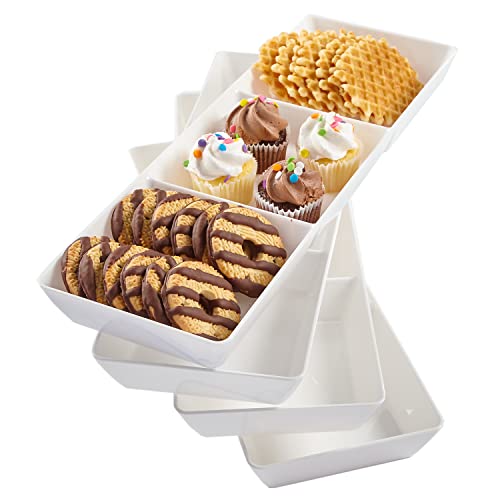


As an Amazon Associate we earn from qualifying purchases at no extra cost to you. Ratings are shown as listed on Amazon.
Best Divided Serving Trays for Appetizers
The right tray depends less on the number of compartments than on the size of each one. A tray designed for crackers and nuts may be frustrating for hummus, olives, sliced vegetables, or hot finger foods. Before buying, compare compartment capacity, overall footprint, carrying comfort, material, and how easily food residue can be removed from corners.
Quick comparison of the main tray types
| Tray type | Typical dimensions | Useful capacity | Weight range | Best for | Main drawback |
|---|---|---|---|---|---|
| Plastic party tray | 14–18 in. diameter or 12 × 18 in. | 6–10 cups total | 1–2.5 lb | Frequent casual entertaining and outdoor use | Scratches and staining over time |
| Melamine divided platter | 15–19 in. diameter | 7–12 cups total | 2–4 lb | Picnics, buffets, and a more polished table | Usually not suitable for microwave use |
| Stainless-steel tray | 12 × 18 to 16 × 22 in. | 8–16 cups total | 2.5–5 lb | Heavy foods, repeated use, and commercial-style serving | Can become uncomfortable to carry when fully loaded |
| Bamboo or wood tray | 14–18 in. diameter or 13 × 19 in. | 5–10 cups total | 2–4 lb | Dry snacks and presentation-focused serving | Needs careful washing and drying |
| Glass divided platter | 12–16 in. diameter | 5–9 cups total | 4–7 lb | Indoor presentation and cold appetizers | Heavy and vulnerable to chips or breakage |
Choose the compartment layout before the material
For a mixed appetizer spread, look for one substantial compartment in the middle or along one end. It should hold approximately 2 to 3 cups, enough for hummus, salsa, whipped feta, dip, or a small pile of marinated vegetables. Four surrounding compartments of roughly ¾ to 1½ cups each work well for crackers, nuts, olives, cheese cubes, grapes, and cut vegetables.
Five equal compartments look tidy but are less versatile. Each section may be too small for a dip and too large for a small garnish. A six- or seven-section tray is useful for candy, nuts, toppings, or children’s snacks, but it rarely replaces a flexible platter for a full appetizer course.
Check the wall height as well as the footprint. Dividers about 1 to 1½ inches high keep nuts and crackers contained without making the tray awkward to serve from. For dips or juicy foods, walls closer to 1¾ inches reduce spills while carrying. Very shallow sections are difficult to use with a spoon, especially when dip is nearly finished.
Best choices by entertaining situation
| Your situation | Recommended specification | Why it fits |
|---|---|---|
| Small apartment or table for two to four | 12–15 in. tray, 4–6 compartments, 4–7 cups total | Provides variety without occupying the entire table |
| Family movie night | Plastic or melamine, 15–18 in., 5–7 compartments | Light, forgiving, and suited to snacks with different textures |
| Outdoor party | Melamine or thick plastic, raised rim, optional lid, under 4 lb empty | Handles casual use better than glass and is easier to transport |
| Frequent hosting | Stainless steel or thick melamine, reinforced rim, dishwasher-safe | Better resistance to stains, odors, and repeated washing |
| Formal indoor presentation | Wood, glass, ceramic, or premium melamine, 14–18 in. | Prioritizes appearance and a stable presentation surface |
Dimensions and carrying handles matter more than they appear
A tray measuring 18 inches across needs a clear carrying route from the kitchen to the table. Measure narrow doorways, refrigerator shelves, and the space where you plan to store it. A large round tray may offer more usable area than a rectangular one, but rectangular trays are often easier to fit in a refrigerator and stack in a cabinet.
Handles are helpful when the tray is heavily loaded, but integrated cutouts can reduce usable space near the edges. Choose handles with openings at least 4 inches wide and enough clearance for your fingers. A thin, sharp-edged cutout can feel uncomfortable when the tray weighs several pounds.
Here is a practical load calculation. Suppose a tray holds 9 cups of food. At an average food density of about 0.5 pound per cup, the contents weigh approximately 4.5 pounds. Add a 2-pound melamine tray and the total is about 6.5 pounds. That is manageable with two strong handles but awkward with a slippery rim or one-handed grip. If you expect to carry a full tray across a room, prioritize a reinforced rim and two-sided handles over an extra compartment.
Material durability and cleanup
Plastic and melamine
Thick plastic is the practical choice for patios, children, and frequent informal use. It tolerates bumps and is usually inexpensive, with general market prices around $10–$30 depending on size and construction. Its weak points are knife scratches, discoloration from tomato-based foods, and odors that can linger in textured surfaces.
Melamine looks more like ceramic while remaining lighter and less fragile. It is commonly priced around $20–$50. Do not assume that “dishwasher-safe” means suitable for high heat indefinitely: repeated exposure to harsh cycles can dull the finish or weaken printed decoration. Melamine should also be kept out of the microwave unless the manufacturer specifically permits it.
Stainless steel
Stainless steel is the strongest option for repeated service. It resists staining, does not absorb odors, and handles warm appetizers better than most plastic or wood trays. Look for a rolled or reinforced rim rather than a razor-thin sheet. General market prices range from about $25–$80.
The trade-off is weight and noise. Metal compartments can make a noticeable clatter when serving utensils touch them, and condensation can make the underside slippery. A rubberized base or nonslip feet are useful additions.
Wood and bamboo
Wooden and bamboo trays provide warmth and visual appeal, but they are best for dry or relatively thick foods. Moisture can enter seams, discolor the surface, or cause warping if the tray remains submerged. Wash promptly with mild detergent, wipe rather than soak, and dry it upright or on its edge.
Do not use a wooden tray as a permanent container for wet dip. A removable bowl or small insert protects the surface and makes cleanup easier.
Glass and ceramic
These materials present food attractively and resist staining, but they add substantial weight. A glass tray weighing 5 pounds empty can become difficult to lift once filled. Inspect edges for chips, avoid placing a cold tray directly on a hot surface, and choose ceramic only when storage and carrying weight are not concerns.
Cleaning features worth paying for
- Rounded compartment corners: They prevent hummus and soft cheese from collecting in unreachable creases.
- A smooth interior: It cleans more easily than a faux-stone or deeply textured finish.
- Removable inserts: These are useful when a tray combines dry snacks with dips, although extra pieces can be misplaced.
- Dishwasher compatibility: Confirm whether both the tray and any nonslip feet or lids can go in the dishwasher.
- A raised underside: Feet help prevent moisture rings and allow air to circulate after washing.
Clean sticky foods before they dry. A useful routine is to scrape each compartment with a silicone spatula, soak only dishwasher-safe pieces in warm soapy water, and use a soft brush around dividers. Avoid abrasive pads on plastic, painted melamine, polished metal, and finished wood because small scratches can become future stain and odor traps.
Common buying mistakes
- Counting sections instead of measuring them: Eight tiny sections may hold less useful food than four well-sized ones.
- Ignoring filled weight: A large metal or glass tray can become uncomfortable even when its empty weight seems reasonable.
- Choosing a tray without a dip compartment: Small bowls placed on a flat tray can slide unless the surface has a recess or textured grip.
- Assuming all materials are microwave-safe: Check the care instructions, especially with melamine, bamboo, and trays containing metal trim.
- Buying a deep tray for dry snacks: High walls make crackers and nuts harder to reach and can hide food from guests.
Bottom line
For most households, a 15–18-inch melamine or thick plastic tray with five or six compartments, one 2–3-cup section, rounded corners, and comfortable two-sided handles offers the best balance. Choose stainless steel when the tray will be used repeatedly or with heavier foods, wood when presentation matters more than convenience, and glass or ceramic when the tray will stay indoors and be carried only a short distance. The winning design is not the one with the most compartments; it is the one whose sections match the foods you actually serve and whose weight and cleanup routine you will tolerate after the party.



Write Your Review
No reviews yet. Be the first to share your experience!