

Key takeaways
- Before serving: Wash with warm water and a little mild dish soap, then dry completely. This removes dust and prevents water from collecting under the board.
- During use: Set out acidic, oily, or strongly colored items in bowls when practical. Use cheese knives gently; marble can chip if struck with force.
- After serving: Wipe up wine, oil, fruit juice, and sauces promptly. Wash by hand with mild soap and a soft cloth, then dry with a towel.
- For storage: Store flat on a stable shelf, or stand it securely with padding between stone and other dishes. Don’t stack heavy cookware on top.
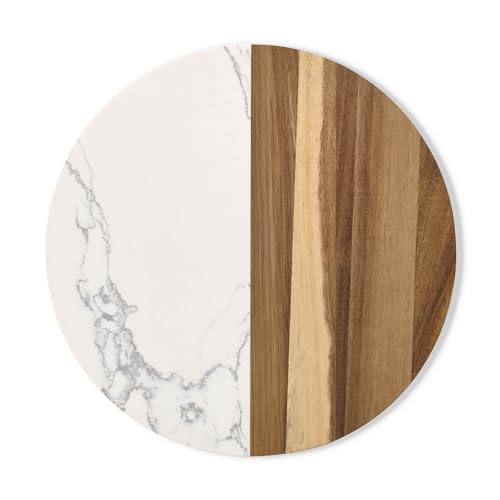
The best marble serving board for entertaining is a manageable, food-safe slab with a stable base and enough usable surface for the menu: choose roughly 12 × 16 inches for a small cheese spread, 12 × 20 inches for a party platter, or two smaller boards when you need to separate foods or make serving easier. Before buying, check the weight, edge profile, and whether the non-slip feet are removable for cleaning.
Our top picks


As an Amazon Associate we earn from qualifying purchases at no extra cost to you. Ratings are shown as listed on Amazon.
Choose by menu and serving situation
Marble stays cool, which can help keep firm cheeses and chilled desserts from warming quickly while they’re being served. It is not a substitute for refrigeration: don’t leave perishable foods at room temperature longer than food-safety guidance allows. Marble is also heavy and can chip, so the right size is the largest one you can comfortably carry and store—not necessarily the largest one on display.
| Situation | Useful board size | Approximate marble weight | Why it fits |
|---|---|---|---|
| Cheese for 2–4 | 10 × 14 in | 5–8 lb | Enough room for several cheeses and a small garnish bowl without taking over the table. |
| Cheese and charcuterie for 4–8 | 12 × 16 in | 7–11 lb | A practical balance of display area, storage, and carrying weight. |
| Large spread for 8–12 | 12 × 20 in | 9–14 lb | Leaves room for cheeses, sliced meats, and accompaniments, though it may need two hands to move. |
| Dessert service or a small kitchen | 10 × 12 in | 4–7 lb | Works for cookies, petit fours, or a few slices of cake and is easier to store. |
These are estimates for solid marble around ⅜–½ inch thick; actual weight varies with stone density, thickness, and cutouts. A 12 × 16-inch slab at ½ inch thick contains about 0.56 cubic feet? No: its volume is approximately 0.056 cubic feet, which typically puts it in the several-pound range. Use the seller’s listed weight as the better guide, and allow for packaging if you’re checking a cabinet shelf’s capacity.
What matters beyond the dimensions
Weight and handling
Weight helps a board stay put, but it also makes carrying and washing more demanding. If you’ll bring the board from kitchen to dining room while loaded, consider a smaller slab or split the spread across two boards. A board that feels secure on the counter can still be awkward to lift from a crowded buffet, especially when its edges are smooth.
Edges and usable surface
A beveled or rounded edge is more comfortable to grip than a sharp square edge and is less likely to catch on a tablecloth. A raised rim can help contain crumbs, but it reduces the flat area available for arranging food and makes scraping leftovers off less convenient. For cheese and charcuterie, a flat slab with a modest bevel is usually the more versatile shape. Handles or finger notches improve lifting, but cutouts can reduce the area available for food.
Non-slip features
Look for silicone or rubber feet, or use a separate non-slip mat beneath the board. Feet should sit level and be firmly attached; wobbly feet can make slicing or serving less stable. Removable feet are easier to clean around, while fixed feet are less likely to go missing. If the board has no grip, place a damp—not soaking—kitchen towel underneath it on a dry surface. Don’t assume a heavy board cannot slide.
Food-contact suitability
Choose a board explicitly sold as suitable for food contact, with a smooth, intact surface and no flaking coating. Marble itself is nonporous compared with many woods, but it can still stain or etch. Acidic foods such as citrus, vinegar, and some fruit can dull or mark the stone, so serve them in small bowls or on a separate dish. Avoid using a chipped board where fragments could reach food.
Pick the right type for your routine
| Your priority | Best fit | Trade-off to expect |
|---|---|---|
| Occasional entertaining, limited storage | 10 × 14-inch board, about 5–8 lb | Less room for a broad selection; use ramekins for olives and spreads. |
| Regular cheese nights | 12 × 16-inch board with a beveled edge and non-slip feet | Heavy enough to be cumbersome for some users; check its listed weight before ordering. |
| Buffets and larger gatherings | 12 × 20-inch slab or two 10 × 14-inch boards | A long slab is harder to carry; two boards offer flexibility but need more storage space. |
| Mostly desserts | 10 × 12-inch smooth slab with a rounded edge | Marble can mark from acidic fruit or sauces; keep wet toppings separate until serving. |
For a single all-purpose purchase, a 12 × 16-inch board is the safest starting point for most households: large enough for a modest mixed platter, but less unwieldy than a banquet-size slab. If you regularly host more than eight people, two medium boards are often easier to arrange, carry, and chill than one oversized piece.
Care that helps prevent stains and chips
- Before serving: Wash with warm water and a little mild dish soap, then dry completely. This removes dust and prevents water from collecting under the board.
- During use: Set out acidic, oily, or strongly colored items in bowls when practical. Use cheese knives gently; marble can chip if struck with force.
- After serving: Wipe up wine, oil, fruit juice, and sauces promptly. Wash by hand with mild soap and a soft cloth, then dry with a towel.
- For storage: Store flat on a stable shelf, or stand it securely with padding between stone and other dishes. Don’t stack heavy cookware on top.
Skip the dishwasher, abrasive scouring pads, and harsh acidic cleaners unless the manufacturer specifically says otherwise. Dishwasher heat and impacts can stress the stone or loosen feet; abrasive cleaning can scratch or dull a polished finish. Don’t use the serving board as a chopping block: repeated knife work can mark the surface and dull blades. Marble is durable for serving, but it is brittle rather than shatterproof. Corners and thin edges are usually the first places to chip if the slab is dropped or knocked against a sink.
How to size a platter before buying
Measure the table or shelf where the board will live, then sketch the intended footprint with removable tape. Leave about 2 inches of clearance around the board on a serving table so guests can reach it and you can lift it without hitting glasses. For a buffet, also account for the space taken by bowls and serving utensils; a board that fits the table may not leave room for the rest of the spread. If the board’s listed weight is close to what you’d find awkward to lift, choose a smaller size rather than relying on the dimensions alone.
Bottom line
For most cheese, charcuterie, and dessert service, look for a food-contact-safe marble board around 12 × 16 inches, with a smooth surface, a comfortable beveled edge, and stable non-slip feet. Choose a smaller slab for occasional use or limited storage, and consider two medium boards for large gatherings. The best purchase is one you can carry safely, clean by hand, and store without risking a chipped edge.




Write Your Review
No reviews yet. Be the first to share your experience!