

Key takeaways
- For one standard bottle: Look for a 750–1,000 mL capacity. It holds a 750 mL bottle with room for swirling, though a low, wide shape may need to be filled carefully to avoid splashing.
- For easy pouring and everyday use: Choose a balanced, moderately sized vessel with a narrow-to-medium neck and a pronounced pouring lip. Avoid unusually heavy or bulbous designs if you often serve at the table.
- For wines that benefit from broad exposure: A wide base creates more surface area for wine to meet air. It also takes up more space and can be harder to reach into for cleaning.
- For compact storage: A slimmer base and shorter overall height are easier to fit in cupboards, but check that the opening is still wide enough to rinse by hand.
- For a lower-maintenance crystal option: Favor lead-free crystal and a simple shape without tight curves, decorative ridges, or hard-to-reach corners.
The best crystal wine decanter for most homes is a 750–1,000 mL lead-free crystal model with a stable base, a neck wide enough to rinse, and a pour lip that returns drips to the vessel. Choose by the bottle size and your sink—not by capacity alone: a broad-bottom decanter can need much more counter and cabinet space than its listed volume suggests.
Our top picks

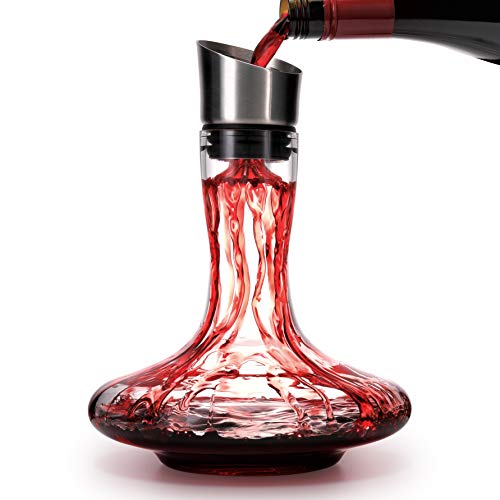


As an Amazon Associate we earn from qualifying purchases at no extra cost to you. Ratings are shown as listed on Amazon.
Best crystal wine decanters by use
- For one standard bottle: Look for a 750–1,000 mL capacity. It holds a 750 mL bottle with room for swirling, though a low, wide shape may need to be filled carefully to avoid splashing.
- For easy pouring and everyday use: Choose a balanced, moderately sized vessel with a narrow-to-medium neck and a pronounced pouring lip. Avoid unusually heavy or bulbous designs if you often serve at the table.
- For wines that benefit from broad exposure: A wide base creates more surface area for wine to meet air. It also takes up more space and can be harder to reach into for cleaning.
- For compact storage: A slimmer base and shorter overall height are easier to fit in cupboards, but check that the opening is still wide enough to rinse by hand.
- For a lower-maintenance crystal option: Favor lead-free crystal and a simple shape without tight curves, decorative ridges, or hard-to-reach corners.
Several established makers, including Riedel, Spiegelau, Schott Zwiesel, and Waterford, offer crystal decanters in different shapes and price tiers. Product dimensions vary by model, so compare the specific item’s capacity, height, base width, and opening rather than relying on the brand name or a shape label.
Compare the dimensions that affect daily use
The table below shows practical size bands, not measurements for a particular branded model. Use them as a screening guide when checking product specifications. A decanter’s listed capacity is usually its maximum volume; the comfortable serving volume is lower when you want room to swirl or pour without sloshing.
| Decanter profile | Capacity | Typical height | Typical widest base | Typical neck opening | Best fit |
|---|---|---|---|---|---|
| Compact, narrow base | 600–800 mL | 22–28 cm | 12–17 cm | 3–5 cm | Limited cabinet space or occasional use |
| Standard, balanced shape | 750–1,000 mL | 24–32 cm | 16–22 cm | 4–7 cm | Most single-bottle servings |
| Broad-bottom, high-capacity | 1,000–1,500 mL | 25–36 cm | 20–30 cm | 5–9 cm | More aeration area or larger pours |
Before buying, measure the cabinet opening and the clear space around your sink. Include room to tilt the decanter under the faucet and to lift it out of storage. For example, a 25 cm base may fit on a shelf that is 26 cm deep, but leave little room to grasp it safely; a narrow shelf is not a good fit just because the nominal measurements work.
How neck and base shape change pouring
A wide base can spread wine into a shallower layer, increasing its exposed surface. The trade-off is leverage: when full, a broad vessel can feel awkward to lift, especially if its neck is short or smooth. Look for a neck that gives your hand a secure grip and a base broad enough to resist tipping when set down.
A narrower neck helps control the stream but may make pouring slower and cleaning more demanding. A defined lip can reduce drips, though no shape eliminates them if wine runs down the outside or the decanter is tilted too quickly. If serving at a crowded table, prioritize a comfortable grip and a balanced pour over the widest possible base.
Capacity matters in use, not just on paper. A 750 mL bottle nearly fills a 750 mL vessel, leaving little room for swirling. A 1,000 mL decanter gives a standard bottle more headroom. If you regularly decant larger bottles or pour for a group, consider a larger model—but check that its filled weight and footprint are manageable.
Cleaning: the ownership trade-off
Crystal can be clear and elegant, but it is still breakable glassware. The parts most likely to cause trouble are a narrow neck that blocks access, a heavy base that is difficult to handle when wet, and curves where droplets remain after rinsing. Decorative details may also trap residue. For routine care:
- Rinse promptly after use so wine does not dry into a stain.
- Wash by hand with lukewarm water and a small amount of mild dish soap, unless the manufacturer specifically confirms dishwasher suitability.
- Use a decanter brush only if it fits without force; twisting a stiff brush against thin crystal can cause damage.
- Drain upside down on a stable rack, then let the interior air-dry fully. A lint-free cloth can dry the outside, but pushing fabric into a narrow neck may leave fibers or put pressure on the glass.
- For mineral spots, follow the maker’s care guidance rather than using abrasive powders or metal tools.
With frequent use, the practical wear points are usually chips at the lip, scratches or cloudiness from harsh cleaning, and accidental knocks against a faucet or sink. Store a decanter where it cannot be crowded by heavier cookware. If you want the easiest care, a smooth, wide-mouth design is generally more forgiving than an elaborate shape.
Choose by your kitchen and serving habits
| Situation | What to prioritize | Trade-off to accept |
|---|---|---|
| Small kitchen or shallow cabinets | Compact base, modest height, roughly 750–1,000 mL capacity | Less surface area and less room for swirling |
| Frequent dinners and shared pours | Stable base, comfortable grip, clear pouring lip | May be heavier or wider than a compact model |
| Infrequent use and simple care | Lead-free crystal, smooth interior, wide neck | May have a less sculptural silhouette |
| One bottle with room to swirl | About 1,000 mL capacity and a balanced base | Requires more storage space than a small carafe |
| Display piece as well as serving ware | Finish and shape, with dimensions checked against storage | More intricate forms can be harder to wash and dry |
What is worth paying for?
Price varies widely by maker, craftsmanship, and design; crystal decanters range from general-market options under $50 to premium pieces costing several hundred dollars. A higher price may reflect hand-finishing or a distinctive design, but it does not guarantee easier pouring or cleaning. For a practical purchase, compare the opening, base diameter, capacity, weight if listed, and care instructions first. Then decide whether a particular finish or maker is worth the added cost.
For most shoppers, the best crystal wine decanters are not necessarily the largest or most sculptural. A lead-free, 750–1,000 mL design with enough headroom for one bottle, a stable base, a manageable neck, and an opening you can rinse is the strongest everyday choice. If any of those dimensions conflict with your cabinet or sink, choose the shape that fits your kitchen rather than buying for capacity alone.





Write Your Review
No reviews yet. Be the first to share your experience!