

Key takeaways
- Best Bamboo Serving Tray Sets The best bamboo serving tray set for most homes is a three-piece nesting set with trays around 13 × 9, 16 × 11, and 19 × 13 inches, a raised lip of at least 1.25…
Best Bamboo Serving Tray Sets
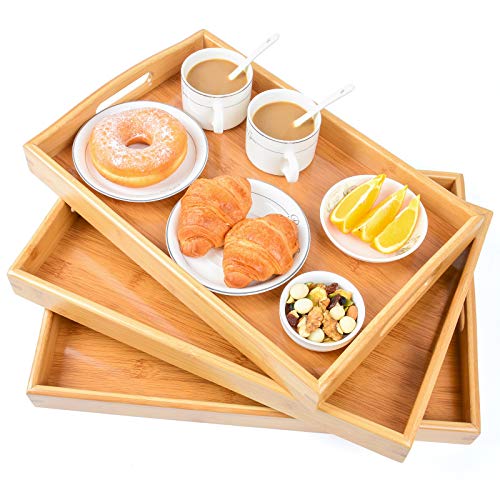
The best bamboo serving tray set for most homes is a three-piece nesting set with trays around 13 × 9, 16 × 11, and 19 × 13 inches, a raised lip of at least 1.25 inches, and handles cut into the tray rather than attached as decorative hardware.
That combination covers breakfast in bed, drinks for two, and a larger spread without taking much cabinet space. The right choice changes if you carry heavy cookware, wash trays frequently, or have limited storage. Below is a practical comparison based on the features that affect daily use: dimensions, lip height, handle design, nesting, finish, moisture resistance, and carrying stability.
Our top picks


As an Amazon Associate we earn from qualifying purchases at no extra cost to you. Ratings are shown as listed on Amazon.
Best bamboo serving tray sets compared
| Set type | Typical tray dimensions | Typical weight | Lip height | Best for | Main limitation |
|---|---|---|---|---|---|
| Compact two-piece set | 12 × 8 and 15 × 10 in | 2.5–4 lb total | 0.75–1 in | Small kitchens, snacks, coffee | Limited room for plates and glasses together |
| Everyday three-piece nesting set | 13 × 9, 16 × 11, and 19 × 13 in | 4–6 lb total | 1.25–1.75 in | Most households and occasional entertaining | The largest tray may be too wide for a narrow cabinet |
| Deep-lip hospitality set | 14 × 10, 17 × 12, and 20 × 14 in | 5–8 lb total | 1.75–2.25 in | Carrying drinks, outdoor meals, uneven routes | Heavier and less comfortable for smaller hands |
| Decorative multi-piece set | 11 × 7 through 18 × 12 in | 4–7 lb total | 0.5–1.25 in | Display, light serving, layered presentation | Low lips and ornate handles reduce stability |
These are useful market specifications rather than promises for every individual model. Bamboo serving sets commonly cost about $25–$70, with thicker, larger, or better-finished sets often reaching $80 or more.
Our picks by serving situation
Best overall: the three-piece nesting set
Choose the everyday three-piece format if you want one purchase to handle breakfast, appetizers, and family meals. A 19 × 13-inch tray usually fits two dinner plates, two glasses, cutlery, and a small bowl, while the 13 × 9-inch tray is easier to use for a single person.
Look for smoothly routed handholds on both short ends. Cutout handles keep the tray’s center of gravity low and are less likely to loosen than handles fastened with screws. A surrounding lip between 1.25 and 1.75 inches is a useful compromise: high enough to contain a sliding glass, but not so high that it obstructs access.
Best for small cabinets: a compact two-piece set
A compact set is the better choice when cabinet depth or counter space is limited. Before buying, measure the actual storage opening, not just the shelf. Allow at least 1 inch of clearance for lifting the nested stack. A tray listed as 15 inches long may need 16 inches of usable clearance once its handles or outward-curving rim are included.
Compact trays are particularly suitable for tea, pastries, condiments, and two mugs. They are less suitable for a full meal because an 8-inch plate, a 10-inch plate, and a glass need more usable surface than the advertised outside dimensions suggest.
Best for carrying drinks: a deep-lip hospitality set
If the route from kitchen to patio includes steps, carpet transitions, or a crowded room, prioritize stability over appearance. A 1.75- to 2.25-inch lip helps retain items, while a broad tray base reduces tipping during a turn. Handles should have at least 4 inches of usable opening and enough vertical clearance for your fingers when the tray is loaded.
Deep lips cannot prevent spills caused by an overloaded tray. For drinks, keep the heaviest items between the handles and close to the center. A 20 × 14-inch tray can carry more, but it also creates a longer lever when held from the ends. Smaller loads on a 17 × 12-inch tray may feel safer than filling the largest option.
Best for occasional entertaining: a presentation-focused set
Decorative sets can look attractive on a dining table, but inspect the practical details before choosing one. Thin painted edges, glossy lacquer, and metal handles may photograph well while making the tray slippery or difficult to clean. These sets work best for dry foods, napkins, and light dishes rather than hot or wet service.
What separates a good set from a frustrating one?
Dimensions and usable capacity
Measure the interior floor, not just the outside length and width. A tray with a wide rim can lose 1 to 2 inches of usable space in each direction. For a simple fit check, add the diameters of the items you plan to carry and include about 1 inch of gap between neighboring pieces.
For example, two 10-inch plates placed side by side need 20 inches before allowing any separation. They will not fit comfortably on a tray with only 18 inches of usable length. A smaller 13 × 9-inch tray is better treated as a breakfast or snack tray than a dinner-service tray.
Lip height and corner shape
A low 0.5-inch rim offers easy access but does little to stop a mug from moving. A 1.25-inch rim is more protective for ordinary indoor carrying. Rounded inside corners are easier to wipe clean than sharp decorative corners, where crumbs and moisture collect.
Handles and carrying stability
Compare the handle opening, not simply whether handles are present. Narrow openings can force your fingers against the tray edge, especially when carrying a heavy load. The most stable designs keep the handholds aligned with the tray’s center and use a flat, rigid base that does not flex when lifted.
To improve stability, distribute weight evenly and keep liquid-filled glasses away from the outer corners. A tray that twists when lifted is more concerning than one that is slightly heavier; flex can make items slide toward the rim.
Finish quality and moisture resistance
Bamboo is not automatically waterproof. Look for a continuous, even finish on the top, underside, rim, and inside the handle openings. Dry-looking patches, rough end grain, raised fibers, or finish pooling in corners indicate uneven protection.
Moisture resistance means the tray tolerates brief contact with condensation or a damp cloth. It does not mean the tray is dishwasher-safe or suitable for soaking. Laminated bamboo may resist warping better than a thin solid-bamboo panel, but exposed edges and joints still need prompt drying.
Decision matrix for choosing your set
| Your situation | Recommended configuration | Why | Avoid |
|---|---|---|---|
| Budget under $35 | Two-piece, 12–15 inch range | Fewer joints and less material reduce cost | Oversized sets with thin, glossy finishes |
| Frequent weekly use | Three-piece set, 1.25-inch-plus lip | Multiple sizes reduce overloading and wear | Unsealed edges and stapled decorative handles |
| Very limited storage | Tightly nesting two- or three-piece set | Uses one footprint instead of several | Handles that extend beyond the largest tray |
| New to serving trays | Medium tray, flat base, cutout handles | Easier to balance than a very large tray | Extra-deep rim that blocks visibility |
| Outdoor or uneven carrying route | Deep lip, rigid base, wide handles | Provides more control when walking | Lightweight, flexible decorative trays |
Care routine that extends the set’s life
- Wipe immediately after use. Use a damp cloth with a small amount of mild dish soap. This removes sugars, oils, and salt before they dry into the grain.
- Dry both sides. Stand the tray on its edge or wipe the underside separately. Leaving moisture beneath a nested tray is a common cause of odor, swelling, and finish dullness.
- Never soak or put it in the dishwasher. Prolonged heat and water can open laminated joints, raise fibers, or warp the base.
- Use protection for hot cookware. Bamboo serving trays are generally intended for serving, not as direct-contact trivets for hot pans. Use a mat unless the manufacturer specifically states otherwise.
- Recondition only when appropriate. If the finish is food-contact-safe and the care instructions permit it, apply a small amount of suitable board oil or conditioner to a clean, dry surface. Do not cover a peeling or cloudy finish with oil; replace or refinish it properly.
Common buying mistakes
The most frequent mistake is choosing by the largest outside dimension. A big tray can be awkward to carry when fully loaded and may not fit where it will be stored. The second is assuming bamboo construction guarantees water resistance. Finish coverage, edge sealing, and maintenance matter more than the word “bamboo” on the label.
Also check whether the set actually nests. Some three-piece designs stack but have handles that project outward, increasing the storage footprint. Finally, inspect the base for rocking on a flat surface. A small wobble can become a spill when the tray is loaded.
Final recommendation
For the widest range of uses, choose a three-piece nesting bamboo set with interior sizes close to 13 × 9, 16 × 11, and 19 × 13 inches, a 1.25- to 1.75-inch lip, routed handles, a rigid base, and a sealed underside. Choose the compact two-piece option when storage is the priority, and move to a deep-lip hospitality design when carrying stability matters more than low weight. Whichever format you buy, measure the storage space, inspect the finish on every edge, and treat the tray as moisture-resistant rather than waterproof.



Write Your Review
No reviews yet. Be the first to share your experience!