

Key takeaways
- For a small kitchen or occasional baking: Pick a compact stand, or a 10-inch model with a low dome. A wide base and tall cover take up more cabinet space than the product photo suggests.
- For a standard 9-inch layer cake: A 10- to 12-inch plate gives room to set down the cake without crowding the edge. Measure the finished cake, including frosting decorations, before choosing the dome.
- For tall cakes or cupcakes: Prioritize interior dome height. Measure from the plate surface to the highest decoration, then leave about 1 inch of clearance so the cover does not brush icing.
- For frequent entertaining: Look for a broad, stable base and a handle that is easy to grasp with two fingers. A heavier ceramic or wood base can feel secure, but it also makes the stand harder to move when loaded.
- For a strict budget: Basic glass-on-glass and glass-dome-with-ceramic-base designs are commonly found in the roughly $20–$50 range. More decorative, larger, or specialty-material designs often cost more; compare dimensions and construction rather than appearance alone.
Best Cake Stands With Glass Domes: The Right Pick Depends on What You Serve
The best cake stand with glass dome for most kitchens is a 10- to 12-inch model with a thick, flat glass cover, a stable base, and enough interior height for your tallest usual bake. Choose a low dome for everyday cakes and tight storage, a taller cover for layered cakes or cupcakes, and an airtight design only if the maker specifies a seal—most glass domes simply protect food from dust rather than keeping it fresh.
Compare the Key Specs Before You Buy
Dimensions vary by maker, so treat the ranges below as practical shopping targets rather than specifications for a particular product. Check both the usable plate diameter and the dome’s interior clearance: a cake that fits the plate can still hit the glass.
Our top picks


As an Amazon Associate we earn from qualifying purchases at no extra cost to you. Ratings are shown as listed on Amazon.
| Type | Usable stand diameter | Typical dome clearance | Common base material | Best for | Storage footprint |
|---|---|---|---|---|---|
| Compact | 8–9 in | 4–5 in | Glass or ceramic | Small cakes, pastries, limited counters | About 9–10 in across |
| Everyday | 10–12 in | 5–7 in | Glass, ceramic, or wood | Standard layer cakes and serving | About 11–13 in across |
| Tall-cover | 10–12 in | 7–9 in | Glass or ceramic | Tall cakes, cupcakes, decorated bakes | About 11–13 in across; greater vertical clearance needed |
| Large platter | 13–14 in | 5–8 in | Wood, ceramic, or glass | Wide cakes, tarts, mixed desserts | About 14–15 in across |
Glass thickness is seldom listed consistently. If it is specified, roughly 3–5 mm is a useful range to compare: thinner glass is lighter but can feel less substantial, while thicker glass adds weight and may be less comfortable to lift. Thickness alone does not guarantee durability; rim shape, glass quality, and careful handling matter too.
Choose by Your Kitchen and Baking Habits
- For a small kitchen or occasional baking: Pick a compact stand, or a 10-inch model with a low dome. A wide base and tall cover take up more cabinet space than the product photo suggests.
- For a standard 9-inch layer cake: A 10- to 12-inch plate gives room to set down the cake without crowding the edge. Measure the finished cake, including frosting decorations, before choosing the dome.
- For tall cakes or cupcakes: Prioritize interior dome height. Measure from the plate surface to the highest decoration, then leave about 1 inch of clearance so the cover does not brush icing.
- For frequent entertaining: Look for a broad, stable base and a handle that is easy to grasp with two fingers. A heavier ceramic or wood base can feel secure, but it also makes the stand harder to move when loaded.
- For a strict budget: Basic glass-on-glass and glass-dome-with-ceramic-base designs are commonly found in the roughly $20–$50 range. More decorative, larger, or specialty-material designs often cost more; compare dimensions and construction rather than appearance alone.
Head-to-Head: Glass Base, Ceramic Base, or Wood Base?
Glass base
A glass base gives a coordinated, transparent look and is easy to match with tableware. It can be heavy and vulnerable to chips, especially around the rim or stem. Look for a flat plate that sits securely on its support rather than a narrow, wobbly contact point.
Ceramic base
Ceramic offers a solid, often colorful platform and can add stability. Its trade-offs are weight and the possibility of chips or cracks if knocked against a sink or counter. Check whether the underside is glazed or has protective feet to avoid scratching a table.
Wood base
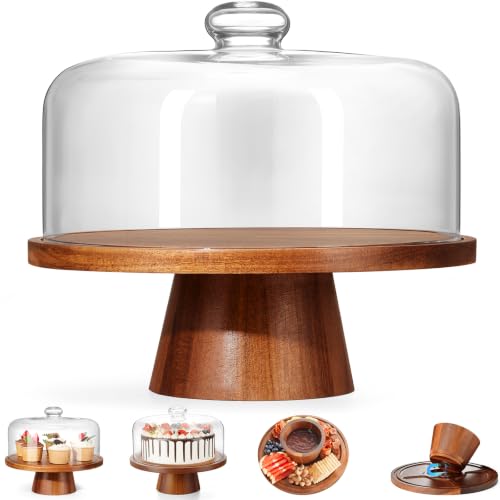
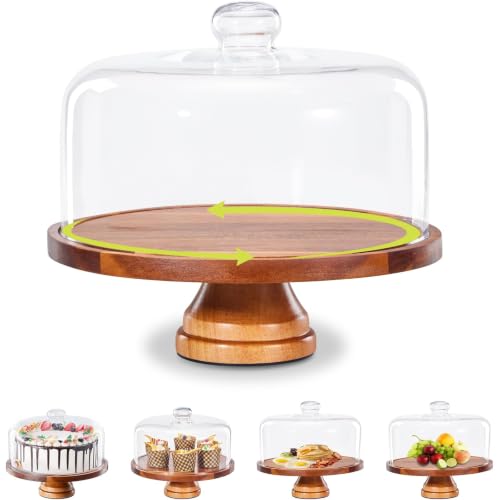
Wood is lighter than many ceramic options and brings a warmer serving style. It needs gentler care: avoid soaking it, and dry it promptly if the cake or dome leaves moisture on the surface. A wood base is a poor fit if you want every component to go into the dishwasher.
Check the Dome, Seal, and Handle—Not Just the Plate
A dome’s shape affects both clearance and usable space. A steeply rounded cover may provide good height at the center but less room near the edge, where frosting peaks or cupcakes can meet the glass. Measure the widest decorated portion of your bake as well as its height.
Do not assume a glass cover is airtight. Many domes rest directly on the stand without a gasket, leaving small gaps that help make them easy to lift but provide no dependable seal. For cakes that dry out quickly, store them according to the recipe’s requirements; a dome is primarily a serving cover, not a substitute for airtight storage.
Handle design matters when the cover is full of condensation or your hands are slightly damp. A rounded knob should be large enough to grip without pinching. A small, decorative finial may look neat but can be awkward to lift. Confirm that the handle is securely attached and that its height does not prevent the covered stand from fitting on your shelf.
Measure the Fit and Storage Footprint
Use this quick fit check before ordering:
- Measure the cake’s widest point after decorating. Choose a plate at least 1 inch wider overall, leaving approximately half an inch of margin on each side.
- Measure from the plate surface to the highest decoration. Add about 1 inch for dome clearance.
- Measure the full outside diameter of the stand and the height of the assembled dome. Check the cabinet opening, shelf depth, and any vertical obstruction.
- Check whether the dome can be stored upside down over the base, whether the pieces nest, and whether the handle can be removed. These details can determine whether the stand stays accessible or becomes a cupboard obstacle.
For example, a cake that measures 9 inches across and 5 inches high with decorations needs more than a 9-inch plate and a 5-inch dome. A 10- to 11-inch plate and at least 6 inches of interior clearance are safer targets. Add another inch if the cake has soft piped details that should not touch the glass.
Keep It in Good Shape
Glass domes are vulnerable to edge impacts, so lift the cover by its handle and set it down gently rather than sliding it across the plate. Wash and dry glass by hand if the manufacturer does not clearly label it dishwasher-safe; sudden temperature changes can stress glass, and a tall dome may strike other dishes in a crowded dishwasher. Wash wood bases by hand and keep them out of standing water. Before serving, check for chips, loose handles, or a rocking base, and do not use damaged glass.
For the best balance of capacity and practicality, most households should start with a 10- to 12-inch stand and a dome with 6–7 inches of interior clearance. Go smaller when cabinet space is the priority, taller when your cakes need it, and choose by measured dimensions—not the listed diameter alone.





Write Your Review
No reviews yet. Be the first to share your experience!