

Key takeaways
- Flat, eased edges: Most practical for wiping, stacking, and everyday use.
- Rounded edges: Comfortable to carry and less likely to chip, especially on a board used by a busy household.
- Juice groove: Helpful for juicy fruit or serving meat, but it reduces the uninterrupted space available for crackers and cheese.
- Natural edge: Attractive and distinctive, but inspect for loose bark, deep fissures, and uneven contact with the table.
- Raised feet: Keep the board off a damp counter, although they can make the board less stable for cutting and harder to stack.
The best olive wood serving board for most kitchens is a medium board about 16–18 inches long, 7–9 inches wide, and ¾–1 inch thick, with a gently rounded edge, a smooth food-safe oil finish, and enough surface area for cheese, sliced fruit, and crackers without becoming awkward to wash.
Our top picks



As an Amazon Associate we earn from qualifying purchases at no extra cost to you. Ratings are shown as listed on Amazon.
Best olive wood serving boards by situation
| Best for | Recommended size | Ideal construction | Why it fits |
|---|---|---|---|
| Small table or apartment kitchen | 12–14 × 6–8 in; 1.5–3 lb | Single-piece board, rounded edge | Easy to store and carry; enough for a small snack spread |
| Everyday serving for two to four | 16–18 × 7–9 in; 2.5–5 lb | ¾–1 in thick, routed handle or juice groove optional | The best balance of capacity, stability, and manageable cleaning |
| Large charcuterie spread | 20–24 × 9–12 in; 5–9 lb | Thick slab with broad, flat edges | Leaves room for separate cheese, meat, fruit, and condiment zones |
| Frequent chopping and prep | 16–20 × 10–12 in; at least 1 in thick | Flat, stable work surface without decorative cracks | More practical than a thin serving board, though it still needs gentle knife use |
| Occasional entertaining or gifting | 14–18 × 6–9 in; 2–5 lb | Prominent natural grain and polished, eased edges | Prioritizes presentation while remaining useful between gatherings |
How the leading board styles compare
Medium single-piece board: the best all-around choice
A solid medium board is the strongest default recommendation. Its surface is large enough for a modest charcuterie arrangement but not so large that it dominates a dishwasher-free sink or kitchen cabinet. Look for a board with a thickness of at least ¾ inch. Very thin olive wood boards can be attractive, but they are more likely to flex, slide, or develop a slight warp as moisture changes.
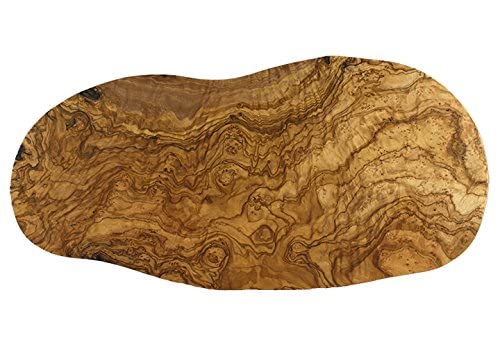
These boards usually have the most useful combination of durability and appearance: contrasting cream, honey, brown, and darker streaks make every piece individual, while the compact dimensions keep the board practical for everyday serving.
Long narrow board: best for a linear spread
A 20–24-inch board works well on a dining table or kitchen island when food is arranged in a row. It can hold sliced baguette, a wedge of cheese, cured meat, and small bowls of olives or mustard. Its limitation is storage. Measure the cabinet, shelf, or drawer before buying; a board that fits the table may not fit vertically in the kitchen.
Long boards also benefit from a substantial thickness and a broad underside. A narrow, lightweight board can tip when someone reaches for food at one end.
Thick slab: best for dramatic presentation
Thick olive wood slabs show off irregular grain and organic edges. They are excellent for a centerpiece, but the irregular edge reduces usable space and can make cleaning more time-consuming. A slab with a natural edge should still have a level underside, no loose bark, and no deep crevices that trap crumbs or moisture.
Small handled board: best for portable serving
A compact handled board is convenient for breakfast, snacks, and carrying cheese from the refrigerator to the table. The handle is useful only if it is integrated smoothly into the wood. Avoid narrow handles with sharp transitions, which can be uncomfortable and may become weak if the board is repeatedly lifted while loaded.
Grain pattern, edge profile, and finish: what matters
Olive wood is valued for its dense structure and highly variable grain. Straight grain tends to look calmer and more uniform. Swirled or feathered grain creates a more decorative board but may include natural knots or small voids. Those features are not automatically defects; the important question is whether they are stable, sealed, and easy to clean.
- Flat, eased edges: Most practical for wiping, stacking, and everyday use.
- Rounded edges: Comfortable to carry and less likely to chip, especially on a board used by a busy household.
- Juice groove: Helpful for juicy fruit or serving meat, but it reduces the uninterrupted space available for crackers and cheese.
- Natural edge: Attractive and distinctive, but inspect for loose bark, deep fissures, and uneven contact with the table.
- Raised feet: Keep the board off a damp counter, although they can make the board less stable for cutting and harder to stack.
For food safety, choose a board labeled with a food-safe finish, such as a penetrating food-grade drying oil or a food-safe mineral-oil treatment. A glossy decorative coating is less desirable if it is not clearly identified for food contact. Avoid boards with a strong chemical odor, peeling surface, tackiness, or unsealed cracks.
Olive wood versus common serving-board materials
| Material | Appearance | Moisture tolerance | Knife friendliness | Typical care |
|---|---|---|---|---|
| Olive wood | Highly varied, bold natural grain | Good when maintained; vulnerable to soaking | Good for light slicing and serving | Hand-wash, dry promptly, oil periodically |
| Acacia | Usually darker and more consistent | Good, but still not dishwasher-safe in most cases | Good for general serving and light prep | Similar wood-board maintenance |
| Bamboo | Uniform, striped appearance | Reasonable, though laminations need protection | Acceptable for serving; can feel harder under a knife | Hand-wash and oil as directed |
| Marble | Cool, polished, formal | Very good | Hard on knife edges | Wipe clean; avoid acidic spills sitting on the surface |
A practical buying decision matrix
- Budget-conscious buyer: Choose a plain 14–18-inch board with a smooth edge and no feet or complicated inlay. Decorative construction adds cost without adding serving capacity.
- First-time wood-board owner: Choose a medium, flat board with clearly stated care instructions and no deep natural fissures. Simpler geometry is easier to maintain.
- Small kitchen: Stay under 18 inches and verify both cabinet length and sink width. A board that cannot be washed comfortably will be used less often.
- Frequent host: Choose 20 inches or longer, at least ¾ inch thick, with a broad flat base. Consider buying a second small board for condiments rather than overcrowding one oversized board.
- Mostly decorative use: Prioritize grain, edge character, and presentation, but confirm that the finish is food-safe if food will touch it.
- Frequent chopping: Select the thickest, flattest design available, but use it for light prep rather than heavy cleaver work. A dedicated cutting board is better for daily knife tasks.
Care requirements and the mistakes that shorten board life
Olive wood is durable, but durability depends more on moisture control than on thickness alone. Wash the board by hand with warm water and a small amount of mild dish soap. Wipe both sides, then dry it immediately and stand it on edge or prop it so air can circulate. Do not leave it submerged, place it in a dishwasher, or allow one side to remain wet against a counter.
Apply a thin coat of food-safe board oil when the surface begins to look pale, dry, or slightly rough. For many households, that means approximately every four to eight weeks; a board used only monthly may need oil just a few times a year. Let the oil soak in according to its label, then wipe away excess. A wax-and-oil board conditioner can add water resistance, but it is not a substitute for drying.
Simple maintenance calculation
Suppose a 16-inch board is used three times each week. That is about 156 uses per year. If one small bottle of board oil costs roughly $10–$18 and lasts a year with periodic applications, the maintenance cost is approximately 6–12 cents per use. The larger ownership cost is usually not oil; it is replacing a board damaged by soaking, heat, or a dishwasher cycle.
- Do not put an olive wood board in the oven, microwave, or refrigerator for long-term storage.
- Do not use it as a trivet for hot cookware.
- Do not leave cut tomatoes, citrus, or wet foods on it for hours.
- Do not sand away a stain aggressively unless the manufacturer permits it; excessive sanding can thin the board and remove its finish.
- Do not use a deeply cracked board for food service if the crack cannot be cleaned and dried fully.
What to inspect before buying
Run your hand over the entire surface. It should feel smooth, without splinters, raised fibers, sticky patches, or sharp transitions around handles and grooves. Set the board on a flat surface and press opposite corners; noticeable rocking suggests an unstable base. Check that any feet are firmly attached and that decorative inlays sit flush.
Also compare the usable surface rather than the advertised outer dimensions. A 20-inch natural-edge board may provide less practical space than a 17-inch rectangular board. For charcuterie, allow roughly 25–35 square inches per person for a light snack spread, or more if the board is serving as the main meal. Six guests therefore need about 150–210 square inches of usable area, which usually points to a large rectangular board or two medium boards.
Bottom line
For most buyers in 2026, the best olive wood serving board is a 16–18-inch solid board, ¾–1 inch thick, with smooth eased edges, a level base, and a clearly identified food-safe finish. Choose a long board for table-length presentations, a thick slab for visual impact, and a smaller handled board for portable snacks. Whichever style you select, careful hand-washing, prompt drying, and occasional oiling will matter more to its working life than an elaborate grain pattern or decorative edge.





Write Your Review
No reviews yet. Be the first to share your experience!