

Key takeaways
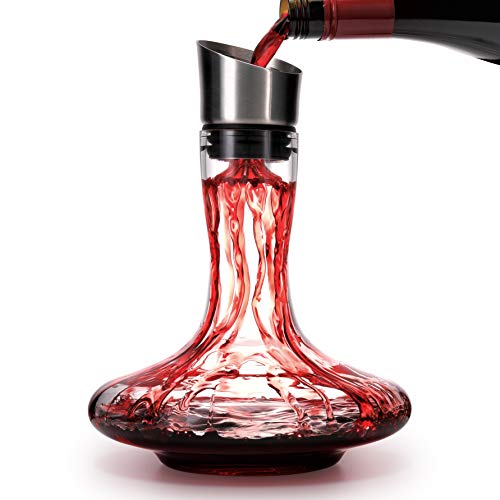
- Very young, tannic red: Choose a broad-bowl decanter and give the wine 30–90 minutes, tasting periodically. A large decanter such as the Riedel Ultra is suited to this job.
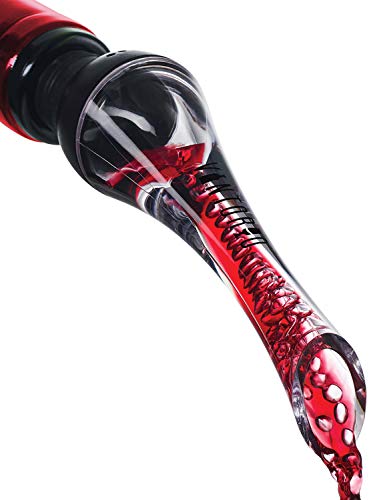
- Young red needed immediately: Choose the Vinturi Red Wine Aerator or another pour-through Venturi design. It is the practical option when dinner is already being served.
- Delicate or mature wine: Use a narrow-neck decanter and pour slowly. Decant mainly to separate sediment, then serve soon rather than leaving the wine exposed for hours.
- White wine that benefits from opening up: Use a smaller, easy-clean decanter or aerator and avoid prolonged exposure. Full-bodied whites can benefit; fragile older whites may not.
- Frequent casual use: Pick a simple 750–1,000 ml vessel with a stable base and a mouth wide enough to fit a cleaning brush.
- Formal presentation: A hand-finished Riedel decanter offers more visual impact, but its appearance usually comes with more delicate handling and cleaning effort.
The best aerating wine decanters are the Riedel Ultra for maximum separation and presentation, the Vinturi Red Wine Aerator for fast everyday pours, and a narrow-neck 750–1,000 ml glass decanter for the best balance of control, price, and easy storage.
Our top picks


As an Amazon Associate we earn from qualifying purchases at no extra cost to you. Ratings are shown as listed on Amazon.
Best aerating wine decanters at a glance
| Pick | Aeration design | Useful capacity | Pour speed | Cleaning difficulty | Best for |
|---|---|---|---|---|---|
| Riedel Ultra Decanter | Wide, sculptural bowl with large exposed wine surface | About 1,230 ml | Moderate | High | Full-bodied young reds and formal serving |
| Vinturi Red Wine Aerator | Venturi chamber mixes air into wine during pouring | About 750 ml per continuous pour | Very fast | Low to moderate | Quick weeknight aeration and small spaces |
| Riedel Cabernet Decanter | Broad bowl and long neck for decanting and presentation | About 1,200 ml | Moderate | Moderate to high | One standard bottle with room to swirl |
| Narrow-neck 750–1,000 ml glass decanter | Moderate bowl with controlled, conventional aeration | 750–1,000 ml | Moderate | Moderate | Budget-conscious, frequent use |
| Stopper-top aerating decanter | Pour-through stopper or built-in screen adds turbulence | 750–1,000 ml | Fast | Moderate to high | Pouring directly at the table with drip control |
Capacities are nominal and vary by model or production version. A standard 750 ml bottle needs more than 750 ml of internal space if you want to pour without filling the vessel to its neck, so a 1,000–1,300 ml decanter is usually more practical than a vessel that barely fits one bottle.
How the aeration designs differ
Wide-bowl decanters: the most complete aeration
A broad bowl spreads the wine into a relatively thin layer, increasing contact with air. This is the most useful design for a young, concentrated Cabernet Sauvignon, Syrah, Malbec, or similar red that tastes tight, tannic, or overly dominated by alcohol immediately after opening.
The trade-off is handling. Wide bowls are easier to knock over, harder to grip with one hand, and more demanding to wash. Their large footprint also matters: a decanter with a 20–25 cm base may not fit comfortably beside plates or on a narrow bar shelf. They are better for planned service than for an improvised glass at the end of dinner.
Venturi aerators: the fastest route from bottle to glass
A Venturi aerator narrows the wine stream through a chamber, drawing air into the flow before the wine reaches the glass. The Vinturi Red Wine Aerator is the best-known example of this format. It aerates while pouring, so there is no need to transfer the entire bottle or wait for a decanting period.
This design wins on speed and storage. It is also easier to use when only one or two glasses are wanted. However, the wine receives a shorter, more forceful exposure to air than it would in a broad bowl. That can be useful for a robust young red but less suitable for an old or delicate wine whose aromas may fade quickly.
Narrow-neck decanters: controlled and versatile
A conventional decanter with a moderate bowl and narrow neck gives you a compromise. It provides meaningful air contact, lets you watch for sediment while pouring, and usually has a more manageable footprint. It does not aerate as aggressively as a very wide bowl, but that restraint is an advantage for Pinot Noir, older Rioja, mature Bordeaux-style blends, and other wines that need careful handling.
Best choice by wine and occasion
- Very young, tannic red: Choose a broad-bowl decanter and give the wine 30–90 minutes, tasting periodically. A large decanter such as the Riedel Ultra is suited to this job.
- Young red needed immediately: Choose the Vinturi Red Wine Aerator or another pour-through Venturi design. It is the practical option when dinner is already being served.
- Delicate or mature wine: Use a narrow-neck decanter and pour slowly. Decant mainly to separate sediment, then serve soon rather than leaving the wine exposed for hours.
- White wine that benefits from opening up: Use a smaller, easy-clean decanter or aerator and avoid prolonged exposure. Full-bodied whites can benefit; fragile older whites may not.
- Frequent casual use: Pick a simple 750–1,000 ml vessel with a stable base and a mouth wide enough to fit a cleaning brush.
- Formal presentation: A hand-finished Riedel decanter offers more visual impact, but its appearance usually comes with more delicate handling and cleaning effort.
Decision matrix: match the decanter to your habits
| Your situation | Recommended design | Why | Acceptable compromise |
|---|---|---|---|
| Under about $40 and occasional use | Simple glass decanter or entry-level pour-through aerator | Low replacement cost and adequate performance | Expect less refined drip control and thicker glass |
| Small kitchen or limited cabinet space | Vinturi-style aerator | Stores in a drawer and works directly over a glass | Less sediment separation than a traditional decanter |
| New to decanting | Stable 750–1,000 ml narrow-neck vessel | Forgiving pouring technique and simple timing | Slower aeration than a broad bowl |
| Several bottles per week | Wide-mouth, brush-accessible glass decanter | Faster rinsing and less frustration between uses | May have a less dramatic silhouette |
| Mostly old or delicate wines | Narrow-neck decanter with a controlled pour | Prioritizes sediment removal over aggressive aeration | Requires closer tasting during service |
Pour speed, drip control, and sediment handling
Pour speed is not the same as aeration quality. A fast pour-through aerator is convenient, but a broad decanter gives the wine more time in contact with air. If you are serving a full bottle to six people, transferring it into a decanter takes roughly 30–60 seconds with a steady pour. A Venturi device can aerate each glass in seconds, but the final glass may not receive exactly the same flow conditions as the first.
For drip control, look for a rolled or flared rim, a pronounced pouring lip, or a stopper designed to return wine into the vessel. Decorative swan-neck shapes can look elegant but may be awkward when the bottle is nearly empty. A removable stopper can reduce dust during a short serving period, though it should not be treated as long-term wine preservation.
Traditional decanting remains the better method when sediment matters. Stand the bottle upright for several hours, pour slowly toward a light source, and stop when sediment approaches the shoulder. A built-in aerator may improve aroma, but it generally cannot replace watching the bottle and controlling the pour.
Cleaning difficulty and ownership realities
Cleaning is where many attractive decanters become inconvenient. The narrowest part of the neck, not the bowl, is usually the limiting factor. Wine residue dries into a sticky film, especially around the shoulder and beneath a stopper. Rinse immediately with warm—not boiling—water, drain upside down with airflow, and use an appropriately sized soft brush when needed.
Avoid abrasive brushes, harsh dishwasher cycles, and sudden temperature changes. Thin crystal can be more vulnerable to chips and thermal shock than ordinary soda-lime glass. If the manufacturer permits dishwasher use, check that the vessel fits securely and cannot touch other items; hand-washing is still the safer choice for tall, thin designs.
For persistent residue, soak with warm water and a small amount of unscented dish soap, then rinse thoroughly. Decanter-cleaning beads can reach curved interiors, but they must be collected carefully and dried completely. Do not leave metal beads or standing water inside for long periods.
A simple setup that avoids over-aeration
- Inspect the wine first. Pour a small taste before decanting so you know whether it is tight, reduced, balanced, or already fading.
- Choose the vessel. Use a broad bowl for youthful, tannic wine and a narrower vessel for mature or fragile wine.
- Pour deliberately. For sediment-prone bottles, keep the shoulder low and use a lamp or phone flashlight behind the neck.
- Set a tasting interval. Taste after 15 minutes, then every 15–30 minutes. Stop waiting when fruit and texture improve; more air is not always better.
- Serve and rinse immediately. Prompt rinsing prevents the most common cleaning problem: dried wine film in the neck.
What to buy
Choose the Vinturi Red Wine Aerator if speed, compact storage, and one-glass-at-a-time service matter most. Choose the Riedel Ultra Decanter if you regularly open powerful young reds and want maximum air contact with a presentation-focused design. Choose a Riedel Cabernet Decanter or a simple narrow-neck 750–1,000 ml glass decanter if you want one traditional vessel for ordinary dinners, sediment control, and moderately delicate wines.
The best aerating wine decanters are not necessarily the largest or most elaborate. The right choice is the one whose aeration intensity matches your wine, whose pour remains controlled, and whose interior you will actually clean after every use.




Write Your Review
No reviews yet. Be the first to share your experience!