

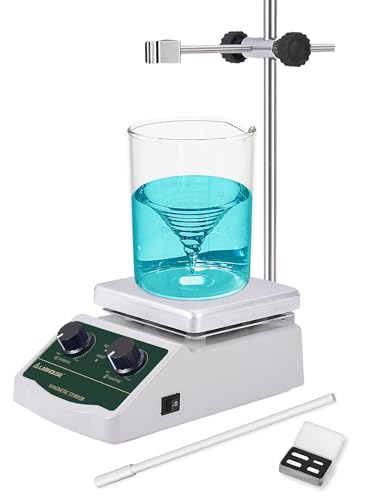
For routine lab work that needs repeatable temperature and stirring, the Corning PC-420D digital stirring hot plate and the IKA C-MAG HS 7 are the two models that reviewers and supplier pages cite most often, with the Corning favored for digital precision on small to medium vessels and the IKA favored for higher heating power and larger volumes. Teaching labs, school science departments and hobby chemists on a tight budget may be better served by a simpler analog unit, while anyone heating flammable solvents should look at hot plates built for that purpose and consult their safety officer. This guide compares the main specifications as the makers and suppliers state them.
Our top picks


As an Amazon Associate we earn from qualifying purchases at no extra cost to you.
At a Glance: Lab Hot Plate Stirrers Compared
| Model | Plate | Stated temperature range | Stated stirring speed | Notes |
|---|---|---|---|---|
| Corning PC-420D | 5 x 7 in (12.7 x 17.8 cm) Pyroceram top | 5 to 550 C (41 to 1022 F), 5 C steps | 60 to 1150 rpm, closed-loop control | 120 V, 698 W, UL and cUL approved, 2-year warranty per the maker |
| IKA C-MAG HS 7 | Ceramic plate, reported as 180 x 180 mm by one supplier and 200 x 200 mm by another | Up to 500 C heating range; fixed safety circuit at 550 C | 100 to 1500 rpm | 1000 W heating; stirs up to 10 L of water; contact thermometer socket |
| Analog entry-level stirring hot plates (various brands) | Varies, often aluminum or ceramic | Knob-controlled, usually lower limit | Knob-controlled | Cheaper, less precise; check each maker sheet |
The Corning figures come from Corning’s own catalog page. The IKA figures come from supplier listings, which disagree on plate size, and from the maker’s published specifications as quoted there. Where sources conflict, this guide shows both numbers rather than choosing one. A misec.net roundup names both the Corning PC-420D and the IKA C-MAG HS 7 as the units it trusts for repeatable results, and another listing site ranks the Corning first; these are roundup opinions, not independent laboratory testing.
Corning PC-420D
Corning lists a 5 by 7 inch Pyroceram top, a digital LED display for temperature with a blinking indicator until the target is reached, and temperature control in 5 degree Celsius steps from 5 to 550 degrees Celsius. Stirring runs from 60 to 1150 rpm. Corning describes a stronger magnet with automatic ramp-up intended to reduce stir bar decoupling, and closed-loop stirring control that adapts to different solution types. Power is listed as 120 V at 60 Hz, drawing 698 watts. It is UL and cUL approved and carries a two-year warranty. The unit is described as the suggested replacement for the earlier 6795-420.
The plate size is the key point. A 5 by 7 inch surface suits beakers and flasks up to a modest size, and it is compact enough for a crowded bench. For multiple small vessels or large flasks, the footprint is limiting. One reseller listing quotes different ranges for this model than Corning does, so rely on the maker’s datasheet for any purchase decision.
IKA C-MAG HS 7
IKA’s C-MAG HS 7 is a larger, higher-powered hot plate stirrer. The maker lists a heating output of 1000 W, a heating range up to 500 C, a stirring speed range of 100 to 1500 rpm, and capacity to stir up to 10 liters of water at a single stirring position. The plate is chemical-resistant ceramic. A fixed 550 C safety circuit and a “hot top” indicator warn the user that the surface is still hot after switching off. A DIN bushing allows connection of an external contact thermometer for tighter temperature control. It weighs around 5 kg.
The trade-off is control style. Reviewers note the HS 7 uses a rotary knob for heat and a 0 to 6 scale for stirring rather than a fully digital interface, though a display shows set and actual temperature. If you need to set an exact figure and hold it, add an external probe. If you need bulk heating and a large volume, the IKA is the stronger match.
Features That Matter When Choosing
- Plate material: Ceramic and Pyroceram tops resist chemicals and are easier to wipe clean than bare aluminum. Aluminum plates heat evenly but can corrode if exposed to acids or bases.
- Plate size: Choose a plate larger than the base of your biggest vessel for even heat and stability.
- Stirring range: A low minimum rpm helps with delicate solutions, while a high maximum helps with viscous liquids. Check the stated maximum volume.
- Temperature control: Digital control and an external probe give accurate set points. Knob-only controls are simpler but less repeatable.
- Safety features: Look for a hot-surface indicator, over-temperature cutoff, and certification marks such as UL or CE where the maker lists them.
- Magnet strength: A strong coupling keeps the stir bar from jumping at high speeds in thick liquids.
Safety and Fit Notes
A lab hot plate gets extremely hot, and the plate can stay hot for a long time after being turned off. Use heat-resistant gloves and tongs, never leave heating unattended, and keep the surface clear of paper, plastic and cords. Flammable solvents are a serious hazard on any hot plate with exposed heating elements or an unprotected switch; vendors and institutions often specify “explosion-safe” or spark-free designs for such work. If you are unsure whether your intended use is safe, consult your institution’s safety officer, a qualified chemist, or the manufacturer before proceeding. Home users should avoid heating unknown chemicals and should follow the manual closely.
For electrical fit, check the voltage and plug type. The Corning PC-420D version described above is for 120 V North American supply. Imported units may need a different plug or voltage, and a licensed electrician should handle any wiring changes. Place the unit on a stable, level, non-flammable surface and keep liquids away from the housing. Clean spills only when the plate is cool and unplugged.
Care and Daily Use
Let the plate cool fully before wiping it down, and use a damp cloth with a mild cleaner rather than abrasive pads that can scratch a ceramic or Pyroceram surface. Remove stir bars with a retrieval wand or magnet rather than your fingers. Keep ventilation slots clear and avoid placing the unit where water from a sink can reach it. Calibrate the setting against a separate thermometer when your process depends on an exact temperature, because the display shows the plate or sensor reading, not necessarily the temperature inside your flask. Record the settings that work for each procedure so results stay repeatable between sessions. Keep the maker’s manual with the unit, and send it to an authorized service center for repair instead of opening the housing yourself.
Budget, Mid-Range and Premium Tiers
- Budget: Basic analog stirring hot plates for teaching and hobby use. Less precise control and sometimes lower plate quality.
- Mid-range: Digital units with ceramic tops and a defined temperature range, such as the Corning PC-420D, which one outlet calls a mid-range option.
- Premium: High-power or high-capacity units from specialist makers such as IKA, often with external probe connections and safety circuits.
Pick X If… Decision Table
| If you… | Pick | Why |
|---|---|---|
| Need digital set points on small vessels | Corning PC-420D | Digital display, 5 C steps, closed-loop stirring |
| Heat larger volumes or run higher stirring speeds | IKA C-MAG HS 7 | 1000 W, up to 10 L of water, up to 1500 rpm |
| Need tight temperature accuracy | IKA with external contact thermometer | DIN bushing for the probe |
| Teach basic labs on a budget | Analog stirring hot plate | Simple knobs, lower cost |
| Have limited bench space | Corning PC-420D | Compact 5 x 7 inch footprint |
Alternatives Worth Considering
- Standalone magnetic stirrer plus separate hot plate: Offers flexibility and can be cheaper if one part fails.
- Heating mantles and oil baths: Better for round-bottom flasks and even heat. Use with a stirrer for uniform results.
- Other lab brands: Thermo Scientific, Heidolph, Ohaus and VWR offer comparable digital stirring hot plates. The sources reviewed here did not provide detailed specifications for them, so consult each maker’s datasheet.
Frequently Asked Questions
Can I use a lab hot plate stirrer in a kitchen?
These are laboratory devices, and mixing them with food preparation is not advised. Surfaces and stir bars may be contaminated by chemicals. Use dedicated equipment for food or follow the manufacturer’s guidance.
What size stir bar should I use?
Choose a bar about two thirds the vessel base width, long enough to spin freely. Stronger magnets help with viscous liquids. Follow the maker’s rpm and volume guidance.
Why does my stir bar jump or stop?
Decoupling happens when the speed is too high or the liquid is too thick for the magnet. Lower the speed, use a larger bar, or use a model with a stronger magnet or ramp-up feature, as Corning describes for the PC-420D.
Is a ceramic top better than aluminum?
Ceramic and Pyroceram resist chemical attack and clean easily. Aluminum conducts heat quickly but can be attacked by corrosive spills. Pick based on the chemicals you handle and the maker’s care instructions.
Do I need an external temperature probe?
For accurate liquid temperature control, yes. The hot plate surface temperature differs from the liquid temperature, especially with larger volumes. A contact thermometer, such as the one supported by the IKA’s DIN bushing, closes that gap.
Can I heat flammable solvents on a hot plate?
Only with equipment specifically designed for that purpose and under appropriate supervision. Ordinary hot plates can ignite vapors. Ask your safety officer or the manufacturer before proceeding.





Write Your Review
No reviews yet. Be the first to share your experience!