

Key takeaways
- Two to four people: choose a 10.5- to 12-inch bowl holding about 2.5 to 3.5 quarts.
- Four to six people: choose a 12- to 14-inch bowl holding about 3.5 to 5 quarts.
- Six to eight people: choose a 14- to 16-inch bowl holding about 5 to 7 quarts, or use two medium bowls for easier handling.
Best Large Pasta Serving Bowl Sets
The best large pasta serving bowl set for most families is a pair of 12- to 14-inch, 3- to 5-quart stoneware or porcelain bowls: they provide enough surface area for tossing and serving, withstand normal oven and dishwasher use, and nest more efficiently than a single oversized bowl.
Quick comparison: which set fits your table?
| Best for | Recommended size | Material | Typical set | Approximate market range in 2026 |
|---|---|---|---|---|
| Weeknight family meals | 11.5–13 in diameter, 3–4 qt capacity | Porcelain or stoneware | 2 bowls | $35–$90 |
| Large families and entertaining | 13–15 in diameter, 4–6 qt capacity | Stoneware, porcelain, or stainless steel | 2 bowls or bowl plus serving utensils | $60–$150 |
| Small kitchens | 10.5–12 in diameter, 2.5–3.5 qt capacity | Melamine or lightweight porcelain | 3–4 nesting bowls | $30–$80 |
| Oven-to-table cooking | 11–14 in diameter, 3–5 qt capacity | Oven-rated stoneware or borosilicate glass | 2 bowls | $45–$120 |
| Outdoor dining and low breakage | 11–13 in diameter, 3–4 qt capacity | Melamine | 2–4 bowls | $25–$70 |
These are general market ranges rather than fixed prices. Capacity is the bowl’s approximate volume to the rim; practical serving capacity is lower because pasta needs room for mixing without spilling.
Our top picks
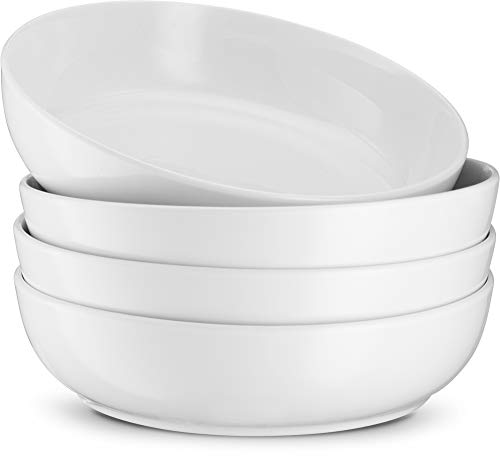

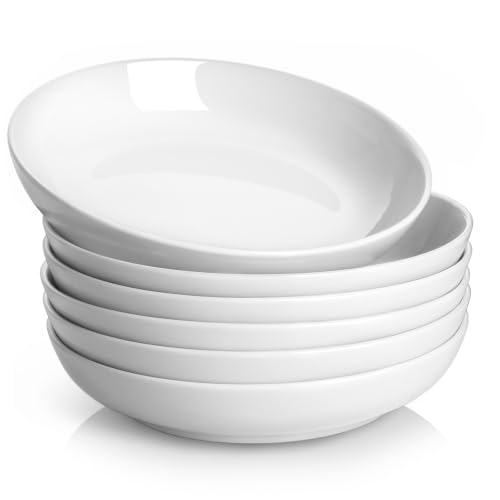

As an Amazon Associate we earn from qualifying purchases at no extra cost to you. Ratings are shown as listed on Amazon.
How large should a pasta serving bowl be?
Diameter matters more than shoppers often expect. A deep, narrow bowl may hold plenty of food but make it difficult to combine pasta, sauce, vegetables, and grated cheese. A broad bowl gives you room to toss and lets diners serve themselves without reaching into a tall container.
- Two to four people: choose a 10.5- to 12-inch bowl holding about 2.5 to 3.5 quarts.
- Four to six people: choose a 12- to 14-inch bowl holding about 3.5 to 5 quarts.
- Six to eight people: choose a 14- to 16-inch bowl holding about 5 to 7 quarts, or use two medium bowls for easier handling.
A useful rule is to leave roughly one-third of the bowl empty when pasta is mixed. For example, a 5-quart bowl should normally hold no more than about 3.3 quarts of food. That empty space prevents sauce from climbing over the rim and gives tongs enough clearance.
A practical serving calculation
For a family meal, allow approximately 2 ounces of dry pasta per adult as a main course, with more for particularly hungry diners and less when serving several side dishes. Six adults therefore require about 12 ounces of dry pasta, which commonly expands to roughly 6 cups cooked, depending on shape and cooking time. Add sauce, vegetables, meat, and cheese, and the finished dish may occupy 10 to 12 cups—about 2.5 to 3 quarts. A 4-quart bowl gives that amount useful mixing space without requiring an awkwardly oversized vessel.
Material head-to-head
Porcelain: the balanced everyday choice
Porcelain bowls are smooth, relatively light, nonporous, and usually easy to clean. They suit both casual and formal tables, and white porcelain makes colorful sauces visible. Many porcelain serving bowls are microwave- and dishwasher-safe, but the exact label matters. Thin porcelain can chip at the rim if knocked against a sink or metal pan, so inspect the edge before buying.
Choose porcelain when you want a polished appearance, moderate weight, and regular dishwasher use. It is particularly practical for a two-bowl set: one bowl for pasta and one for salad, bread, or vegetables.
Stoneware: substantial and attractive, but heavy
Stoneware retains heat well and feels stable on the table. Its weight helps prevent a large bowl from sliding while you toss pasta, and reactive or colored glazes can make it a centerpiece. The trade-off is storage and handling: a 14-inch stoneware bowl can be difficult to lift when full, and the glaze may scratch or chip over time.
Look for a clearly stated oven rating, microwave compatibility, and dishwasher instructions. Avoid moving a cold stoneware bowl directly into a very hot oven unless the manufacturer specifically permits it; sudden temperature changes can cause thermal shock.
Glass: useful for visibility and reheating
Heat-resistant borosilicate glass or other specifically oven-rated glass lets you see the food and can be convenient for reheating. It is nonporous and does not retain garlic or tomato odors. Glass can be slippery when wet, however, and large bowls may feel fragile even when they are designed for kitchen use.
Do not assume every glass serving bowl is oven-safe. A bowl intended only for cold food should not be placed under a broiler or on a hot stovetop. Also avoid pouring boiling food into a chilled bowl unless the care instructions allow it.
Melamine: lightweight and break-resistant
Melamine is a sensible option for patios, children, and households that want a large set without the weight of stoneware. It is commonly dishwasher-safe on the top rack, but it should not be used in a microwave or conventional oven. Use it for serving rather than cooking or reheating.
Stainless steel: durable utility
Stainless steel is hard to chip, light for its size, and easy to use for mixing large quantities. It is less visually warm than ceramic and can become hot or cold quickly. A silicone-covered base or a rolled rim can improve stability and handling. Stainless steel is best when durability and frequent use matter more than oven-to-table presentation.
Best picks by situation
| Your situation | Best choice | Why | Watch out for |
|---|---|---|---|
| Limited cabinet space | Three-bowl nesting set, 10.5–13 in | Different sizes cover pasta, salad, and leftovers while stacking | Smallest bowls may be too shallow for mixing |
| Weekly pasta dinners | Two 12–14 in porcelain bowls | Good balance of capacity, appearance, and cleaning ease | Check rim thickness and chip resistance |
| Frequent entertaining | Two 13–15 in stoneware or stainless-steel bowls | Large capacity and stable serving surface | Full bowls can be heavy; consider two smaller portions |
| Oven-finished pasta | Oven-rated stoneware or borosilicate glass | Can move from heating to serving when instructions permit | Prevent thermal shock and verify the temperature limit |
| Outdoor or breakage-prone use | Melamine, 11–13 in | Lightweight and resistant to ordinary knocks | Never microwave or oven-use unless explicitly labeled for it |
Nesting, footprint, and storage details
“Nesting set” does not always mean space-efficient. Measure the complete stacked height and the widest bowl, not only the diameter printed on the package. A three-piece set may nest neatly but still require 15 inches of vertical clearance. Also check whether the rims lock together or slide easily; smooth glazed bowls can shift when pulled from a high shelf.
For a cabinet with a 14-inch-wide shelf, a bowl listed as 14 inches may not fit once its flared rim is measured. Leave at least 1 inch of clearance for gripping. If your shelf is narrow, two 12-inch bowls often work better than one 16-inch bowl, even when the total capacity is similar.
Heat resistance and care
Separate three different claims: microwave-safe, oven-safe, and broiler-safe. They are not interchangeable. A bowl may tolerate microwave heating but fail under direct broiler heat. For oven use, check the maximum temperature, whether preheating is permitted, and whether the bowl must begin at room temperature.
- Let a refrigerated ceramic or glass bowl warm gradually before exposing it to high heat.
- Place hot bowls on a dry trivet rather than a wet or cold countertop.
- Do not use a serving bowl on a stovetop unless it is specifically designed for that purpose.
- Use nonmetal utensils in glazed bowls if you want to reduce visible scuffing.
- Inspect chips and hairline cracks; retire damaged bowls because cracks can spread during heating or handling.
Tomato sauce, cheese, and oil are usually easy to remove with prompt soaking. Dried starch is more likely to require a long soak than aggressive scrubbing. For stoneware and porcelain, avoid stacking while wet if moisture can collect between pieces. That reduces trapped odors and makes chips easier to spot.
What wears out first?
On ceramic sets, the rim and the contact points between nested bowls usually show damage first. On melamine, surface scratches and fading are the main cosmetic concerns. Stainless steel generally lasts longest structurally, but thin-gauge bowls can dent and noisy rims may be less pleasant for serving. Rubber or silicone bases, when included, can loosen before the bowl itself fails.
For most households, a pair of 12- to 14-inch porcelain bowls is the strongest all-around purchase. Choose stoneware when heat retention and table presence matter more than weight, melamine for outdoor durability, glass for visible oven-to-table dishes, and stainless steel for high-volume mixing. The right set is not the one with the largest quoted capacity; it is the one that leaves enough empty room to toss the pasta, fits your cabinet, and remains manageable when full.







Write Your Review
No reviews yet. Be the first to share your experience!