

Key takeaways
- Choose three bowls if you cook for one or two people, have limited storage, or already own small prep bowls.
- Choose four bowls if you bake weekly or regularly prepare recipes with multiple components.
- Choose five bowls only if the smallest and largest sizes are genuinely different and you have enough shelf or drawer space.
- Choose lids if you often refrigerate marinating food, rising dough, chopped produce, or leftovers.
- Skip lids if they make the set expensive or bulky and you already have reusable covers.
Best Glass Mixing Bowl Set
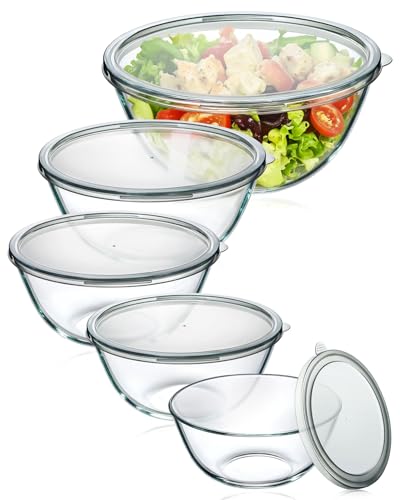
The best glass mixing bowl set for most kitchens is a three- or four-bowl nesting set with useful capacities from about 1.5 to 4 quarts, clear measurement markings, a stable rim, and microwave-safe tempered glass; choose a lighter borosilicate set if you frequently move bowls from refrigerator to oven or microwave.
Glass is easier to inspect than stainless steel, does not retain odors as readily as plastic, and can usually go from mixing to serving. Its drawbacks are weight, breakability, and less comfortable handling when a bowl is full. The right set therefore depends less on the number of pieces than on capacity spacing, storage footprint, and the quality of the rims and markings.
Our top picks



As an Amazon Associate we earn from qualifying purchases at no extra cost to you. Ratings are shown as listed on Amazon.
Our top picks by kitchen situation
| Kitchen situation | Best choice | Useful capacity range | Why it fits |
|---|---|---|---|
| One-person or compact kitchen | Three-piece nesting set | 1, 1.5, and 2.5 quarts | Uses little cabinet space and covers dressings, batters, and small batches |
| Frequent home baking | Four- or five-piece set | 1, 1.5, 2.5, 4, and 5 quarts | Provides separate bowls for ingredients, creaming, and rising dough |
| Family cooking and large batches | Heavy-duty tempered-glass set | 1.5, 2.5, 4, and 5 quarts | Large bowls are more practical for salad, pancake batter, and doubled recipes |
| Microwave-heavy cooking | Lightweight borosilicate-glass set | 1, 2, 3, and 4 quarts | Usually easier to handle when warming butter, chocolate, or leftovers |
| Serving as well as mixing | Clear bowls with smooth rims and lids | 1.5, 2.5, and 4 quarts | Works for preparation, storage, and serving without transferring food |
Best overall: a four-piece nesting set with a 4-quart largest bowl
For the broadest usefulness, look for bowls around 1, 1.5, 2.5, and 4 quarts. The smallest bowl handles beaten eggs, sauces, and measured ingredients. The middle sizes suit cake batter, dips, and chopped vegetables. A 4-quart bowl is large enough for most cookie dough, pancake batter, and family-size salads without being excessively heavy.
A set with a 5- or 6-quart bowl may appear more versatile, but capacity is only useful if the bowl fits your sink, refrigerator, and dishwasher. A large glass bowl filled with dough can weigh several kilograms, making a broad, comfortable rim more important than an extra quart of space.
Pyrex and Anchor Hocking both make widely available glass food-preparation and storage products. Their ranges vary by market and package, so check the exact set for capacity, markings, lid compatibility, and temperature guidance rather than assuming every bowl in a brand’s line has the same features.
Head-to-head: the features that separate good sets from frustrating ones
Capacity spacing
Some inexpensive sets contain four bowls whose capacities are too close together to be useful. A practical sequence should increase by roughly 50% to 100% at each step. For example, 1, 1.5, 2.5, and 4 quarts gives noticeably different working sizes.
Do not confuse total volume with working capacity. A bowl advertised as 4 quarts may hold that amount only to the rim. For whisking or tossing, leave at least 20% of the bowl empty. A 4-quart bowl therefore has a comfortable working capacity of about 3.2 quarts.
Nesting efficiency
Measure the cabinet before buying. A well-designed four-piece set may occupy only 7 to 10 inches of vertical height when nested, but thick rims or permanently attached handles can add several inches. Check whether the smallest bowl sits securely inside the next bowl without rocking.
Efficient nesting should not mean that the bowls are difficult to separate. Slightly flared rims and a small air gap are helpful. If two glass bowls create a vacuum when wet, drying them separately and storing the smaller bowls upside down can prevent sticking.
Measurement markings
Interior markings are more useful than marks printed only on the outside because they remain visible while ingredients are added. Look for both cup and milliliter graduations, with clear intervals at ¼-cup or 50-milliliter increments. Markings are convenient for liquids but should not replace a scale for flour, sugar, or other ingredients where volume varies with packing.
Printed markings can fade after repeated dishwasher cycles. Raised or etched graduations generally last longer, though they may be harder to read. If markings are a priority, verify that they appear on every bowl, not just the largest one.
Handles and pour spouts
A handle is valuable on a large bowl containing thick batter, but it also increases storage width and can make nesting awkward. Prefer a broad, integrated handle that leaves enough room for four fingers. Narrow glass handles concentrate stress and are uncomfortable when the bowl is heavy.
Pour spouts help with pancake batter, custard, and sauces. The best designs have a distinct channel that pours cleanly at a slow angle. A shallow notch often dribbles down the outside instead. For general mixing, a smooth rounded rim is easier to scrape and clean than a complicated spout.
Durability and thermal safety
Tempered soda-lime glass is common and generally robust for everyday mixing. Borosilicate glass is lighter and handles temperature changes well, but it is not unbreakable. In either case, avoid sudden thermal shock: do not place a cold bowl on a hot burner, fill a hot bowl with cold liquid, or move a bowl directly from the freezer into a hot oven unless the manufacturer specifically permits it.
Microwave-safe does not mean heatproof in every situation. Glass can become hot from the food inside, and localized heating can occur with thick sauces or sugary mixtures. Use oven mitts, allow steam to escape, and inspect bowls regularly for chips, cracks, or deep scratches. Retire damaged glass rather than continuing to use it.
Glass versus stainless steel and plastic
| Material | Typical weight for a 4-quart bowl | Microwave use | Main advantage | Main compromise |
|---|---|---|---|---|
| Glass | 2.5–4.5 lb | Usually yes, if labeled microwave-safe | Non-porous, visible contents, useful for serving | Heavy and breakable |
| Stainless steel | 1–2 lb | No | Light, durable, and comfortable for vigorous mixing | Cannot see contents and may react poorly with some acidic mixtures if low quality |
| Plastic | 0.5–1.5 lb | Depends on the plastic | Lightweight and resistant to impact | Can stain, scratch, or retain odors |
Many cooks benefit from combining materials rather than expecting one set to do everything. Glass is especially useful for microwave tasks, refrigerator storage, and serving. Stainless steel is better for beating egg whites or handling large quantities without worrying about breakage.
How much set do you actually need?
Use this quick decision rule:
- Choose three bowls if you cook for one or two people, have limited storage, or already own small prep bowls.
- Choose four bowls if you bake weekly or regularly prepare recipes with multiple components.
- Choose five bowls only if the smallest and largest sizes are genuinely different and you have enough shelf or drawer space.
- Choose lids if you often refrigerate marinating food, rising dough, chopped produce, or leftovers.
- Skip lids if they make the set expensive or bulky and you already have reusable covers.
As a simple space calculation, a set that nests to 9 inches high and occupies a 10-inch-wide shelf needs about 90 square inches of shelf footprint. A set that nests to 13 inches but has the same width may not fit below a cabinet shelf or inside a standard lower drawer. Measure the storage location, not just the bowls’ advertised dimensions.
Ownership details that matter after purchase
The first parts likely to wear are printed measurement marks, silicone feet, plastic lids, and rim edges damaged by contact with metal utensils. Wash bowls before first use, avoid stacking wet glass tightly, and use non-abrasive cleaners if the manufacturer warns that markings can fade.
Dishwasher cleaning is convenient, but allow bowls to cool before loading them into a cold wash cycle. Do not stack heavy cookware on top of glass. Silicone-bottomed bowls offer extra grip, although the silicone may loosen or discolor sooner than the glass. If a lid becomes warped, replace the lid rather than forcing it onto the bowl, which can stress the rim.
For most buyers, a four-piece tempered- or borosilicate-glass set in the 1-to-4-quart range is the best balance of usefulness, storage, and price. Prioritize sensible capacity gaps, readable markings, a comfortable rim, and explicit microwave guidance over extra accessories or an impressive piece count.



Write Your Review
No reviews yet. Be the first to share your experience!