

Key takeaways
- The best Japanese cocktail shakers for home bars are the BIRDY Cocktail Shaker for the smoothest, most controlled shaking experience, YUKIWA’s 18-8 stainless-steel cobbler shaker for dependable everyday value, and a Japanese-style tin-on-tin shaker when speed, capacity, and easy separation…
The best Japanese cocktail shakers for home bars are the BIRDY Cocktail Shaker for the smoothest, most controlled shaking experience, YUKIWA’s 18-8 stainless-steel cobbler shaker for dependable everyday value, and a Japanese-style tin-on-tin shaker when speed, capacity, and easy separation matter more than a built-in strainer.
Our top picks

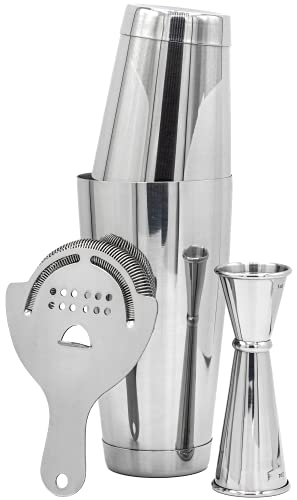


As an Amazon Associate we earn from qualifying purchases at no extra cost to you. Ratings are shown as listed on Amazon.
Quick picks by home-bar situation
| Situation | Best choice | Why it fits | Typical market range |
|---|---|---|---|
| First serious shaker | YUKIWA 18-8 stainless cobbler, 500 ml | Simple three-piece design, durable steel, integrated strainer | $25–$50 |
| Most precise home mixing | BIRDY Cocktail Shaker, 350 ml | Excellent seal, refined internal finish, compact single-drink capacity | $80–$120 |
| Two cocktails at once | Japanese-style tin-on-tin, 750–850 ml | Fast chilling, generous capacity, easy to open after shaking | $25–$70 |
| Small kitchen or occasional use | 350–500 ml stainless cobbler | Stores neatly and avoids the extra strainer required by Boston designs | $20–$45 |
What “Japanese-style” means in a shaker
Japanese cocktail shakers are usually associated with compact, polished stainless-steel cobbler shakers, careful finishing, and a tight, precise seal. A cobbler has three parts: the lower tin, a perforated middle section that acts as a strainer, and a cap. That makes it approachable for home bartenders because the drink can be poured without buying a separate Hawthorne strainer.
The term can also describe a tall, narrow tin-on-tin shaker influenced by Japanese bartending technique. This design has no built-in strainer: two metal cups form the seal, and the finished drink is poured through a separate strainer. It is generally quicker to chill and easier to open than a tightly fitted cobbler, but it requires more coordination.
Head-to-head comparison
| Shaker type or example | Construction | Nominal capacity | Approximate empty weight | Seal behavior | Strainer design | Best use |
|---|---|---|---|---|---|---|
| BIRDY Cocktail Shaker CS350 | 304 stainless steel, three-piece cobbler | 350 ml | About 260 g | Very secure, with a close-fitting cap | Built-in perforated strainer | One carefully measured cocktail |
| BIRDY Cocktail Shaker CS500 | 304 stainless steel, three-piece cobbler | 500 ml | About 320 g | Secure, though more difficult to open when overfilled | Built-in perforated strainer | Larger drinks or a generous single serving |
| YUKIWA 18-8 stainless cobbler | 18-8 stainless steel, three-piece cobbler | 500 ml | About 250–350 g, depending on model | Firm when correctly assembled | Built-in perforated strainer | Reliable everyday home use |
| Japanese-style tin-on-tin | Stainless-steel or tin-plated steel, two-piece | 750–850 ml total | About 300–450 g | Strong but intentionally breakable by hand | Separate Hawthorne or julep strainer | Two cocktails or fast service |
Capacities above are nominal vessel measurements, not recommended liquid fills. Leave room for ice and movement: a 350 ml cobbler usually works best with roughly 150–220 ml of liquid plus ice, while a 500 ml model commonly handles about 200–300 ml. Filling to the rim reduces agitation, increases leakage risk, and makes the cap harder to remove.
BIRDY: the precision pick
BIRDY is the standout choice when the feel of the shaker matters as much as its basic function. Its stainless-steel shakers are made in Japan and are known for carefully finished interiors and a deliberately engineered surface intended to promote smooth movement of ice and liquid. The result is a controlled, compact shaker that suits drinks such as a Daiquiri, Whiskey Sour, or Clover Club.
The 350 ml size is particularly well matched to one cocktail. It is less wasteful of ice than a large tin and takes up little drawer space. Its limitation is capacity: trying to make two full cocktails in it is likely to produce a crowded, weakly agitated mix. The 500 ml version gives more room but remains a cobbler, so the top can tighten as the metal chills.
Choose BIRDY if you shake several times a week, value a refined fit and finish, and are comfortable paying a premium for a compact tool. It is not the automatic best buy for someone making one cocktail a month.
YUKIWA: the practical everyday choice
YUKIWA’s 18-8 stainless-steel cocktail shakers are a sensible middle ground. The material resists corrosion, tolerates frequent washing, and does not retain the aromas of citrus, bitters, or strongly flavored spirits when cleaned promptly. The three-piece format keeps the workflow familiar: add ingredients, add ice, cap, shake, then pour through the integrated strainer.
YUKIWA models are available in several forms and sizes, so check the exact dimensions before ordering. A 500 ml cobbler is usually the most useful size for a home bar. It can make one substantial drink or a modest pair, but it should not be filled with two large cocktails and a full load of ice.
The trade-off is that the built-in strainer has larger and less adaptable openings than a separate Hawthorne strainer. Fine pulp, herbs, and small ice fragments may pass through. For clear drinks, this is rarely a problem; for mint-heavy or fruit-forward drinks, a separate fine strainer may still be useful.
When a tin-on-tin shaker is better
A Japanese-style tin-on-tin shaker is the better tool when you prioritize fast chilling, two-drink capacity, and easy opening. The smaller cup fits inside the larger one, creating a seal that can usually be released with a light tap. Stainless steel transfers cold quickly, and the absence of a built-in cap-and-strainer assembly means fewer parts to jam.
Its disadvantages are practical rather than technical. You need a separate strainer, the seal depends on correct alignment, and pouring requires a steadier hand. A tin-on-tin set also takes more vertical storage space than a compact cobbler. For a beginner who wants to shake and pour without learning another tool, a cobbler remains simpler.
Buying criteria that matter more than appearance
Tin construction
Look for food-grade stainless steel, commonly identified as 18-8 or 304 stainless. A heavier wall feels stable and resists dents, but extra weight is not automatically better. Thin tins chill quickly and are easier to handle; very light tins can dent and may feel harsh against the hands. Polished exteriors look attractive but show fingerprints, while brushed finishes hide wear better.
Seal quality
A good cobbler cap should seat positively without requiring excessive force. A good tin-on-tin set should hold during a vigorous shake but separate without a countertop bang. Avoid overfilling and do not twist a frozen cobbler cap aggressively; both habits can distort the rim. A small leak around the cap is usually an assembly or fill problem before it is a manufacturing problem.
Strainer design
Built-in cobbler strainers are convenient, but hole size and placement affect the pour. Larger holes allow more foam and pulp through; smaller holes slow the pour and may clog with herbs. If you make drinks with egg white, crushed fruit, or muddled herbs, buy a separate fine-mesh strainer regardless of the shaker style.
Capacity
Choose by normal batch size, not the largest number printed on the package. For one standard cocktail, 350–500 ml is usually enough. For two cocktails, a 750–850 ml tin-on-tin set offers more working room. A larger shaker does not chill a small drink better; it simply requires more ice to create effective movement.
Maintenance and ownership realities
- Rinse immediately. Cold water removes citrus oils, sugar, and egg residue before they dry onto the metal.
- Wash all parts separately. Pay attention to the underside of the cap and the joint around the cobbler’s strainer.
- Use mild detergent and a soft sponge. Abrasive pads can leave scratches that trap residue and dull the finish.
- Dry fully before storage. A trapped film of water can leave spots, especially on polished stainless steel.
- Inspect the rim regularly. Dents and flattened edges are the main causes of poor seals in metal shakers.
The part most likely to become troublesome is the cobbler cap, not the stainless body. Repeated freezing, prying, and impact can make it stick or loosen. Built-in strainers may also become annoying if pulp dries in the perforations. Tin-on-tin sets have fewer moving parts, but their rims can dent if dropped. Neither type needs special polish for normal use; prompt washing matters more.
Final recommendation
For most home bars, buy a 500 ml YUKIWA stainless-steel cobbler: it offers the best balance of price, durability, capacity, and simplicity. Choose the BIRDY CS350 if you mainly make one cocktail at a time and want the most refined compact cobbler. Choose a 750–850 ml Japanese-style tin-on-tin shaker if you regularly make two drinks, want rapid chilling, or prefer a separate strainer and easier post-shake release.
The best Japanese cocktail shakers are not separated by branding alone. Match the capacity to your normal batch, the strainer to your ingredients, and the seal to your tolerance for learning technique. Those choices will affect the finished drink—and how often you actually reach for the shaker—more than a mirror-polished exterior.






Write Your Review
No reviews yet. Be the first to share your experience!