

Key takeaways
- Allow at least 7 inches from the underside of the shelf to the lowest obstruction for ordinary stemmed wine glasses.
- Choose 8 to 10 inches of clearance if you use large red-wine glasses or want to remove glasses without tilting them.
- Leave roughly 3.5 to 4.5 inches of horizontal rack width per glass.
- Keep the front of the rack at least 1 inch behind the shelf’s front edge so stems do not catch on passing clothing or kitchen equipment.
- Check the glass rack’s slot width; a narrow slot may hold stems securely but may not accept thicker champagne or decorative stems.
Best Bar Shelf with Glass Rack for Small Bars
The best bar shelf with glass rack for a small bar is usually a wall-mounted shelf about 24 to 30 inches wide, 8 to 10 inches deep, and rated for at least 35 pounds, with 7 inches or more of clear space below the shelf for standard wine glasses.
That format gives you useful bottle storage without consuming counter space. A floating shelf can look cleaner and hold more varied glassware, but it generally needs stronger installation and more careful clearance planning because the glass rack is often mounted beneath the shelf or attached to the wall separately.
Our top picks
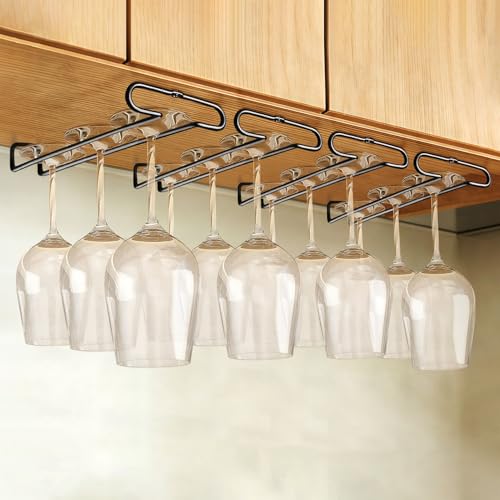

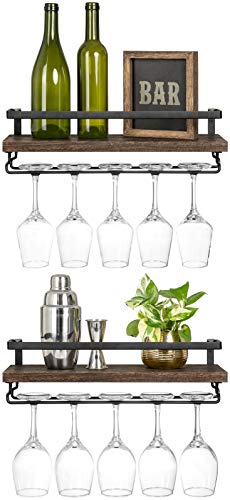

As an Amazon Associate we earn from qualifying purchases at no extra cost to you. Ratings are shown as listed on Amazon.
Wall-Mounted Bar Shelf vs. Floating Shelf
“Wall-mounted” and “floating” are sometimes used interchangeably, but they describe different construction approaches. A conventional wall-mounted bar shelf usually has visible brackets, a back rail, or a metal frame that supports both the shelf and stemware rack. A floating bar shelf hides its mounting hardware inside the shelf or on a concealed cleat.
| Feature | Wall-mounted shelf with rack | Floating shelf with separate rack |
|---|---|---|
| Useful width for a small bar | 24–30 inches | 24–36 inches |
| Typical depth | 8–10 inches | 9–12 inches |
| Typical shelf capacity | 25–50 pounds | 20–40 pounds |
| Recommended rack clearance below shelf | 7–8 inches | 8–10 inches |
| Installation difficulty | Low to moderate | Moderate to high |
| Best use | Compact, frequently used bar setup | Minimalist appearance and flexible storage |
A shelf’s published weight rating is only meaningful when the shelf is installed into suitable wall structure. A unit rated for 40 pounds may not safely hold that load if attached only to drywall with light-duty anchors. For bottles, use studs where possible, or use anchors specifically rated for the wall material and expected load.
How Much Space Do Bottles and Glasses Actually Need?
Most standard 750-milliliter wine bottles are approximately 3 to 3.5 inches in diameter and 11.5 to 13 inches tall, depending on the bottle style. A shelf that is only 6 inches deep may technically hold a bottle, but 8 to 10 inches provides a more stable landing area and room for a small tray, cocktail tools, or a bottle stopper.
For a small bar, a 24-inch shelf commonly accommodates five or six standard bottles in a single row. At 30 inches, six to eight bottles are realistic, depending on bottle diameter and whether you leave room between them. Avoid planning around maximum theoretical capacity: tightly packed bottles are harder to remove and more likely to be knocked into the wall or neighboring glassware.
Standard wine glasses create the more easily missed measurement. A typical bowl is about 3 to 4 inches wide, with an overall height of 8 to 10 inches. Red wine glasses are often taller and wider than white wine glasses. Champagne flutes can be 9 inches or more tall, while coupe glasses need more vertical and horizontal space because of their broad bowls.
- Allow at least 7 inches from the underside of the shelf to the lowest obstruction for ordinary stemmed wine glasses.
- Choose 8 to 10 inches of clearance if you use large red-wine glasses or want to remove glasses without tilting them.
- Leave roughly 3.5 to 4.5 inches of horizontal rack width per glass.
- Keep the front of the rack at least 1 inch behind the shelf’s front edge so stems do not catch on passing clothing or kitchen equipment.
- Check the glass rack’s slot width; a narrow slot may hold stems securely but may not accept thicker champagne or decorative stems.
Best Choice by Small-Bar Situation
| Your situation | Recommended configuration | Why it fits |
|---|---|---|
| Very limited wall space | 24-inch wall-mounted shelf, 8-inch depth, four- to six-glass rack | Uses a narrow footprint while keeping bottles and glasses together |
| Frequent entertaining | 30–36-inch shelf, 10–12-inch depth, eight- to ten-glass rack | Provides more bottle separation and faster access |
| Rented apartment | Lightweight shelf under 20 pounds with approved anchors | Reduces installation load and potential wall damage |
| Heavy bottles or barware | Bracketed shelf rated for 40–50 pounds, fixed into studs | Offers a larger safety margin than concealed hardware |
| Minimalist kitchen | Floating shelf with a separate, low-profile metal rack | Keeps hardware visually discreet and allows rack replacement |
Weight Capacity: Calculate the Real Load
Do not estimate capacity from the number of bottle slots alone. A full 750-milliliter bottle commonly weighs about 2.5 to 3.5 pounds, including the glass. Six bottles can therefore contribute approximately 15 to 21 pounds before adding glassware and accessories.
For example, a practical load calculation for a 30-inch shelf might be:
- Six wine or spirit bottles: 18 pounds
- Eight wine glasses: 6 pounds
- Shaker, jigger, corkscrew, and stoppers: 4 pounds
- Decorative tray or small decanter: 4 pounds
- Total working load: 32 pounds
For that setup, select a shelf rated for at least 40 pounds, preferably with the rating based on proper stud or masonry installation. A 20-pound shelf may look adequate when empty but leaves little allowance for heavier bottles, accidental impact, or uneven loading.
Materials That Hold Up in a Kitchen
Powder-coated steel racks resist everyday scuffs and are easy to wipe clean. Solid wood shelves offer better resistance to edge damage than thin veneer, although unfinished wood can absorb spills. Bamboo is light and attractive but should have a sealed surface if it will sit near a sink or cocktail-mixing area.
Engineered wood can work well when its front edge and mounting points are reinforced. Inspect the thickness rather than judging by appearance: a shelf under about 0.6 inch thick may flex noticeably at longer widths, especially with bottles concentrated in the middle.
The parts most likely to wear first are not usually the shelf itself. Rack screws can loosen from repeated vibration, soft finishes can develop rings from wet bottles, and thin metal slots can scratch glass stems if their edges are unfinished. A removable rack is valuable because it can be tightened, replaced, or cleaned without taking down the entire shelf.
Installation Details That Prevent Common Problems
Measure the complete operating area, not just the shelf board. Before drilling, mark the shelf width, the rack’s lowest point, and the path needed to lift each glass out. A shelf placed above a countertop should generally leave enough room for appliances and mixing activity; a rack that hangs too low can interfere with a coffee maker, cutting board, or cabinet door.
- Measure your tallest wine glass and add at least 1 inch of handling clearance.
- Measure bottle height and confirm the shelf is not under a cabinet that blocks removal.
- Locate studs or identify the correct anchors for the wall surface.
- Install the mounting rail or brackets level before attaching the shelf.
- Load the shelf gradually, placing the heaviest bottles near supported points rather than at the unsupported center.
- After 24 to 48 hours, check for sagging, loose screws, or movement and retighten as needed.
For a floating shelf, pay particular attention to the depth of the concealed cleat and the fasteners. The farther the shelf projects from the wall, the greater the leverage placed on the mounting hardware. A 12-inch-deep shelf holding bottles is substantially more demanding than an 8-inch shelf with the same total weight.
Cleaning and Ownership Tips
Wipe bottle condensation and spills promptly, especially on wood or laminate surfaces. Use a lightly damp cloth followed by a dry one; avoid saturating seams and concealed mounting holes. Clean metal racks with mild dish soap and dry them completely before returning glasses.
Keep a small gap between the shelf and the wall if the design allows ventilation and easier cleaning, but do not create a gap that lets bottles roll backward. Use a nonslip liner only if it does not interfere with the shelf’s load rating or bottle stability. Replace any liner that becomes sticky, cracked, or difficult to clean.
The most common mistake is buying for the empty shelf rather than the loaded shelf. A compact 24-inch unit with six glasses and four bottles may be the best bar shelf with glass rack for a small kitchen, while a larger 36-inch floating shelf can become awkward if it requires oversized anchors or leaves no clearance beneath an upper cabinet. Prioritize secure mounting, 8 to 10 inches of useful depth, and enough stemware clearance for the glasses you actually own.

Write Your Review
No reviews yet. Be the first to share your experience!