

Key takeaways
- 2.5 to 3 inches: suitable for narrow flutes, small white-wine glasses, and compact stemware.
- 3 to 4 inches: the most versatile range for standard wine glasses.
- 4 to 5 inches: better for large red-wine bowls, balloon glasses, or thick stems.
Best Hanging Wine Glass Rack for Kitchen
The best hanging wine glass rack for kitchen use is the one that fits your cabinet or shelf with enough slot spacing for your stems, leaves at least 1 inch of clearance around the glassware, and is secured with hardware rated well above the rack’s loaded weight.
For most kitchens, a ceiling-mounted or under-cabinet rack measuring 12 to 18 inches long, with 3 to 4 inch slot spacing and a capacity of 4 to 6 wine glasses, offers the best balance of storage and accessibility. Choose a shorter 6- to 10-inch rack for a compact cabinet, a longer 24- to 30-inch rack for frequent entertaining, and a screw-mounted model rather than an adhesive design when the rack will hold heavy crystal stemware.
Our top picks
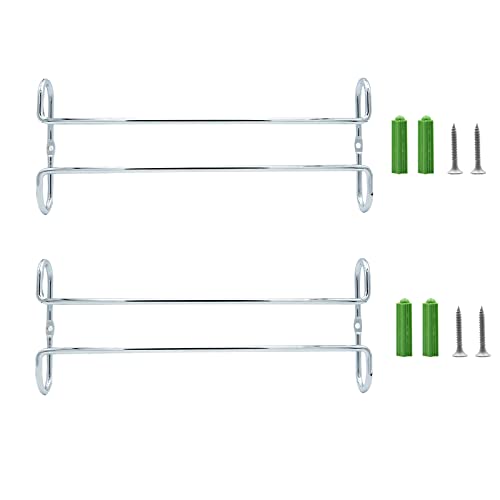


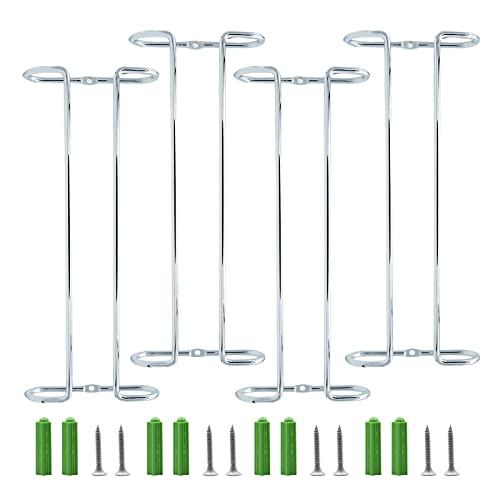
As an Amazon Associate we earn from qualifying purchases at no extra cost to you. Ratings are shown as listed on Amazon.
Quick picks by kitchen situation
| Kitchen situation | Best rack type | Useful target specifications | Why it fits |
|---|---|---|---|
| Small cabinet or apartment kitchen | Single-row under-cabinet rack | 6–10 inches long; 2–3 glasses; 3-inch slots | Uses little clearance and avoids crowding the worktop |
| Everyday use for two to four people | Two-row screw-mounted rack | 12–18 inches long; 4–6 glasses; 3–4-inch slots | Provides practical capacity without extending far into the room |
| Frequent entertaining | Long ceiling- or shelf-mounted rack | 24–30 inches long; 8–12 glasses; 4-inch slots | Stores more glassware while spreading the load across several mounting points |
| Rental or no-drill installation | Adhesive or clamp-on rack | Up to 3 glasses; no more than 5–8 lb loaded | Simple to remove, but better for lightweight glasses and limited use |
| Heavy crystal or oversized bowls | Steel rack with direct screw mounting | 8–12 lb working capacity; 4–5-inch slots | Handles greater weight and wider stems more securely |
How long should a wine glass rack be?
Rack length should follow the number of glasses you plan to store, not the empty space you happen to see. Measure the usable mounting area first, then allow room at both ends for the mounting brackets and for your hand to remove the outermost glass.
A simple sizing formula is:
Required length = number of glasses × slot pitch + 2 inches of end clearance.
For example, six glasses with a 3.5-inch slot pitch need approximately 23 inches: 6 × 3.5 = 21 inches, plus about 2 inches for end clearance. A 24-inch rack would be a reasonable fit, provided the cabinet is at least that wide.
Do not measure only the rack’s advertised overall length. Some of that length may be occupied by mounting plates or decorative end caps. Check the usable slot length and the distance between the mounting holes.
Slot spacing matters more than capacity claims
A rack advertised for six glasses may accommodate six narrow white-wine glasses but only four broad red-wine bowls. Measure the narrowest part of each glass near the stem and the widest part of the bowl that will pass between neighboring glasses.
- 2.5 to 3 inches: suitable for narrow flutes, small white-wine glasses, and compact stemware.
- 3 to 4 inches: the most versatile range for standard wine glasses.
- 4 to 5 inches: better for large red-wine bowls, balloon glasses, or thick stems.
Slot width is also important. A narrow slot can grip a delicate stem, but if it is too tight, inserting and removing the glass creates repeated sideways pressure. A slot opening around 0.25 to 0.4 inches generally works for many standard stems, while unusually thin or thick stems require a physical check before purchase.
Cabinet clearance and glass dimensions
Before choosing the best hanging wine glass rack for kitchen storage, measure three clearances: the vertical space below the cabinet, the depth from the cabinet front to the wall or backsplash, and the height of your tallest glass.
Leave at least 1 inch between the bottom of a hanging glass and the countertop, appliance, or backsplash. Two inches is more comfortable if you regularly remove glasses while cooking. Also check the cabinet doors. A rack that projects more than the cabinet face can interfere with doors, handles, or your head as you work at the counter.
As a practical example, suppose your tallest glass is 8.5 inches high and the rack holds it 1 inch below the cabinet. You need at least 9.5 inches of unobstructed vertical space beneath the cabinet. If the rack has a 1.5-inch mounting plate, confirm that the plate and glass together do not reduce usable clearance below that figure.
Mounting hardware: adhesive, screws, or clamps?
Screw-mounted racks
Direct screw mounting is the most dependable choice for six or more glasses, heavy crystal, or a rack used daily. Use the supplied screws only when they match the cabinet material and thickness. For solid wood, wood screws with a suitable pilot hole are usually appropriate. For particleboard or medium-density fiberboard, use mounting points that avoid damaged edges and consider bolts, threaded inserts, or a reinforcement strip if the panel is thin.
Adhesive-mounted racks
Adhesive racks are convenient for renters, but their capacity depends heavily on the surface. Smooth, clean, nonporous surfaces provide better adhesion than dusty, textured, greasy, or freshly painted surfaces. Temperature changes, steam, and condensation can weaken the bond. Treat the stated load as a maximum, not a target; keeping the load to roughly half the advertised capacity provides a more sensible margin.
Clamp-on racks
Clamp-on designs work well under shelves or cabinet bottoms with accessible edges. Confirm the clamp’s opening range and use protective pads so the finish is not crushed or scratched. Recheck the clamp after the first week and whenever the rack is fully loaded.
Weight capacity: calculate the real load
Manufacturers may state the rack’s maximum load, but your actual load includes the rack itself. A useful estimate is:
Total load = rack weight + (number of glasses × average glass weight).
For six glasses weighing 12 ounces each and a rack weighing 2 pounds, the loaded weight is 2 + 4.5 = 6.5 pounds. A rack rated for 8 pounds technically covers that load, but a model rated for 12 pounds gives a better margin for movement, uneven loading, and heavier replacement glasses.
Use the lowest capacity in the installation system. If the rack supports 15 pounds but the adhesive strip is rated for 8 pounds, the practical capacity is 8 pounds. For screw-mounted racks, capacity also depends on how many screws are engaged and whether they are anchored in solid material.
Materials and finishes that hold up
- Powder-coated steel: a good all-purpose choice; resists scratches and is available in black, white, bronze, and other finishes.
- Stainless steel: useful near sinks and dishwashers, especially when corrosion resistance matters. Look for smoothly finished edges.
- Chrome-plated steel: bright and easy to coordinate with other hardware, but chipped plating can expose the base metal.
- Solid wood: attractive under open shelving, though it needs a sealed finish and should not remain wet.
- Aluminum: lightweight and corrosion-resistant, but some thin designs can flex under a heavy load.
Inspect the slot edges before installation. Sharp burrs are more likely to chip a stem than the rack’s headline capacity suggests. Rubber or silicone sleeves can reduce rattling, but they may collect dust and should be removable for cleaning.
Installation steps that prevent common failures
- Measure the space. Mark the usable width, cabinet depth, glass height, and door swing before ordering.
- Test the glass fit. Place one representative glass against the planned slot spacing. Use your largest bowl and thickest stem, not your smallest glass.
- Locate the mounting points. Keep screws away from cabinet edges and hinges. Use a level to mark both ends.
- Drill appropriate pilot holes. A pilot hole reduces splitting in wood and lowers the chance of stripping the screw head.
- Install the rack without over-tightening. Excess force can deform a metal bracket or crush a thin cabinet panel.
- Load it gradually. Start with one glass, check for sag or movement, then add the remaining glasses evenly.
Ownership realities: cleaning, wear, and replacement
Dust settles inside the slots, particularly on racks installed above a cooktop or near an open window. Remove the glasses periodically and wipe the rack with a damp, mild-soap cloth. Dry it fully before replacing the glassware. Avoid abrasive pads on plated or powder-coated finishes.
The parts most likely to wear first are adhesive pads, thin protective sleeves, painted edges, and mounting holes in low-density cabinet material. A rack that starts to wobble, develops rust, or shows a widening screw hole should be unloaded and repaired rather than tightened repeatedly. Never store wet glasses in a rack intended for dry storage; trapped moisture can stain the finish and encourage corrosion.
For most households, the best value is a screw-mounted steel rack sized for the glasses already owned, with 3- to 4-inch slot spacing, a working capacity of at least twice the calculated load, and enough cabinet clearance to remove each glass without tilting it into a neighboring slot.

Write Your Review
No reviews yet. Be the first to share your experience!