

Key takeaways
- Use the upper rack when the manufacturer permits it, and keep each coupe separated from metal utensils and cookware.
- Choose a low-temperature or glassware cycle rather than the hottest intensive program.
- Do not force a foot into a rack slot that is too narrow; twisting during loading can stress the stem.
- Remove glasses after the cycle rather than leaving them in hot steam for hours.
- For cloudy mineral film, soak in diluted white vinegar, rinse thoroughly, and dry with a lint-free cloth. Do not scrub with abrasive powder.
Best Champagne Coupes for Elegant Entertaining
The best champagne coupes for most hosts are dishwasher-safe crystal or lead-free glass coupes holding 7 to 10 ounces (207 to 296 ml), with a broad foot, a straight or gently flared stem, and a rim that is thin enough for comfortable sipping without feeling fragile.
Coupes are chosen for their low, wide bowls rather than maximum aroma retention. That makes them excellent for champagne towers, dessert pairings, vintage-style cocktails, and quick celebratory toasts. It also creates trade-offs: bubbles fade sooner than they do in a flute, wide bowls are easier to bump, and an unstable stem can turn a crowded drinks table into a spill risk.
Our top picks
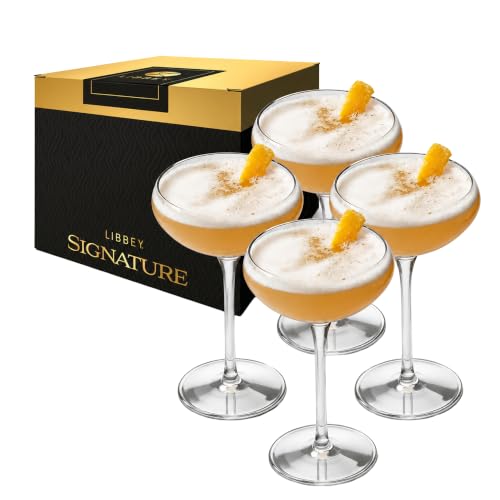


As an Amazon Associate we earn from qualifying purchases at no extra cost to you. Ratings are shown as listed on Amazon.
Best champagne coupes by entertaining situation
| Situation | Best choice | Useful target specifications | Why it works |
|---|---|---|---|
| Frequent parties | Machine-made crystal or lead-free crystal coupe | 8–10 oz capacity, 7–8 oz serving line, dishwasher-safe | Consistent sizing, good replacement availability, and less anxiety about routine washing |
| Occasional elegant dinners | Thin-rimmed stemmed coupe | 6–8 oz capacity, 2.5–3.5 inch bowl, moderate-height stem | Feels refined without requiring a large storage footprint |
| Champagne towers | Low-profile coupe with a wide foot | 7–9 oz capacity, foot at least 3 inches wide, sturdy stem-to-bowl join | Improves balance and gives overflow a controlled path down the stack |
| Everyday toasting | Compact dishwasher-safe glass coupe | 5–7 oz capacity, thick enough rim, stackable or easily nested | Uses less cupboard space and is practical for small pours |
| Cocktails and dessert servings | Wide, heavier coupe | 8–12 oz capacity, reinforced stem, broad bowl opening | Leaves room for a garnish, foam, or a small scoop of dessert |
Head-to-head: what separates the leading coupe styles
Best all-rounder: lead-free crystal with an 8-ounce bowl
A medium-capacity lead-free crystal coupe is the safest recommendation for a mixed-use home. Lines such as Schott Zwiesel Bar Special, Spiegelau’s barware ranges, and comparable machine-made crystal collections commonly offer the balance buyers need: a relatively thin rim, a sturdy stem, and dishwasher compatibility.
An 8-ounce bowl does not mean you should pour 8 ounces. A practical champagne serving is about 4 to 5 ounces, leaving space for foam and reducing the chance of sloshing. This size also accommodates a classic coupe cocktail without looking empty when used for sparkling wine.
Best for a classic formal table: thin-rimmed crystal
Thin-rimmed coupes from established glassmakers such as Riedel, Waterford, and Nachtmann can provide the most polished appearance. Their advantage is tactile: the rim feels precise, and the bowl often has cleaner proportions than thick pressed glass.
The compromise is ownership. Very thin rims are less forgiving when glasses are knocked together, loaded into a crowded dishwasher rack, or stored with hard objects nearby. For a formal set used several times a year, that may be a worthwhile trade. For a weekly dinner, choose a slightly thicker rim and a stronger stem instead.
Best for durability: commercial-style glass
Commercial barware and restaurant-style coupes are usually heavier and less delicate than hand-finished crystal. Libbey and Duralex are familiar examples of brands with practical glassware ranges, although the exact coupe selection varies by collection and market.
These glasses are a good fit for large gatherings, rental-style entertaining, and households where dishwasher use is non-negotiable. They may have a more visible seam, thicker rim, or less sculpted bowl, but those details matter less when the priority is replacing one broken glass without retiring the whole set.
Best for champagne towers: broad-footed, low-profile coupes
A champagne tower needs geometry more than delicacy. Look for a foot that is at least 3 inches wide, a stem that does not taper dramatically at its base, and a bowl with a flat, stable underside. A 7- to 9-ounce bowl is easier to arrange than an oversized cocktail coupe.
Do not fill the glasses before stacking. Build the tower on a level, water-resistant surface, place the glasses rim-to-rim in a tight grid, and pour slowly into the top glass. The same broad foot that helps stability also takes more shelf space, so measure the cupboard before buying a large set.
Capacity, rim, and stability: the specifications that matter
| Feature | Practical range | What to look for | Potential drawback |
|---|---|---|---|
| Bowl capacity | 5–12 oz (148–355 ml) | 7–10 oz for sparkling wine and general entertaining | Very large bowls encourage overpouring and lose carbonation faster |
| Serving volume | 4–5 oz (118–148 ml) | Pour to roughly half or two-thirds of the bowl | A full bowl is harder to carry and more likely to spill |
| Foot diameter | 2.5–3.75 inches | At least 3 inches for towers or busy parties | Wider feet need more shelf and table space |
| Rim thickness | About 1–3 mm | Thin enough to sip comfortably, not feather-light for daily use | Ultra-thin rims chip more easily |
| Overall height | 4.5–6.5 inches | Choose a height that fits the dishwasher rack and cupboard | Tall stems are more vulnerable to side impacts |
| Material | Glass, lead-free crystal, or traditional crystal | Lead-free crystal for a lighter, clear everyday option | Highly thin crystal generally costs more and needs gentler handling |
Dishwasher durability and the parts that wear first
“Dishwasher-safe” describes intended use, not immunity from damage. The bowl rim and the narrow point where the stem joins the bowl are usually the vulnerable areas. Glasses also chip when they touch one another during a wash cycle or when a heavy pan is placed beside them.
- Use the upper rack when the manufacturer permits it, and keep each coupe separated from metal utensils and cookware.
- Choose a low-temperature or glassware cycle rather than the hottest intensive program.
- Do not force a foot into a rack slot that is too narrow; twisting during loading can stress the stem.
- Remove glasses after the cycle rather than leaving them in hot steam for hours.
- For cloudy mineral film, soak in diluted white vinegar, rinse thoroughly, and dry with a lint-free cloth. Do not scrub with abrasive powder.
For a household that entertains six times per year, a set priced at $60 and lasting five years costs about $2 per place setting per event when used by six guests: $60 divided by 30 total guest-events. A $180 thin-crystal set lasting the same period costs about $6 per guest-event. The premium can make sense for formal presentation, but it is not automatically better value if breakage is likely.
How to choose the right coupe in five steps
- Set the actual pour size. For champagne, target 4 to 5 ounces. Select a bowl around twice that capacity so there is room for foam and movement.
- Check the foot before the bowl. If guests will stand, dance, or reach across the table, prioritize a broad foot and a shorter, sturdier stem.
- Run a storage test. Measure the shelf height and dishwasher clearance. A beautiful coupe that cannot fit safely becomes occasional-use clutter.
- Decide how much rim delicacy you can manage. Thin rims suit careful formal service; medium-thickness rims suit frequent use and mixed household handling.
- Confirm the care instructions. If the listing does not clearly state dishwasher compatibility, treat the set as hand-wash-only rather than assuming it is safe.
Common mistakes when buying champagne coupes
The most common mistake is selecting by bowl width alone. A very wide bowl can look dramatic but may be awkward to hold, unstable on a crowded table, and difficult to store. Another is buying a full set without checking whether replacement glasses are sold individually. A set from a widely distributed collection is easier to maintain than a limited seasonal design.
It is also easy to confuse a champagne coupe with a cocktail coupe. Cocktail coupes often have a deeper V-shaped bowl and may hold 8 to 12 ounces, while champagne coupes tend to have a shallower, rounder basin. Either can serve sparkling wine, but the cocktail shape may feel less stable when filled and can make a small champagne pour appear undersized.
Final recommendation
For most homes, choose a dishwasher-safe, lead-free crystal or durable glass coupe holding 7 to 10 ounces, with a 3-inch-or-wider foot and a medium-thin rim. Choose a lighter, thinner formal coupe when presentation matters most; choose commercial-style glass when parties are frequent or replacement is important; and choose a low-profile broad-footed model specifically for champagne towers. The best champagne coupes are not simply the most delicate ones—they are the glasses whose capacity, balance, rim, and care requirements match the way you actually entertain.

Write Your Review
No reviews yet. Be the first to share your experience!