

Key takeaways
- Buying on piece count alone. Fillers such as ten identical steak knives do not improve cooking.
- Putting knives in the dishwasher, which dulls edges and loosens handles.
- Skipping a honing steel. Without regular honing, even premium steel acts dull within weeks.
- Buying a thin Japanese-style set and using it on bones.
- Ignoring warranties. Most major brands list a lifetime warranty against defects, but not against misuse.
If you are deciding which knife set to buy in 2026, start with your budget tier: a Victorinox Fibrox Pro or Cuisinart Triple Rivet set for a first kitchen, a Henckels Classic or Wüsthof Gourmet set for a long-term home set, and a Zwilling Four Star or Shun Classic set if you cook constantly and want a premium upgrade. Skip any set that pads its count with eight steak knives and a pair of scissors, and buy for the chef’s knife, paring knife and bread knife first.
Our top picks
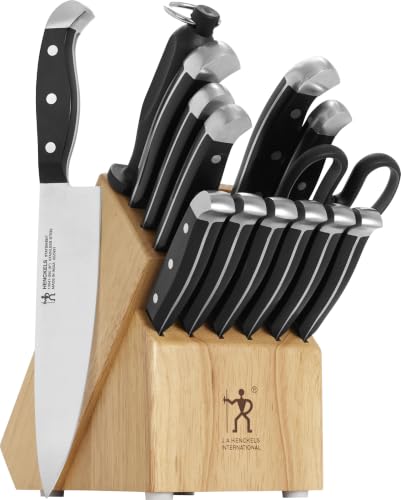


As an Amazon Associate we earn from qualifying purchases at no extra cost to you.
Quick comparison: which knife set to buy at each budget
| Set | Who should buy it | Blade type | Typical pieces | Price range |
|---|---|---|---|---|
| Victorinox Fibrox Pro set | First kitchen, students, busy cooks | Stamped, lightweight | 5 to 8 | Budget |
| Cuisinart Triple Rivet set | Gift buyers wanting a full block | Stamped stainless | 12 to 15 | Budget |
| Henckels Classic set | Families wanting German steel without a premium bill | Forged-style, bolstered | 7 to 16 | Mid-range |
| Wüsthof Gourmet set | Cooks stepping up from budget | Laser-cut stamped, German steel | 6 to 12 | Mid-range |
| Zwilling Four Star set | Daily cooks who want comfort | Forged, ice-hardened steel | 7 to 8 | Premium |
| Shun Classic set | Careful cooks who love a keen edge | VG-MAX core, 16-degree edge | 5 to 7 | Premium |
Starter kitchen: Victorinox Fibrox Pro set
Victorinox is the quiet favorite of professional kitchens, and the Fibrox line shows why. The textured handle stays secure with wet hands, the blades are light and the steel takes a sharp edge easily. Buy it if you want knives that work well from the first day without worrying about a rubbed finish or a dishwasher accident. The compromise is feel: the handles are plain plastic and the stamped blades lack the weight that some cooks prefer for pushing through dense vegetables.
Gift-ready block: Cuisinart Triple Rivet set
For a wedding registry or first-apartment gift, a 12 to 15-piece Cuisinart block set provides the full look at an accessible price. Expect stainless steel blades with triple-rivet handles, a wooden block and steak knives. These sets prioritize volume, so plan to hone them regularly and replace the paring knife first as it dulls. They are fine for casual cooks, but they are not the set to buy if cooking is a daily craft.
Step-up set: Henckels Classic
Henckels Classic offers German-style knives with a traditional full bolster and balanced handle at a mid-range price. These sets use a hardened German stainless steel and are sold from compact seven-piece sets up to large blocks of sixteen. They suit families who want something sturdier than budget stamped knives without paying forged-premium prices. The trade-off is that mid-range sets sometimes include knives you rarely use, so compare the contents carefully.
Best long-term value: Wüsthof Gourmet
Wüsthof Gourmet is the laser-cut, stamped sibling of the forged Classic line. Per the manufacturer, the blades are cut from the same X50CrMoV15 German stainless steel and carry a precision edge, but the handle is a simpler molded design without the full bolster. It offers excellent balance for the price and is a practical set for home cooks who want reputable steel without paying for forging. It is lighter than the Classic, which some people prefer.
Comfort-focused premium: Zwilling Four Star
The Four Star line is Zwilling’s flagship forged series, with a seamless handle that has no rivets to catch dirt and a bolster that supports a pinch grip. Its special-formula steel is ice-hardened for edge retention. Buy it if you cook for a family nightly and want a set that feels good over long sessions. The cost is the premium tier, and the heavy blades can feel clumsy to cooks with small hands.
Sharpest edge: Shun Classic
Shun’s Classic line has a VG-MAX core with layered Damascus-style cladding and a D-shaped pakkawood handle. The edge is ground to 16 degrees per side, thinner and sharper than most German knives. It is ideal for precise vegetable work and boneless proteins, but it is not forgiving. Avoid bones and frozen foods, and use only wood or soft composite cutting boards.
How to decide what to buy
Run a cost-per-useful-knife check
List the knives you will use weekly: a chef’s knife, paring knife, serrated knife and utility knife. Divide the set price by that number. A 15-piece set priced at a low budget level with eight steak knives offers seven working blades, but a four-knife forged set may cost less per useful blade over its lifespan. If you can buy a set with those four plus shears and a honing steel, that is usually enough.
| Cook type | Cooking frequency | Best tier | Pieces you need | Expected lifespan with care |
|---|---|---|---|---|
| Occasional cook | 1 to 2 times a week | Budget | 5 to 8 | 5 to 8 years |
| Regular home cook | 4 to 5 times a week | Mid-range | 6 to 10 | 10 to 15 years |
| Enthusiast | Daily | Premium | 5 to 7 | 20+ years |
| Gift for a new household | Unknown | Budget to mid-range | 12 to 15 | 5 to 10 years |
Check the handle and the grip
Hold the chef’s knife before buying if possible. A blade that tips forward or feels sharp against the index finger will tire you quickly. Small hands usually do better with lighter stamped blades and smaller handles.
Plan where to store the set
Blocks occupy 9 to 11 inches of height and a 5 by 8 inch footprint. If counter space is tight, ask whether the set is available with a magnetic bar or in-drawer tray, or buy loose knives and a wall strip.
Mistakes to avoid when buying
- Buying on piece count alone. Fillers such as ten identical steak knives do not improve cooking.
- Putting knives in the dishwasher, which dulls edges and loosens handles.
- Skipping a honing steel. Without regular honing, even premium steel acts dull within weeks.
- Buying a thin Japanese-style set and using it on bones.
- Ignoring warranties. Most major brands list a lifetime warranty against defects, but not against misuse.
Upgrade path
You do not have to buy everything at once. A smart approach is to start with a budget block, then replace the chef’s knife with an upgraded model after a year or two. Many cooks end up with one excellent chef’s knife and a modest set for everything else, which is cheaper than a premium block and just as satisfying to use.
Frequently Asked Questions
Which knife set should I buy first?
For a first kitchen, a Victorinox Fibrox Pro set is hard to beat on value. It covers the essentials, takes a sharp edge easily and holds up to everyday use.
Are Henckels or Wüsthof knife sets better?
Wüsthof is generally viewed as the higher-end brand, especially in the forged Classic line, while Henckels offers broader price ranges and larger blocks. Both use German stainless steel, so choose by handle comfort and budget.
How many knives do I really need?
Three knives cover most cooking: an 8-inch chef’s knife, a paring knife and a bread knife. A utility knife and kitchen shears round out a complete kit.
Do knife sets last a lifetime?
Quality forged sets can last decades with correct care, including hand washing, honing and periodic sharpening. Budget stamped sets typically need replacement sooner.
Is a knife block or a magnetic strip better?
Blocks protect blades and keep them tidy, but moisture can collect in slots. Magnetic strips save counter space and let knives air dry, as long as they are mounted securely.




Write Your Review
No reviews yet. Be the first to share your experience!