

Key takeaways
- Wide-bowl diameter: about 14–16 cm at the widest point. This provides meaningful aeration without requiring an oversized decanter-like glass.
- Rim diameter: approximately 7–9 cm. A rim that is too narrow can mute the perfume; one that is extremely wide spreads the wine across the palate and makes small pours feel thin.
- Overall height: roughly 22–25 cm. Check this before buying because a large bowl may not fit an enclosed cabinet or dishwasher rack.
- Stem length and base: a long stem keeps hands away from the bowl, while a broad, well-balanced foot reduces tipping.
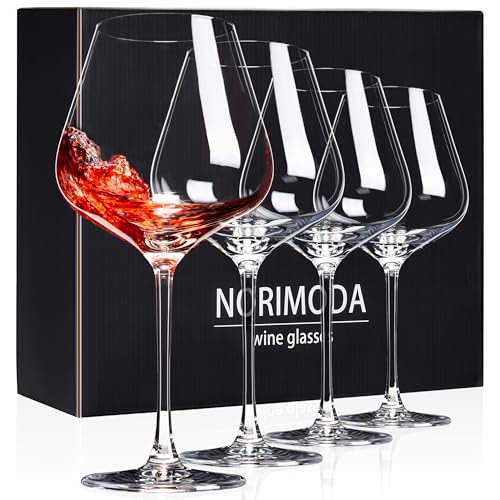
The best burgundy wine glasses for red wine are wide-bowled, lightly built glasses with roughly 900–1,200 ml of capacity, a bowl diameter near 14–16 cm, and a rim wide enough to release Pinot Noir without making the wine feel flat.
That large shape is not about serving a larger pour. A typical tasting pour of 120–150 ml occupies only the lower part of the bowl, leaving room for swirling and concentrating the wine’s perfume. The right glass can make delicate reds more expressive, but the biggest bowl is not automatically the best choice: a very broad glass takes more storage space, feels less stable, and can be awkward to clean.
Our top picks



As an Amazon Associate we earn from qualifying purchases at no extra cost to you. Ratings are shown as listed on Amazon.
Quick picks by buying situation
| Situation | Best choice | Useful target specification | Why it fits |
|---|---|---|---|
| Maximum aroma and classic Burgundy style | Riedel Sommeliers Burgundy Grand Cru | Very large bowl, approximately 1,050 ml capacity | Exceptional aromatic volume and a generous Pinot Noir shape |
| Lightweight, refined stemware | Zalto Denk’Art Burgundy | Approximately 960 ml capacity; thin lead-free crystal | Large bowl with an unusually light, precise feel |
| Frequent use and easier replacement | Spiegelau Definition Burgundy | Approximately 960 ml capacity; machine-washable lead-free crystal | Good aroma space with a more practical ownership profile |
| One red-wine glass rather than a dedicated Burgundy glass | Gabriel-Glas StandArt | Approximately 460 ml capacity | More compact, versatile, and easier to fit in everyday cupboards |
Capacities are nominal manufacturer specifications and can vary slightly by production run or regional listing. They indicate the glass’s total volume, not the amount you should pour.
What makes a Burgundy glass different?
Pinot Noir and other delicate reds generally benefit from a broad bowl rather than a narrow, tall Bordeaux shape. The increased surface area encourages the wine to open, while the rounded sides collect volatile aromas above the liquid. A tapered upper section then directs those aromas toward the nose.
For most buyers, the useful dimensions are:
- Wide-bowl diameter: about 14–16 cm at the widest point. This provides meaningful aeration without requiring an oversized decanter-like glass.
- Rim diameter: approximately 7–9 cm. A rim that is too narrow can mute the perfume; one that is extremely wide spreads the wine across the palate and makes small pours feel thin.
- Overall height: roughly 22–25 cm. Check this before buying because a large bowl may not fit an enclosed cabinet or dishwasher rack.
- Stem length and base: a long stem keeps hands away from the bowl, while a broad, well-balanced foot reduces tipping.
Pinot Noir is the obvious match, but the same profile can suit Nebbiolo, mature Gamay, cool-climate Syrah, elegant Grenache, and other aromatic reds with moderate body. Dense, heavily oaked Cabernet often feels more proportionate in a narrower Bordeaux glass.
Head-to-head: the leading shapes
Riedel Sommeliers Burgundy Grand Cru
This is the traditional large-format choice for someone who wants the most expansive bowl among the named options. Its generous capacity leaves substantial headspace around a normal pour, which helps fragrant Pinot Noir develop in the glass.
The trade-off is ownership. A bowl of this size needs careful handling, a large drying area, and enough cupboard height. Its fine crystal is designed for a refined drinking experience, not rough treatment. It is best for a careful home user who drinks Burgundy regularly and wants a dedicated glass rather than a general-purpose red-wine shape.
Zalto Denk’Art Burgundy
The Zalto Burgundy is similarly aromatic in concept but is known for an especially thin, light profile. Thin crystal makes the rim feel unobtrusive and can make the wine seem more immediate on the palate. The stem and bowl are elegant, but that lightness means the glass deserves deliberate handling.
Look closely at stem stability before buying: a tall, light glass can be perfectly balanced on a flat table yet feel vulnerable when crowded among plates or passed between guests. This is a strong pick for experienced stemware users who value low visual and tactile interference over maximum ruggedness.
Spiegelau Definition Burgundy
The Spiegelau Definition Burgundy occupies a more practical middle ground. It retains the large rounded bowl needed for aromatic reds while using lead-free crystal engineered for everyday use. Its machine-washable positioning makes it more suitable for households that serve Pinot Noir often rather than reserving the glasses for special occasions.
“Dishwasher safe” still does not mean indestructible. Thin rims can chip against plates, cutlery, or a rack tine, and repeated contact can eventually cloud the surface. Use a stemware rack or place the glasses securely between other items so they cannot knock together during a cycle.
Gabriel-Glas StandArt
The StandArt is not a dedicated giant Burgundy bowl, and that is its advantage. Its smaller capacity is easier to store, less intimidating for casual drinkers, and more useful when you want one glass for Pinot Noir, lighter reds, white wine, and sparkling wine.
It will not offer quite the same aromatic spread as a 900–1,200 ml Burgundy glass. Choose it when versatility, cupboard space, and replacement cost matter more than extracting every layer from a mature Grand Cru Burgundy.
Crystal thickness, rim quality, and stability
Thin crystal is desirable at the rim, but “thinner” should not be treated as a complete quality test. A fragile-feeling stem can reduce enjoyment if you are constantly worried about breaking it. Compare these features together:
- Rim: look for a smooth, even edge without a visible lip or rough spot. A very thin rim improves the drinking sensation, but it is also the first area likely to chip.
- Bowl-to-stem junction: this is a common stress point. A clean transition with no visible bubbles, sharp molding marks, or asymmetry is preferable.
- Foot: the base should sit flat and resist wobbling when the bowl is lightly touched. A larger foot is helpful for a tall, broad glass, though it also needs more shelf space.
- Weight: lighter is not automatically better. For frequent entertaining, a moderately light glass with a stable foot may be more practical than an ultra-light model.
- Material: modern lead-free crystal can provide clarity and a fine rim without adding lead. Avoid assuming that “crystal” alone tells you how durable the glass will be.
How to choose the right bowl and rim
Use this simple decision process:
- Measure storage first. Measure the clear height and width of the shelf, not merely the cabinet opening. Allow at least 2 cm of clearance around each glass so the bowl does not touch neighboring items.
- Decide how often you will use it. Occasional Burgundy drinkers can justify a delicate specialist glass. If you wash red-wine glasses several times a week, prioritize machine-washing guidance, replacement availability, and a stable base.
- Match the rim to your pour. A 7–8 cm rim is a balanced starting point for Pinot Noir. Choose the wider end of the range for maximum aromatic exposure; choose the narrower end if you prefer more focused delivery.
- Check the normal pour level. Pour 120–150 ml and confirm that the liquid sits below the bowl’s widest point. If it reaches the widest section, there is too little room for swirling.
- Buy a consistent set. Four matching glasses are usually more useful than two luxury glasses plus miscellaneous shapes. Consistent bowls make side-by-side comparisons easier and simplify storage.
Cleaning and durability: what wears first
The rim usually chips before the bowl becomes visibly worn. The next risks are stem breakage from twisting, and cloudy film caused by hard water or detergent residue. Hand washing is safest for the most delicate glasses, but careless hand washing can also cause damage if the bowl is twisted while the stem is held.
- Rinse soon after use so tannin and pigment do not dry onto the bowl.
- Use warm water and a small amount of unscented detergent; strong fragrances can linger in thin crystal.
- Wash with one hand supporting the bowl, never by twisting the bowl against a fixed stem.
- For dishwasher-safe models, use a low-temperature cycle, keep glasses away from cutlery, and avoid heated drying when the manufacturer advises against it.
- Dry by the foot or let the glass drain on a padded rack. Do not polish by gripping the bowl with one hand and twisting the stem with the other.
- Remove mineral film with diluted white vinegar, then rinse thoroughly. Do not use abrasive powders or scourers.
A simple ownership calculation can clarify the choice. If a $160 set of four lasts 100 uses, it costs $1.60 per set-use, or about $0.40 per glass-use. A $60 set that lasts 30 uses costs $2 per set-use. The cheaper purchase is not necessarily cheaper if its rims chip quickly or the shape makes you use it less often.
Bottom line
Choose the Riedel Sommeliers Burgundy Grand Cru for the largest, most dedicated Pinot Noir experience; the Zalto Denk’Art Burgundy for an exceptionally light and refined glass; the Spiegelau Definition Burgundy for a better balance of broad-bowl performance and everyday practicality; and the Gabriel-Glas StandArt when one versatile glass must cover several wines.
Whatever the brand, prioritize a bowl around 900–1,200 ml, a 14–16 cm maximum diameter, a 7–9 cm rim, a flat stable foot, and cleaning instructions you will actually follow. Those details matter more than a prestigious label or an impressive capacity printed on the box.

Write Your Review
No reviews yet. Be the first to share your experience!